
Canton
Facade insulation — Valais
Contribution per m² depending on requirements met.
Valais support for envelope insulation via the Buildings Programme.
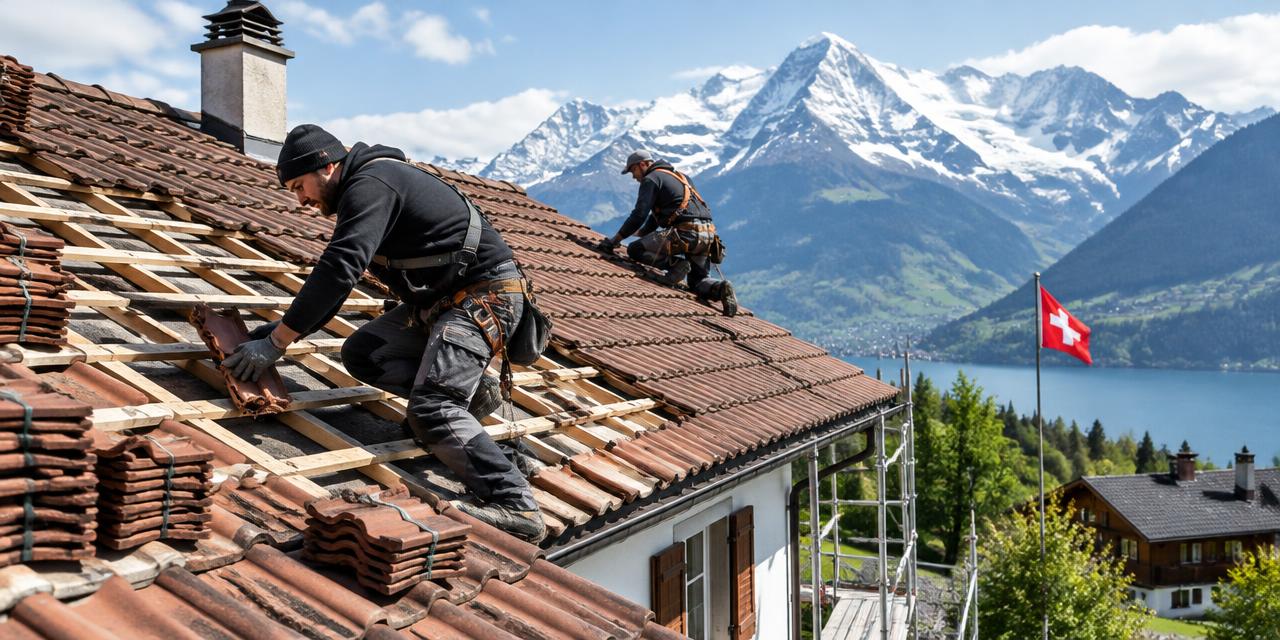
www.leprogrammebatiments.chRoof renovation · Martigny
At a glance
Small project
CHF 16'400 – CHF 37'600
Typical project
CHF 29'700 – CHF 65'400
Large project
CHF 49'600 – CHF 107'200
| Project | Quantity | Low | High | Per unit |
|---|---|---|---|---|
| Small project | 70 m² | CHF 16'400 | CHF 37'600 | CHF 400 |
| Typical project | 140 m² | CHF 29'700 | CHF 65'400 | CHF 300 |
| Large project | 245 m² | CHF 49'600 | CHF 107'200 | CHF 300 |
Computed with our estimator for Martigny (regional factor included), standard finish. Only the project size changes.
Included
Not included
In Martigny, the federal building register lists 2'727 residential buildings and 11'916 dwellings. These municipal benchmarks help put your home in context, but do not replace an individual assessment.
47 % built before 1980
Construction year does not reveal past renovations: check the current insulation condition.
22 % · District heating
This distribution describes recorded buildings, not your system's consumption or efficiency.
| Energy | Heating | Hot water |
|---|---|---|
| Gas | 21 % | 14.2 % |
| Heating oil | 21 % | 16.6 % |
| District heating | 22 % | 16.3 % |
| Heat pump | 13 % | 8.8 % |
| Electricity | 18 % | 40.4 % |
| Wood | 5 % | 1 % |
Each line gives the share of buildings using that energy, separately for heating and for hot water. The two columns do not always reach 100%: some buildings combine two systems, or reported none.
A standard non-condensing boiler is usually older and less efficient.
11.6 % of buildings mix housing with shops or offices.
For homeowners in Martigny, official RegBL figures offer essential insights for renovation planning. With 4 heritage-protected buildings out of 2630 total, verify your property status and contact the municipality early to secure necessary permits. Regarding scale, data coverage is partial: out of 1453 houses, only 70 have volumes measured per SIA 416, with a median of 579 m3. This figure is critical for planning heating and insulation upgrades effectively. Please be aware that volume measurements are limited to a small subset of properties, and no records regarding the renovation year are currently available for this municipality.
Source : Registre fédéral des bâtiments et des logements (RegBL), OFS, 2026. Existing residential buildings; percentages of recorded values.
2 °C and about 50 frost days per year. These climate conditions put significant physical stress on your roof structure, roofing materials, and sealing components, accelerating wear.
Signs such as displaced tiles, water leaks, or visible degradation of the insulation are indicators that an intervention is necessary to prevent more costly structural damage in the long term.
Beyond urgent sealing issues, anticipating renovation allows you to optimize your home's energy efficiency. Given the 2482 heating degree days per year, a well-insulated roof significantly reduces your energy consumption.
Planning these works in advance allows you to choose the best time for the construction and ensures the availability of qualified local craftsmen, while ensuring effective protection against the harsh climatic conditions of the Rhone valley.
Roof renovation involves several major technical choices. The roofing material, whether clay tiles, concrete tiles, or metal sheets, must be selected taking into account local snow loads and frost resistance.
At high altitudes, materials must demonstrate great durability against frequent freeze-thaw cycles.
It is also recommended to take advantage of the roof covering replacement to integrate or improve thermal insulation, a step often eligible for the Building Program to optimize overall energy performance.
Another technical dimension concerns solar equipment. With a global irradiation of 1423 kWh/m²/year, Martigny has high potential for photovoltaics.
If you are planning to install solar panels, their removal and reinstallation must be budgeted for during the roof renovation project. These choices influence not only the cost but also the longevity of the structure and its ability to produce energy.
It is advised to discuss the best technical options adapted to your specific structure with your contractor, while respecting safety requirements related to climatic loads.
In Martigny, the building stock has varied characteristics that require specific analysis before any roofing project.
If your building was built before 1990, it is imperative to conduct a diagnostic to identify the potential presence of asbestos in roofing materials, insulation, or conduits.
Handling these substances requires strict safety measures and disposal in accordance with current legislation. Poor insulation is also a frequent feature of older constructions, making the renovation project all the more relevant for improving indoor comfort.
Older buildings may have roof structures that require a check of the load-bearing capacity before adding new, heavier roofing or additional insulation.
During the work, it is common to have to bring metalwork elements, such as gutters, or roof access points up to current safety standards.
In areas with a high concentration of historical buildings, local structures require special attention when selecting materials to maintain architectural harmony.
It is highly recommended to use professionals experienced in working on old structures in Martigny to avoid costly structural errors.
The Municipality plans to integrate this inventory into its future zoning plan (PAZ) and construction and zone regulations (RCCZ) by 2025. These measures aim to protect and highlight historical buildings.
If your property is located in one of these protected sectors, constraints on materials and renovation techniques may be stricter than in non-protected zones.
Before starting your work, it is essential to check with the municipal technical department regarding the necessary authorizations.
Although some minor repairs do not require a permit, any significant change to the roof's appearance or any structural modification must be validated by the competent authorities.
Information on specific constraints related to solar installations in protected zones must be confirmed by the municipality.
Do not start any construction site without having obtained the required validations, as non-compliance with heritage protection rules can lead to sanctions or the obligation to restore the property to its original state at your expense.
Insulation of the building envelope, including the roof, is eligible for contributions per m² depending on the requirements met.
It is essential to emphasize that the order of steps is strict: any grant application must be submitted before the start of the work. An application submitted after the start of construction will make the project ineligible for any public financial aid.
In addition to direct aid, energy renovation work can have advantageous tax implications, depending on the rules in force in your place of taxation. It is advised to carefully keep all invoices related to your renovation and insulation work.
Consult your tax advisor or the official canton website to verify which expenses can be deducted from your taxable income.
Combining Building Program aid and tax optimization is an effective strategy to reduce the actual cost of your work while increasing the value of your property in the long term in Martigny.
The progress of a roof construction site follows a rigorous logic to guarantee quality and safety.
The first phase consists of preparation, including the technical diagnostic, the building permit application if necessary, and the submission of grant applications.
Once these validations are obtained, the site setup, including scaffolding and safety systems, is put in place.
The removal of the old roof covering then follows, followed by the inspection of the frame, the installation of insulation, and then the placement of the new roof.
Each step requires special attention, especially in periods of frost where working conditions can be slowed down to ensure the proper execution of joints and waterproofing.
The best season to undertake these works in Martigny is ideally temperate periods, avoiding the rigors of the Valais winter. Although frost is not an insurmountable obstacle, it imposes technical constraints that can extend the duration of the site.
It is recommended to plan a flexible schedule allowing for adjustments to the work in case of adverse weather conditions.
Coordination between the different trades, especially for the metalworker, the carpenter, and the electrician if solar panels are installed, is essential to ensure a smooth flow without unnecessary downtime.
To successfully renovate your roof in Martigny, avoid neglecting the asbestos diagnostic if your house was built before 1990. Never request quotes without first checking if grants can be requested, as you would lose all rights to aid after the work has begun.
A common mistake is forgetting to budget for the removal and reinstallation of solar panels if you have them. Also ensure that the requested companies are familiar with the local specifics of the Valais climate and heritage protection requirements.
Checklist before requesting quotes : check if your property is located in a protected zone or ISOS; ensure you have a recent asbestos diagnostic; list your priority objectives (thermal insulation, sealing, solar); contact the municipality to find out the urban planning rules applicable to your plot; check snow load requirements for your sector; request detailed quotes allowing for a clear comparison of materials and services; demand a schedule including the coordination of trades if necessary.
By following these steps, you will secure your investment and avoid unpleasant surprises during construction.
1. Estimate
Set a budget range with the estimator.
2. Grants
Apply before work starts.
3. Quotes
Compare at least 3 quotes.
4. Permit
Check with the municipality whether a permit is needed.
5. Works
Follow the site and do a written handover.
Contribution per m² depending on requirements met.
Valais support for envelope insulation via the Buildings Programme.
www.leprogrammebatiments.chCheck amounts and conditions with the provider before signing: apply before work starts in most cases.
1920 Martigny · about 0 km
Swiss specialist in structural waterproofing, building maintenance, and protection, providing durable solutions for roofs and facades since 1963.
bau.sika.com1920 Martigny · about 0 km
Valais-based specialist in disaster recovery and diagnostics, expert in dehumidification and water or fire damage restoration.
vfsa.ch1920 Martigny · about 0 km
Martigny-based company specializing in tinsmithing, waterproofing, roofing, and sanitary equipment installation.
m.facebook.com1920 Martigny · about 0 km
Valais-based group specializing in construction, painting, solar energy, and general renovation, led by a certified site manager.
globat.chSuggestions from the commercial register by distance and activity. Not an endorsement or partnership.
Yes, it is essential to check with the municipal technical department. Any modification to the exterior or structural appearance requires prior validation.
You can apply for contributions via the Building Program for envelope insulation. The application must strictly be submitted before the start of the work.
For buildings built before 1990, yes. A prior diagnostic is mandatory to identify the presence of asbestos in roofing materials.
Protected zones and ISOS perimeters impose constraints. The feasibility must be confirmed with the municipality before any project.
Temperate seasons are preferred to avoid constraints related to frost. Construction can be slowed down in winter due to weather conditions.
It is highly recommended, as it allows for better energy efficiency and optimizes eligibility for Building Program grants.
Yes, because their removal and reinstallation during roof work must be budgeted for. Their presence also requires additional coordination between craftsmen.
Altitude
471 m
Heating degree days
2'482 Kj/an
20/12 °C
Frost days
50 jours/an
Solar irradiation
1'423 kWh/m²/an
horizontal
Winter design temperature
-8.2 °C
1er percentile des minimales
Mean temperature
12.5 °C
Estimated solar yield
1'252 kWh/kWc/an
toit ~30° sud, PR 0.8, estimation
Source : swisstopo – service d'altitude (MNT) · Open-Meteo Historical Weather API (réanalyse ERA5, moyenne 2015-2024)
Source : Martigny.ch