
EPR Electricité Sàrl
1212 Grand-Lancy · about 0 km
Geneva-based company specializing in electrical installations, home automation, telecommunications, and energy-saving solutions for homes and businesses.
epre.chHome solar battery · Lancy
At a glance
Small project
CHF 4'400 – CHF 10'000
Typical project
CHF 7'900 – CHF 16'900
Large project
CHF 13'600 – CHF 28'000
| Project | Quantity | Low | High | Per unit |
|---|---|---|---|---|
| Small project | 5 kWh | CHF 4'400 | CHF 10'000 | CHF 1'300 |
| Typical project | 10 kWh | CHF 7'900 | CHF 16'900 | CHF 1'200 |
| Large project | 18 kWh | CHF 13'600 | CHF 28'000 | CHF 1'100 |
Computed with our estimator for Lancy (regional factor included), standard finish. Only the project size changes.
Included
Not included
In Lancy, the federal building register lists 1'951 residential buildings and 16'638 dwellings. These municipal benchmarks help put your home in context, but do not replace an individual assessment.
57 % built before 1980
Construction year does not reveal past renovations: check the current insulation condition.
61 % · Gas
This distribution describes recorded buildings, not your system's consumption or efficiency.
| Energy | Heating | Hot water |
|---|---|---|
| Gas | 61 % | 50.1 % |
| Heating oil | 18 % | 14.7 % |
| District heating | 13 % | 10.9 % |
| Heat pump | 4 % | 2.1 % |
| Electricity | 1 % | 7.5 % |
| Wood | 2 % | 0.6 % |
| Solar thermal | 0 % | 9.3 % |
Each line gives the share of buildings using that energy, separately for heating and for hot water. The two columns do not always reach 100%: some buildings combine two systems, or reported none.
A standard non-condensing boiler is usually older and less efficient.
14 % of buildings mix housing with shops or offices.
For your renovation plans in Lancy, please note that official data from the Federal Register of Buildings and Dwellings (RegBL) is currently incomplete. Out of 1900 registered buildings, there is no recorded information regarding renovation years or building volumes measured according to the SIA 416 standard. Given this partial data coverage, homeowners must conduct their own technical assessments before finalizing plans for heating systems or insulation upgrades. It is essential to contact the local municipal authorities early in your planning process to confirm your property details, as these registry figures do not provide a sufficient basis for an automated renovation cost estimate.
Source : Registre fédéral des bâtiments et des logements (RegBL), OFS, 2026. Existing residential buildings; percentages of recorded values.
In Lancy, an altitude of 421 meters and favorable sunshine provide a production potential of approximately 1223 kWh/kWp per year. With 66 frost days per year and a heating demand of 2905 Kj/year, energy needs are significant.
A battery becomes relevant when your photovoltaic system produces a surplus that you do not consume instantly, especially as solar output declines in the evening.
The Lancy Climate Plan aims for carbon neutrality by 2050. By increasing your self-consumption rate through storage, you contribute directly to local objectives.
Installing a battery now aligns your home with local energy transition goals and helps manage energy needs more efficiently during colder periods.
The choice of a battery should be dictated by your daily load profile. There is no point in aiming for excessive capacity if it does not match your actual nighttime consumption.
Dimension storage capacity according to your evening usage, not the peak power of your solar panels. Ensure technical compatibility with your existing inverter, as integrating a battery may require updating or replacing that equipment.
Different battery technologies offer varying lifespans and charging cycles. Prefer modular systems that allow capacity adjustment if your needs evolve.
The location is also a major technical factor : it should be installed in a dry, temperate, and ventilated space to ensure optimal performance and increased longevity, thus avoiding extreme temperature fluctuations.
Lancy has seen steady growth, reaching over 16,000 housing units by the end of 2023. For a solar storage project, the building's age is a determining factor for technical integration.
Buildings constructed before 1990 may require a thorough inspection of existing electrical networks before installation. Ensure your electrical panel meets current standards to accommodate new connections related to the inverter and battery.
Insulation of the technical room is crucial.5 °C, batteries placed in unheated basements may suffer performance drops. It is advisable to provide an insulated enclosure or an indoor location kept frost-free.
For older homes, verify the strength of support structures if the battery is wall-mounted, especially in buildings with historical construction features or fragile materials.
If your battery project is coupled with a new PV installation, note that solar installations benefit from a simplified procedure for compliant pitched roofs, non-visible flat roofs, or specific zones. In these cases, a simple prior declaration may suffice.
However, if you reside in a heritage protection zone or an ISOS A site, requirements are stricter. For high-heritage value buildings, a building permit is mandatory.
Check your building's status before starting work. If you are uncertain whether your project meets landscape integration conditions, contact the Urban Planning Office or Lancy municipal services.
Incorrectly reported installations can lead to restoration orders. Compliance with landscape integration rules ensures the legality of your installation and facilitates dealings with the authorities.
The order of steps is immutable : you must obtain all necessary authorizations before starting any work or signing a firm purchase contract. Expenses incurred before obtaining official agreements could disqualify you from potential future subsidies.
Before launching your procedures, check the tax requirements of your situation. Some installations may be tax-deductible as energy-saving investments. Inquire with your cantonal tax administration about specific declaration procedures.
Careful planning remains your best asset to secure your investment and ensure your self-consumption project fits into the regulatory framework.
The flow of a solar storage project is divided into distinct phases. The first step consists of technical design and submission of the authorization request to the Urban Planning Office.
Once the authorization is obtained, the material ordering phase can begin. The work itself includes connecting the battery to the existing inverter, configuring the energy management system (EMS), and essential safety tests.
It is recommended to plan these works during shoulder seasons to avoid constraints linked to frost days, which can complicate outdoor interventions.
Commissioning also includes a configuration phase where the system learns your consumption habits. The total project duration depends on the complexity of your internal electrical installation.
Good coordination with your installer helps minimize power interruptions when switching to the new storage system.
Avoid the common mistake of overestimating battery capacity at the expense of your actual profitability.
Before requesting quotes, ensure you have the following : a copy of your latest electricity bill, a plan of your electrical installation, and technical documentation of your current inverter.
Do not sign any quote until you have confirmed that the company is able to manage the prior declaration with Geneva authorities.
Checklist before quotes : Check that the planned location for the battery is dry and frost-free. Confirm in writing that your inverter is compatible with the proposed battery. Ensure your electrical panel can support the additional load.
Check if your building is listed or located in a heritage zone. Request an analysis of your nighttime consumption to size the system accurately. Always request acoustic compliance certification if the system includes noisy components.
1. Estimate
Set a budget range with the estimator.
2. Grants
Apply before work starts.
3. Quotes
Compare at least 3 quotes.
4. Permit
Check with the municipality whether a permit is needed.
5. Works
Follow the site and do a written handover.
No specific grant listed for this work. Maintenance tax deductions may still apply.
1212 Grand-Lancy · about 0 km
Geneva-based company specializing in electrical installations, home automation, telecommunications, and energy-saving solutions for homes and businesses.
epre.ch1227 Carouge GE · about 1.4 km
Cap Energie is a company based in French-speaking Switzerland specializing in the installation of renewable energy systems, including solar photovoltaics, heat pumps, and energy storage solutions.
cap-energie.ch1227 Carouge GE · about 1.4 km
Energie 3 SA provides energy concepts, sustainability consulting, and installation of renewable energy and building service systems.
energie3.ch1228 Plan-les-Ouates · about 2.2 km
naoenergy is a Swiss company specializing in sustainable energy solutions such as photovoltaics and heat pumps.
naoenergy.chSuggestions from the commercial register by distance and activity. Not an endorsement or partnership.
Most modern batteries are maintenance-free. However, it is recommended to have electrical connections and system health checked by a professional every two or three years.
No, the installation must be carried out by a qualified electrician. Safety standards in force in Geneva require certified compliance for all grid connections.
Most standard systems shut down for safety. Only systems equipped with a specific backup function can power your home in the event of a grid outage.
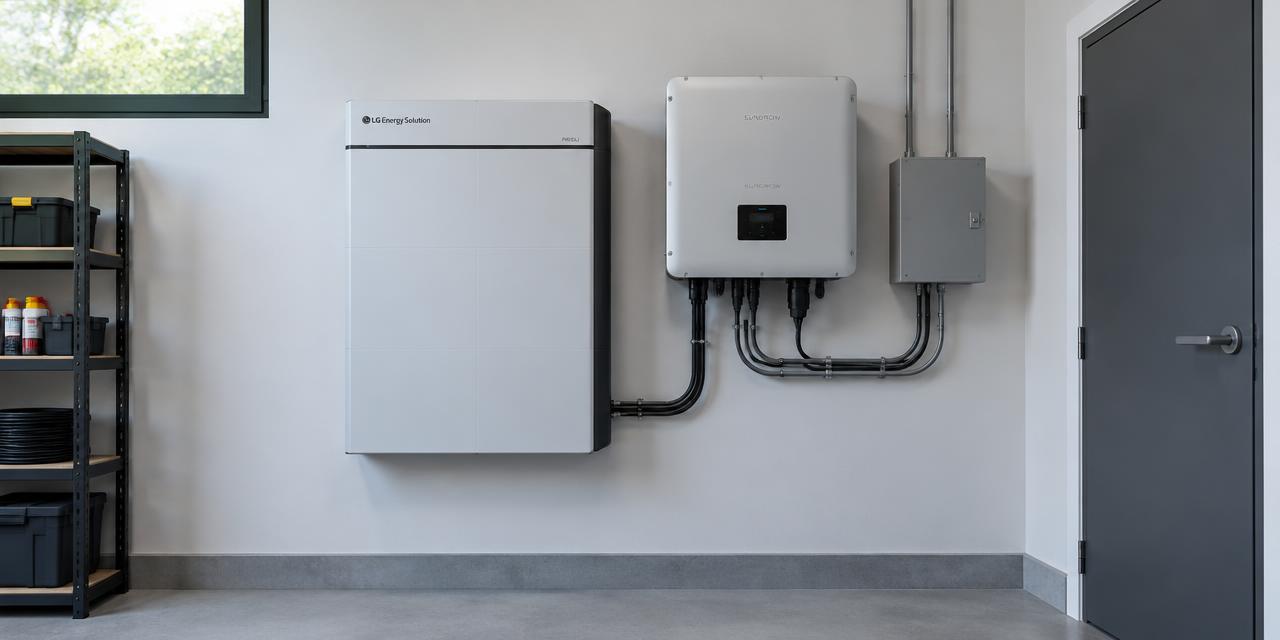
A typical battery occupies about the space of a small wall cabinet. Plan for extra clearance for air circulation around the unit.
Lithium-ion batteries used for residential storage generally have a lifespan of between 10 and 15 years depending on usage.
Yes, temperatures that are too low reduce charging efficiency. It is advisable to install them in temperate areas above 5-10 °C.
It is recommended to contact your insurer to report the installation of a storage system. This allows for adjusting your coverage in case of fire or electrical damage.
Estimated solar yield
1'223 kWh/kWc/an
toit ~30° sud, PR 0.8, estimation
Source : Open-Meteo Historical Weather API (réanalyse ERA5, moyenne 2015-2024)
Source : lancy.ch