
La Maison des Energies SA
1201 Genève · about 0.9 km
La Maison des Énergies specializes in energy transition solutions, including the installation of photovoltaic panels and heat pumps.
lamaisondesenergies.chHome solar battery · Genève
At a glance
Small project
CHF 4'400 – CHF 10'000
Typical project
CHF 7'900 – CHF 16'900
Large project
CHF 13'600 – CHF 28'000
| Project | Quantity | Low | High | Per unit |
|---|---|---|---|---|
| Small project | 5 kWh | CHF 4'400 | CHF 10'000 | CHF 1'300 |
| Typical project | 10 kWh | CHF 7'900 | CHF 16'900 | CHF 1'200 |
| Large project | 18 kWh | CHF 13'600 | CHF 28'000 | CHF 1'100 |
Computed with our estimator for Genève (regional factor included), standard finish. Only the project size changes.
Included
Not included
In Genève, the federal building register lists 7'296 residential buildings and 115'225 dwellings. These municipal benchmarks help put your home in context, but do not replace an individual assessment.
78 % built before 1980
Construction year does not reveal past renovations: check the current insulation condition.
64 % · Gas
This distribution describes recorded buildings, not your system's consumption or efficiency.
| Energy | Heating | Hot water |
|---|---|---|
| Gas | 64 % | 56.8 % |
| Heating oil | 25 % | 23.3 % |
| District heating | 8 % | 7.4 % |
| Heat pump | 1 % | 0.8 % |
| Electricity | 0 % | 3.7 % |
| Wood | 1 % | 0.4 % |
| Solar thermal | 0 % | 5.5 % |
Each line gives the share of buildings using that energy, separately for heating and for hot water. The two columns do not always reach 100%: some buildings combine two systems, or reported none.
A standard non-condensing boiler is usually older and less efficient.
43.7 % of buildings mix housing with shops or offices.
For your renovation plans in Geneva, the official RegBL figures provide vital context. With 60 buildings out of 6768 officially designated for heritage protection, it is crucial to contact municipal authorities early to discuss permit requirements for your property. Regarding building volume, data based on the SIA 416 standard is currently unavailable for the 777 houses listed, as all values are marked as unknown. Due to this partial data coverage, homeowners must obtain a professional on-site assessment to accurately determine the scope and scale of necessary heating or insulation upgrades before beginning any renovation works.
Source : Registre fédéral des bâtiments et des logements (RegBL), OFS, 2026. Existing residential buildings; percentages of recorded values.
In Geneva, with an average global irradiation of 1378 kWh/m²/year, the solar potential is significant. However, photovoltaic production is daytime-dependent, while domestic consumption often centers on the evening.
A storage battery becomes relevant when your production clearly exceeds your immediate daytime needs. By storing the surplus, you avoid feeding energy back into the grid at low value and instead use it during sunless hours.
The Geneva climate, with about 50 frost days per year and significant heating needs (average 2752 Kj/year), requires a holistic view of energy efficiency.
Carrying out these works is ideal during an electrical renovation or when adding solar panels, to dimension the entire system coherently to cover your night-time needs and strengthen your energy resilience against seasonal fluctuations.
The selection of your battery depends primarily on your actual consumption profile. It is crucial to dimension the storage capacity based on what you actually consume during your hours of presence, and not just on the peak power of your solar panels.
An oversized battery will never be fully amortized, while an insufficient capacity will limit your autonomy.
Compatibility with your existing inverter is an essential technical step. Carefully verify if your current equipment is ready for DC coupling or AC coupling.
Modern technologies allow for modular systems, offering the possibility to add extra storage units later if your needs evolve.
It is also advisable to evaluate the cell type to ensure the longevity of the installation, while ensuring the energy management system (EMS) allows for intelligent control, capable of optimizing charge and discharge cycles.
The Geneva building stock is very diverse, ranging from historical urban ensembles to recent detached houses.
Before any installation, it is necessary to examine the state of your interior electrical network, especially in older buildings where upgrading to current standards may be a necessary prerequisite for connecting a battery.
The space available to house the storage units must also be chosen carefully: a dry technical room, sheltered from extreme temperature fluctuations, is recommended.
If your project involves heavy electrical work in older buildings, be vigilant about the potential presence of old materials. Although installing batteries is less invasive than a roof renovation, the routing of cables must comply with current standards.
The structure of your building must also be able to support the weight of the equipment, especially if you opt for large-capacity floor-standing storage solutions in attics or basements with limited load-bearing capacity.
If your installation is part of a photovoltaic production project, be aware that federal law often takes precedence over cantonal aesthetic regulations for "sufficiently adapted" installations.
However, for listed buildings or those located in heritage zones (particularly in the Old Town or in the sector south of the old fortifications), strict constraints apply.
The Office of Urban Planning is the competent authority for issuing the building permit required in these protected perimeters.
For buildings listed in the inventory or located in an ISOS village zone, reinforced attention is required regarding the visual integration of the equipment.
Even if the battery itself is installed indoors, its integration into the overall system must respect local procedures.
It is imperative to check with your municipality to see if your property is located in an area requiring a specific building permit application.
In less restrictive cases, a simple notification is often enough, but never skip a formal check to avoid any future disputes.
The golden rule for any request for financial aid is the submission of the complete file before the start of work. A request filed after the start of the site is systematically refused by the funding agencies.
Each program may have specific eligibility criteria regarding battery technology or the performance of the associated solar system. Make sure you obtain all necessary written confirmations from the competent authorities.
Keep every proof of your steps carefully, as well as detailed quotes and final invoices.
Taxation may also offer possibilities for deductions for energy-saving works; inquire with the cantonal tax administration to check if your specific investment falls within the scope of deductible expenses in your tax return.
The execution of a solar storage project follows a logical schedule, dictated by the administrative and technical phases. The first step is an audit of your consumption and an assessment of your existing photovoltaic installation.
Once the sizing is validated, building permit applications should be submitted, if necessary, then wait for official feedback.
It is advisable to avoid planning the commissioning phase during periods of extreme cold, although indoor installations are less sensitive to the 50 annual Geneva frost days than outdoor installations.
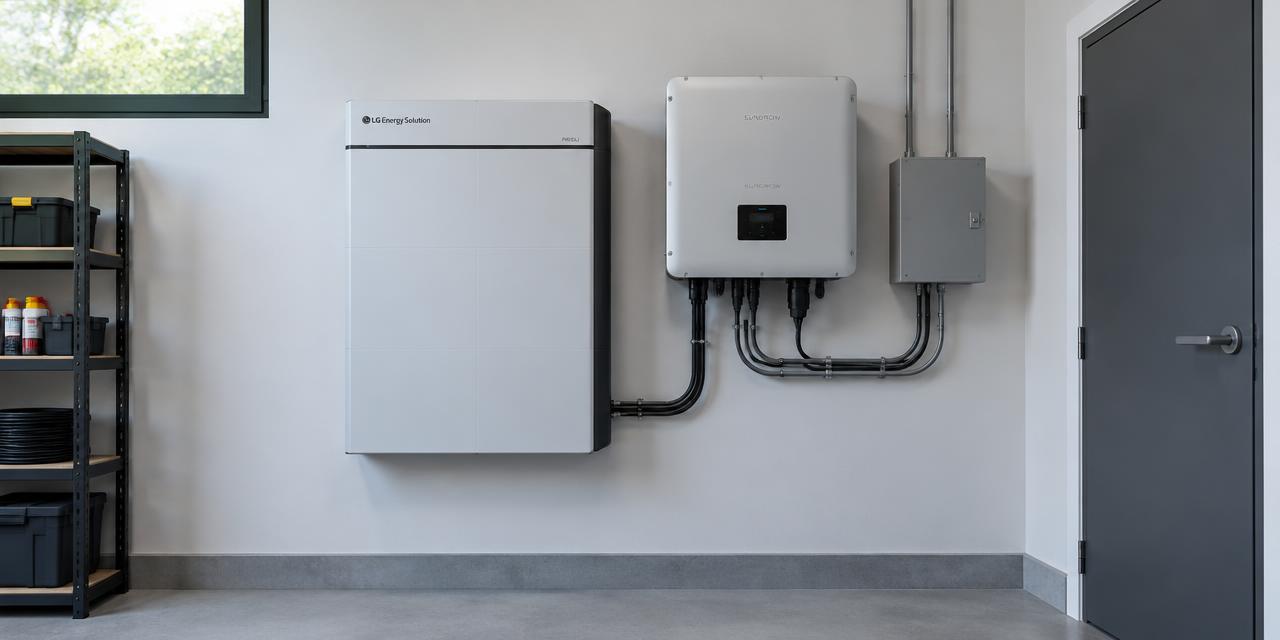
The site itself includes the physical installation of the batteries, the connection to the main electrical panel, and the configuration of the control system.
The ideal time to carry out the work is often in the mid-season, when heating demand is moderate and technicians are more available.
Once the equipment is installed, the test phase allows verifying the proper communication between the inverter, the battery, and the internal network manager. Allow for an adjustment time to configure the system according to your actual consumption habits.
Never request quotes without checking the compatibility of your current inverter with the envisaged storage systems. Ensure that the location intended for the battery is dry and sheltered from extreme temperature fluctuations to preserve the life of the cells.
Systematically check with your municipality if a building permit is required for your project before validating any order.
Do not dimension your storage according to the peak power of your solar panels, but exclusively according to your actual consumption during night hours.
Require installers to provide an acoustic conformity certificate if your system includes noisy cooling components.
Among common errors, forgetting to apply for financial aid before signing the quote is the most penalizing. Also, do not neglect the state of your electrical panel which might require an expensive upgrade beforehand.
Do not overlook visual integration if you reside in a heritage-protected perimeter, at the risk of having to dismantle your installation.
Finally, choose a service provider capable of explaining the intelligent control of the system rather than a simple hardware supplier.
1. Estimate
Set a budget range with the estimator.
2. Grants
Apply before work starts.
3. Quotes
Compare at least 3 quotes.
4. Permit
Check with the municipality whether a permit is needed.
5. Works
Follow the site and do a written handover.
No specific grant listed for this work. Maintenance tax deductions may still apply.
1201 Genève · about 0.9 km
La Maison des Énergies specializes in energy transition solutions, including the installation of photovoltaic panels and heat pumps.
lamaisondesenergies.ch1207 Genève · about 1.4 km
Helvetia Energy specializes in energy audits and the installation of heat pump heating systems, photovoltaic panels, and battery storage solutions.
helvetia-energy.ch1207 Genève · about 1.4 km
Helvetia Energy provides energy renovation services, including the installation of solar panels, heat pumps, and roof and window insulation improvements.
helvetia-energy.ch1227 Carouge GE · about 1.8 km
Energie 3 SA provides energy concepts, sustainability consulting, and installation of renewable energy and building service systems.
energie3.chSuggestions from the commercial register by distance and activity. Not an endorsement or partnership.
No, it is only useful if your production clearly exceeds your daytime consumption. It allows storing the surplus for use during your night-time needs.
You must dimension the capacity according to the actual evening consumption, not the power of the panels. Analyze your bills to estimate your night-time needs.
No, always verify compatibility with your existing inverter before purchasing. An AC or DC coupling system must be correctly identified by a professional.
This depends on your geographic area and heritage classification. Consult the Office of Urban Planning or your municipality before starting the work.
The application must strictly be submitted before the start of work. An already paid invoice prevents any aid from being obtained.
Yes, buildings listed in the inventory or in protected zones require strict visual integration. Federal law can, however, facilitate adapted installations.
The mid-season is ideal for installer availability. Avoid periods of extreme cold for total peace of mind during installation.
Estimated solar yield
1'213 kWh/kWc/an
toit ~30° sud, PR 0.8, estimation
Source : Open-Meteo Historical Weather API (réanalyse ERA5, moyenne 2015-2024)