
swisspro SR SA, succursale de Vernier (canton de Genève)
1219 Le Lignon · about 3.5 km
swisspro is a specialist in electrical installations, building automation, and energy solutions such as photovoltaics and charging infrastructure.
swisspro.chHome solar battery · Meyrin
At a glance
Small project
CHF 4'400 – CHF 10'000
Typical project
CHF 7'900 – CHF 16'900
Large project
CHF 13'600 – CHF 28'000
| Project | Quantity | Low | High | Per unit |
|---|---|---|---|---|
| Small project | 5 kWh | CHF 4'400 | CHF 10'000 | CHF 1'300 |
| Typical project | 10 kWh | CHF 7'900 | CHF 16'900 | CHF 1'200 |
| Large project | 18 kWh | CHF 13'600 | CHF 28'000 | CHF 1'100 |
Computed with our estimator for Meyrin (regional factor included), standard finish. Only the project size changes.
Included
Not included
In Meyrin, the federal building register lists 1'522 residential buildings and 11'338 dwellings. These municipal benchmarks help put your home in context, but do not replace an individual assessment.
57 % built before 1980
Construction year does not reveal past renovations: check the current insulation condition.
34 % · Gas
This distribution describes recorded buildings, not your system's consumption or efficiency.
| Energy | Heating | Hot water |
|---|---|---|
| Gas | 34 % | 27.3 % |
| Heating oil | 26 % | 20.7 % |
| District heating | 31 % | 26.8 % |
| Heat pump | 4 % | 2.1 % |
| Electricity | 3 % | 7.6 % |
| Wood | 1 % | 0.8 % |
| Solar thermal | 0 % | 10.4 % |
Each line gives the share of buildings using that energy, separately for heating and for hot water. The two columns do not always reach 100%: some buildings combine two systems, or reported none.
A standard non-condensing boiler is usually older and less efficient.
14.1 % of buildings mix housing with shops or offices.
When planning renovations in Meyrin, reviewing official building register data is a critical first step. With 19 buildings listed under heritage protection, but with overall data coverage being partial, contacting municipal authorities early is essential to clarify permit requirements. Furthermore, since the 745 house volumes are not recorded using the standard SIA 416, you will need to obtain precise physical measurements to accurately plan your heating and insulation upgrades. Relying on current register figures requires caution, so a professional on-site assessment remains the most reliable way to establish accurate costs for your specific renovation project.
Source : Registre fédéral des bâtiments et des logements (RegBL), OFS, 2026. Existing residential buildings; percentages of recorded values.
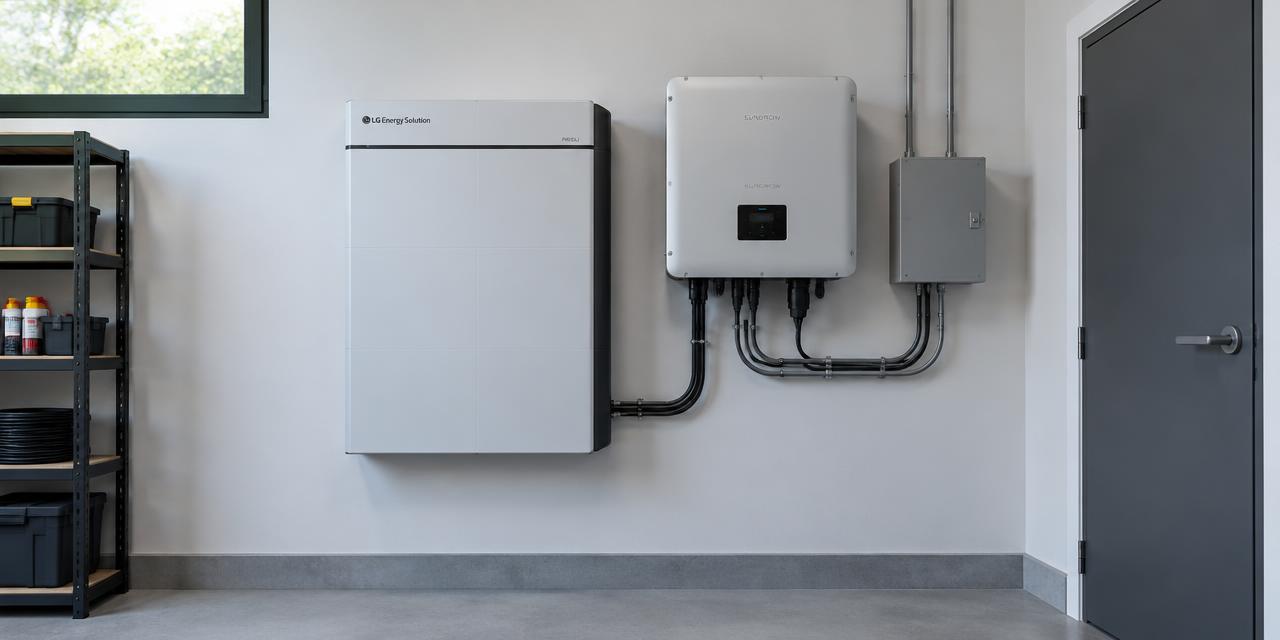
In Meyrin, the decision to add a battery storage system to a photovoltaic installation is a matter of economic and ecological optimization.
With attractive annual global irradiation, your roof produces valuable energy, but the discrepancy between consumption peaks and solar production often justifies storage.
A battery becomes relevant when your production clearly exceeds your daytime consumption, allowing you to use your own electricity in the evening. Given the 54 frost days per year and seasonal variations, securing energy autonomy is a pragmatic step.
It is advisable to act before your current inverter becomes obsolete or during a comprehensive thermal renovation, to intelligently integrate your home's power flows at this altitude of 440 meters.
The selection of your storage equipment mainly depends on the cell chemistry and storage capacity. It is crucial to size the capacity according to your household's evening consumption rather than relying solely on the peak power of your panels.
A common mistake is to oversize the battery relative to actual needs, which unnecessarily lengthens the payback period. Systems are divided into high-voltage and low-voltage models, each requiring strict compatibility with your existing inverter.
You must verify this compatibility before any purchase.
In addition, intelligent management options, allowing the battery to be controlled based on local weather forecasts, can significantly improve the overall yield of your installation in the specific climate context of Meyrin.
The building stock in Meyrin presents varied challenges depending on the decade of construction.
For houses built before 1990, it is imperative to identify the presence of hazardous materials such as asbestos, particularly in technical areas or old electrical installations, before attaching battery supports or drilling walls.
Older buildings often feature undersized or non-compliant electrical grids, which requires an upgrade to support the load of a modern storage system.
The structure of roofs and walls must be carefully inspected to ensure fire safety, as batteries are quite heavy. Finally, the overall thermal insulation of your building directly influences the heating energy demand.
By improving this insulation, you reduce your overall consumption, which can influence the choice of your battery size, thus optimizing the balance between solar production and real consumption throughout the seasons.
Installing solar panels on roofs is subject to a building permit, but often benefits from a simplified procedure if criteria for landscape integration and compliance with zoning laws are met.
For pitched roofs, panels must not exceed the roof surface by more than 20 cm and must form a grouped unit, without being reflective.
If you reside in a protected area, an ISOS A village area, or a building of high heritage value, constraints are stricter and a building permit is systematically required.
It is strongly advised to contact the Urban Planning Office or the municipal technical service to verify if your plot has specific restrictions before signing any commitment.
Strict compliance ensures not only the legality of your project but also preserves the architectural value of your property.
The municipality offers municipal grants through funds dedicated to energy, climate, and biodiversity. The process begins with verification from the competent municipal department to learn about current eligibility criteria and available amounts.
There is no automatic right to a grant; each application is analyzed according to local priorities.
Tax-wise, inquire with your cantonal tax administration about the possibilities of deducting investment costs related to energy efficiency measures and renewable energy production, which may be deductible from your taxable income.
Financial planning must integrate these elements from the design phase to optimize the long-term profitability of your investment.
The installation schedule for a solar battery requires careful planning to avoid any inconvenience.
The first phase consists of the technical audit of your electrical installation and verification of the necessary administrative permits with the municipality of Meyrin.
Once permits are obtained and grants reserved, equipment can be ordered from your installer.
The installation phase itself is relatively quick, but it must imperatively take place outside periods of intense frost to ensure the correct handling of sensitive electronic components.
A transition period or spring is often favored to ensure optimal working conditions. The workflow includes installing mounts, connecting the battery to the existing inverter, and commissioning the management system. At each stage, safety tests are performed.
The final conformity assessment is an essential step before the final operation of the storage system.
To make your project in Meyrin successful, avoid neglecting the technical compatibility between your inverter and the new battery. It is crucial not to oversize the storage capacity relative to your actual needs.
Ensure the installation location is dry, ventilated, and frost-free. Never begin work without having received the necessary administrative authorization and confirmation of your financial aid. Checklist: Check the state of your current electrical network.
Confirm compatibility with the inverter. Obtain at least three detailed quotes and compare overall services. Check the installer's reputation. Ensure the company has the necessary qualifications for electrical work in the Canton of Genève.
Request an acoustic conformity certificate if you are installing noisy auxiliary equipment. Verify that all conditions for grants are met and documented before signing.
The durability of your battery system depends largely on rigorous maintenance.
Although modern systems are designed to operate with minimal human intervention, an annual check is recommended to verify electrical connections, cable integrity, and software updates of your management system.
It is essential to protect components against extreme temperature fluctuations, despite the mild annual mean temperature in Meyrin. Avoid exposing the battery to damp or dusty conditions that could accelerate the wear of electronic components.
If you notice an abnormal decrease in charge or discharge performance, call a qualified professional for a quick diagnosis.
Regular preventive maintenance helps ensure the maximum lifespan of your investment while guaranteeing constant performance of your energy storage system over the years of operation.
1. Estimate
Set a budget range with the estimator.
2. Grants
Apply before work starts.
3. Quotes
Compare at least 3 quotes.
4. Permit
Check with the municipality whether a permit is needed.
5. Works
Follow the site and do a written handover.
No specific grant listed for this work. Maintenance tax deductions may still apply.
1219 Le Lignon · about 3.5 km
swisspro is a specialist in electrical installations, building automation, and energy solutions such as photovoltaics and charging infrastructure.
swisspro.ch1219 Le Lignon · about 3.5 km
Amaudruz SA is a company specializing in electrical installations, home automation, and photovoltaic solutions.
amaudruz.ch1242 Satigny · about 3.8 km
Geneva-based specialist in electrical installations, energy renovations, energy management, and photovoltaic systems for buildings.
spm-metallurgie.ch1242 Satigny · about 3.8 km
SRET SA in Satigny specializes in electrical installations, fiber optic deployment, and sustainable energy solutions.
sret.chSuggestions from the commercial register by distance and activity. Not an endorsement or partnership.
Installing an indoor battery often requires a simple declaration. However, always check with the local urban planning office for your specific situation.
Modern batteries generally last between 10 and 15 years. This mainly depends on the number of charge cycles and usage conditions.
This depends on whether your installation includes a backup function. This is not automatic on all models, specify this need to your installer.
Yes, if the garage is insulated and temperate. Batteries dislike frost and humidity, which can affect their performance in Meyrin.
No, aid is never retroactive. The application must be validated before the start of work to be eligible.
This depends on your current model. Compatibility is paramount, check it with a professional before any purchase.
In most cases, no, but a check of the load-bearing capacity is recommended for wall-mounted or very large installations.
Estimated solar yield
1'213 kWh/kWc/an
toit ~30° sud, PR 0.8, estimation
Source : Open-Meteo Historical Weather API (réanalyse ERA5, moyenne 2015-2024)