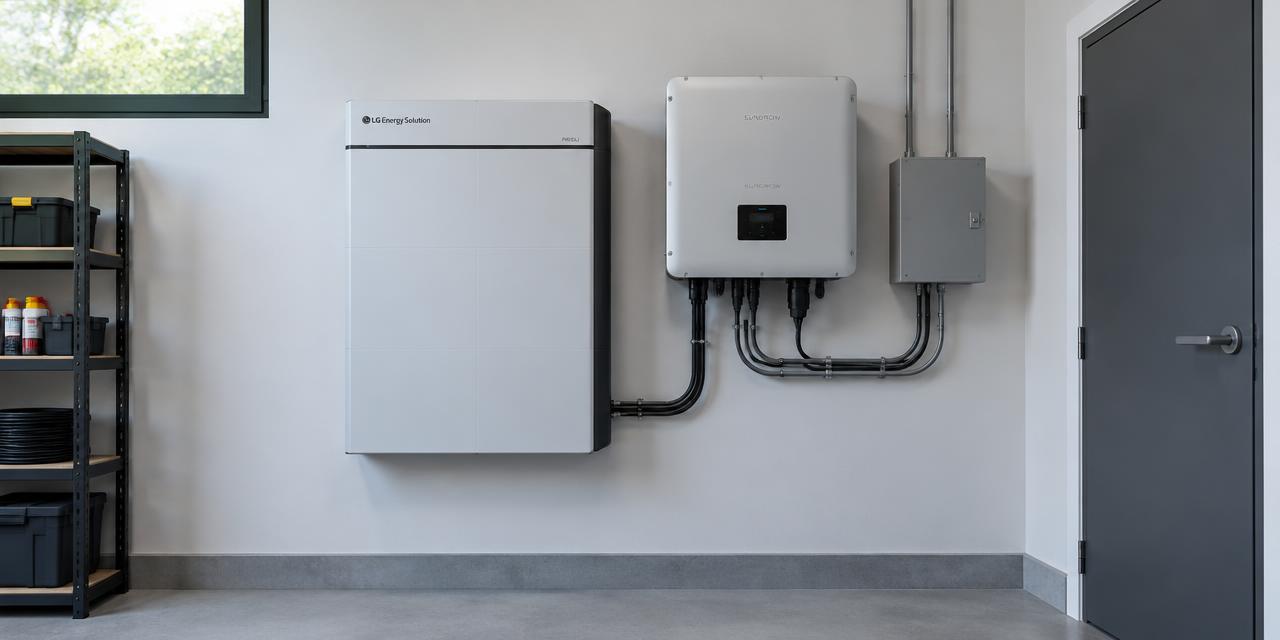
Optimizing solar self-consumption with a battery in Carouge
Do you live in Carouge and want to maximize the use of your solar energy? Installing a storage battery is a key solution to turn your photovoltaic system into a more autonomous energy source.
At a glance
Typical budget
CHF 7'900 – CHF 16'900
Midpoint
CHF 11'600
Grants found
0
Nearby companies
4
Worked examples in Carouge
Small project
CHF 4'400 – CHF 10'000
Typical project
CHF 7'900 – CHF 16'900
Large project
CHF 13'600 – CHF 28'000
Project
Quantity
Low
High
Per unit
Small project
5 kWh
CHF 4'400
CHF 10'000
CHF 1'300
Typical project
10 kWh
CHF 7'900
CHF 16'900
CHF 1'200
Large project
18 kWh
CHF 13'600
CHF 28'000
CHF 1'100
Computed with our estimator for Carouge (regional factor included), standard finish. Only the project size changes.
Cost split (typical project)
Labour :CHF 2'300(20 %)
Materials :CHF 8'100(70 %)
Other costs :CHF 1'200(10 %)
What the price covers
Included
Supply and installation
VAT
Battery, charge management and standard connection; options according to answers
Not included
Permits and architect fees
Unexpected structural issues
Possible subsidies
Solar panels and complete electrical refurbishment
Carouge's housing stock in figures
In Carouge, the federal building register lists 1'146 residential buildings and 11'591 dwellings. These municipal benchmarks help put your home in context, but do not replace an individual assessment.
63 %built before 1980
90 %heated by oil or gas
3.4 %electric hot water
7.4 %with declared solar thermal
Age of residential buildings
63 % built before 1980
Before 191927 %
1919–194510 %
1946–19609 %
1961–19709 %
1971–19808 %
1981–199010 %
1991–200010 %
2001–20108 %
Since 20119 %
Construction year does not reveal past renovations: check the current insulation condition.
Main heating energy
74 % · Gas
Gas74 %
Heating oil16 %
District heating7 %
Heat pump2 %
Electricity1 %
This distribution describes recorded buildings, not your system's consumption or efficiency.
Heating and hot water: which energies?
Energy
Heating
Hot water
Gas
74 %
64.2 %
Heating oil
16 %
15 %
District heating
7 %
7.3 %
Heat pump
2 %
1.1 %
Electricity
1 %
3.4 %
Solar thermal
0 %
6.9 %
Each line gives the share of buildings using that energy, separately for heating and for hot water. The two columns do not always reach 100%: some buildings combine two systems, or reported none.
Type of heating system
Boiler (unspecified)74.1 %
Heat exchanger (district)6.9 %
Standard boiler6.3 %
Condensing boiler6.2 %
Heat pump5.4 %
Central electric heating0.7 %
A standard non-condensing boiler is usually older and less efficient.
Houses or apartment buildings?
Single-family houses20 %
Two-dwelling houses6.4 %
Apartment buildings (3+)62.7 %
Other10.9 %
38.4 % of buildings mix housing with shops or offices.
The typical building
storeys (median)
4
median footprint
201 m²
median dwelling area
74 m²
Renovations, heritage and volumes
For your renovation projects in Carouge, the RegBL data shows partial coverage regarding key building metrics. While 20 buildings are officially noted under heritage considerations, information regarding past renovation years is unavailable for the entire building stock. Additionally, the building volume for the 229 houses is not measured according to the SIA 416 standard, which is typically vital for scaling insulation or heating upgrades. Given these data gaps, it is highly recommended that you contact the municipal authorities early in your planning process to obtain precise details about your specific property before estimating your total renovation costs.
0
buildings flagged as protected
status known for 20 of 1'021 buildings; check with the municipality
Why and when to invest in solar storage in Carouge
Carouge, at 382 meters above sea level with attractive global annual solar irradiation, offers significant potential for photovoltaic production.
As a 'Cité de l'énergie Gold' certified municipality, Carouge is actively committed to the cantonal climate plan aiming for carbon neutrality by 2050.
Installing a battery becomes relevant when your solar production significantly exceeds your daytime consumption, allowing you to store surplus energy rather than feeding it into the grid at a lower rate.
9 °C, influences the management of your energy needs. In winter, heating requirements are increased, as indicated by the 2,695 Kj/year heating degree days.
A battery offers you more flexibility to manage your consumption, especially if you couple your installation with a heat pump, thus promoting smart management of your self-consumption throughout the year.
Technical choices for your battery
The sizing of your storage system should be based on your actual consumption during sunless hours, not just on the peak power of your panels.
A battery that is too large will never be full, while insufficient capacity will force you to import electricity from the grid during the evening. It is essential to check the technical compatibility of the battery with your current inverter.
If you already have a photovoltaic installation, some modern inverters allow hybridization, but it is sometimes necessary to add a dedicated battery inverter.
On the market, Lithium Iron Phosphate (LFP) technology is common for its durability and safety. Ranges vary according to the number of guaranteed charge cycles, the permitted depth of discharge, and modularity.
An interesting option is the backup capability that allows certain priority circuits to be powered in the event of a public grid power outage.
Take the time to analyze your nocturnal consumption profiles to choose a useful capacity that truly matches your domestic usage in Carouge.
Specifics of the built environment and heritage protection in Carouge
Because of this importance, the municipality was the subject of a national pilot project starting in 2016 to reconcile heritage preservation with solar energy.
If your building is protected or located in a site plan, specific constraints apply to the visual appearance of your installations. It is crucial to consider landscape integration as early as the reflection phase.
Beyond the heritage aspect, older buildings may present technical challenges, particularly concerning the condition of electrical panels or the strength of the roof structure to support additional panels if necessary.
Ensure that the location intended for the battery is dry, temperate, and ventilated to guarantee its longevity and efficiency.
Although precise data by housing type is missing, it is recommended to hire a professional accustomed to working on Geneva's built environment, capable of evaluating the compliance of your internal electrical installation when connecting the storage system.
Authorizations and rules in Carouge
However, a simplified procedure exists in certain cases : if the installations are located on compliant pitched roofs, non-visible flat roofs, or in certain planning perimeters (Zone 4B, 5, 5A, 5B, 6), a prior declaration may suffice.
Regarding storage, check with the municipality if the technical room requires specific arrangements for fire safety.
The Vieux-Carouge, as a protected zone, imposes a strict building permit requirement for any solar project. You must ensure that your project respects the conditions of landscape and heritage integration.
Given the regulatory complexity for sensitive areas, it is strongly advised to contact the Urban Planning Office or municipal services before taking any action.
If your project includes a heat pump, be aware that those exceeding 10 kW require a building permit, while smaller ones require a prior declaration with an acoustic compliance certificate, as noise rules apply.
Financial aid and taxation
Inquire with the cantonal and municipal authorities about the current subsidy programs, as the mechanisms evolve regularly according to the priorities of the cantonal climate plan.
Regarding taxation, be aware that investments related to improving the energy efficiency of your building can be deductible from your taxable income. This deduction constitutes an important financial lever for owners.
Keep all invoices and certificates of compliance after work carefully, as they will be needed for your tax returns.
Do not forget to check the municipal specificities, as Carouge, as an 'Energy City', may offer support or specific conditions linked to its climate objectives. Preparation upstream is the guarantee of a financially facilitated energy transition.
Schedule and site progression
The completion of a solar battery project follows several key stages. Everything begins with a feasibility study and precise sizing with your installer. Once the necessary authorizations have been obtained, the equipment can be ordered.
The site itself is relatively quick, limited mainly to mounting the battery, connecting it to the inverter, and commissioning the energy management system.
There is no strictly imposed season for this installation, but it is preferable to avoid periods of extreme cold, as frost days can complicate technical interventions on external wiring or in unheated premises.
The typical process includes first preparing the room, then the physical installation of electrical cabinets and battery modules, followed by charge and discharge tests. Once the tests are successful, the installation is commissioned.
Anticipate the timeframes related to administrative procedures and material delivery, which can vary depending on the availability of components on the market.
By planning this work outside of peak frost periods, you ensure better logistics and optimal working comfort for the technicians working at your home.
Frequent mistakes and checklist
Among common mistakes, we note over-sizing the battery, which increases cost without real benefit, or failing to check compatibility with the existing inverter.
It is essential to ensure that the installer verifies the maximum discharge capacity in relation to your evening needs. Do not start any work without having received the necessary administrative validations from the Urban Planning Office.
Before asking for quotes, check that your electrical panel meets standards and is capable of accommodating a new storage system. Also request an assessment of your actual nocturnal consumption.
Here is a checklist to prepare your quotes : Verify that you have clearly identified your annual and nocturnal consumption. Ensure that the battery location meets temperature and humidity conditions.
Check with the municipality for specific heritage protection zones. Always ask the installer to justify the proposed sizing against your consumption data.
Request a detailed quote including commissioning, connection, and training on how to use the system control interface.
Your project in 5 steps
1. Estimate
Set a budget range with the estimator.
2. Grants
Apply before work starts.
3. Quotes
Compare at least 3 quotes.
4. Permit
Check with the municipality whether a permit is needed.
5. Works
Follow the site and do a written handover.
Grants and subsidies
No specific grant listed for this work. Maintenance tax deductions may still apply.
Companies in the area
Cap Energie SA
1227 Carouge GE · about 0 km
Cap Energie is a company based in French-speaking Switzerland specializing in the installation of renewable energy systems, including solar photovoltaics, heat pumps, and energy storage solutions.
Geneva-based company specializing in electrical installations, home automation, telecommunications, and energy-saving solutions for homes and businesses.
Note : La Ville de Carouge a mis à jour sa planification énergétique communale pour atteindre les objectifs du Plan climat cantonal et atteindre la neutralité carbone d’ici 2050. Carouge a été labellisée "Cité de l'énergie" depuis 2008.
Targets : atteindre la neutralité carbone d’ici 2050