
SecuSuisse AG, Succursale de Genève/Lancy
1212 Grand-Lancy · about 0 km
Swiss specialist in security solutions and access control systems for residential and commercial buildings.
secusuisse.chFence installation · Lancy
At a glance
Small project
CHF 1'800 – CHF 4'900
Typical project
CHF 3'100 – CHF 8'000
Large project
CHF 5'000 – CHF 12'700
| Project | Quantity | Low | High | Per unit |
|---|---|---|---|---|
| Small project | 15 m | CHF 1'800 | CHF 4'900 | CHF 200 |
| Typical project | 30 m | CHF 3'100 | CHF 8'000 | CHF 200 |
| Large project | 53 m | CHF 5'000 | CHF 12'700 | CHF 200 |
Computed with our estimator for Lancy (regional factor included), standard finish. Only the project size changes.
Included
Not included
In Lancy, the federal building register lists 1'951 residential buildings and 16'638 dwellings. These municipal benchmarks help put your home in context, but do not replace an individual assessment.
57 % built before 1980
Construction year does not reveal past renovations: check the current insulation condition.
61 % · Gas
This distribution describes recorded buildings, not your system's consumption or efficiency.
For your renovation plans in Lancy, please note that official data from the Federal Register of Buildings and Dwellings (RegBL) is currently incomplete. Out of 1900 registered buildings, there is no recorded information regarding renovation years or building volumes measured according to the SIA 416 standard. Given this partial data coverage, homeowners must conduct their own technical assessments before finalizing plans for heating systems or insulation upgrades. It is essential to contact the local municipal authorities early in your planning process to confirm your property details, as these registry figures do not provide a sufficient basis for an automated renovation cost estimate.
Source : Registre fédéral des bâtiments et des logements (RegBL), OFS, 2026. Existing residential buildings; percentages of recorded values.
In Lancy, with an average altitude of 421 meters, the climate imposes specific constraints on exterior landscaping. The municipality records about 66 days of frost per year, which directly impacts the durability of structures placed at property boundaries.
Undertaking fencing work not only improves the security and privacy of your real estate but also durably structures your gardens against local temperature variations.
The choice of timing for starting the work is crucial. It is highly recommended to plan the installation outside periods of intense frost to ensure the stability of post foundations.
3 °C and the climatic conditions of the Geneva region require materials resistant to freeze-thaw cycles. Anticipation during mild seasons allows for better fixation and avoids structural issues caused by soil movement after winter.
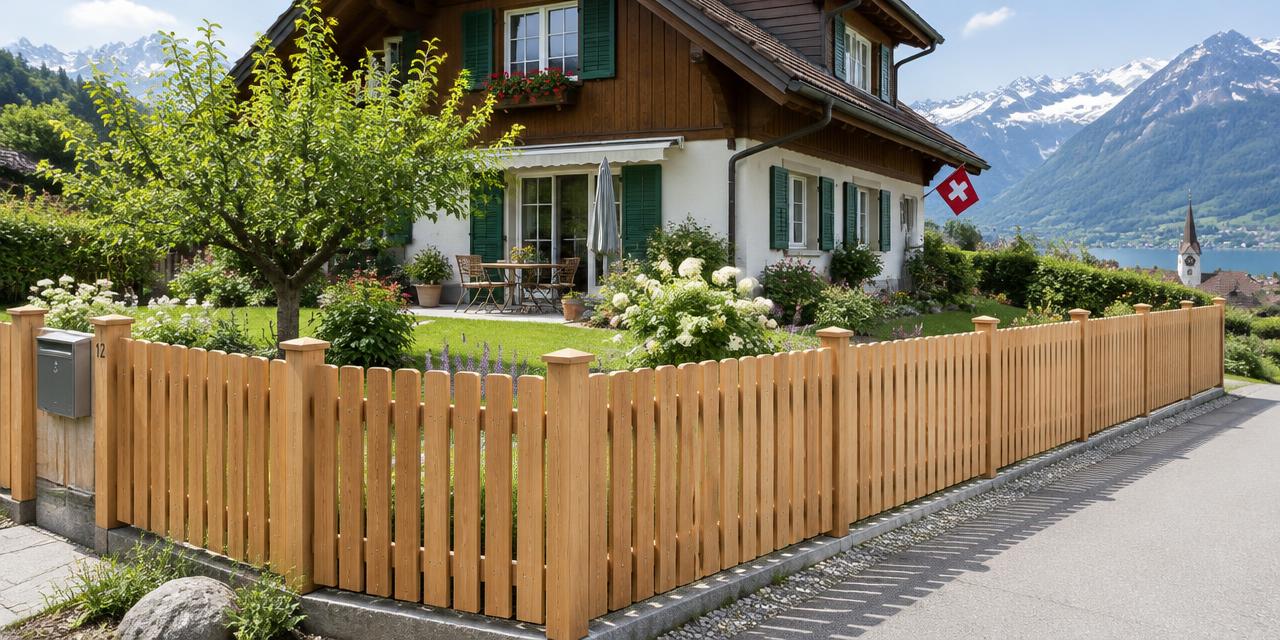
The fencing project depends primarily on the chosen material and its implementation. Options range from simple, discreet wire mesh to rigid galvanized steel panels, wood, or gabions. Each material has its own installation requirements.
Post foundations often account for a significant portion of the cost, especially on sloped terrain where anchoring must be reinforced to prevent long-term tilting.
The chosen range also influences maintenance and durability. An integrated gate or screening options like PVC or wood slats add technical complexity due to wind load.
It is therefore essential to assess the robustness of the posts and the fixing system according to your plot's exposure.
Remember that heights and distances to boundaries are set by municipal regulations, which often impose strict constraints on the design and choice of the final fence.
4% of the cantonal total between 2003 and 2023. With 16,074 housing units recorded by the end of 2023, the municipality features a diverse building stock ranging from detached villas to large developments.
When installing a fence, it is imperative to check for underground utilities (electricity, water, gas) that may cross property lines without always being apparent on old cadastral plans.
For houses built before 1990, particular attention must be paid to the subsoil. Old foundations or existing retaining walls could contain materials that should be handled with caution during excavation.
Furthermore, if your fence is adjacent to a historical building or located in a specific zone, check if excavation restrictions apply.
The soil in Lancy must allow for firm post anchoring; on backfilled terrain, reinforcing foundations is often necessary to ensure structure stability.
Before any project, it is essential to consult the urban planning office or municipal services to determine property boundary setbacks and authorized heights.
Heights and distances to boundaries are set by municipal regulations, and non-compliance with these prescriptions may result in the obligation to dismantle or modify the structure at your own expense.
Regarding heritage, although fences are generally minor developments, certain protected areas or listed buildings may impose material choices (wood, wrought iron, live hedges) to respect landscape harmony.
If your land is in a sensitive sector, a prior inquiry with the competent authority is a mandatory step before starting any construction.
Inform your neighbors beforehand : a shared fence is sometimes split, and obtaining their written consent greatly facilitates project management and avoids subsequent disputes.
Unlike major energy renovations, fences are considered private improvements whose costs are entirely borne by the owner.
It is important to note that any authorization application, if required by the municipality, must mandatorily be made before the start of the work.
Tax-wise, the costs of maintenance and repair of an existing fence can sometimes be deducted from income tax if such work serves to maintain the value of the property.
However, the construction of a new fence is generally considered a non-deductible capital investment.
It is recommended to carefully keep all invoices and the obtained building permit, as they are essential supporting documents in case of resale of the property.
Consult your cantonal tax administration to verify eligibility according to your specific situation.
Building a fence follows a structured process. The first step is to precisely define the project and obtain the necessary authorizations from the municipality.
Once the permit is obtained, the site preparation phase begins: marking locations, clearing, and possibly leveling. The best season to start is spring or early autumn, when the soil is neither frozen nor waterlogged, facilitating digging post holes.
The construction then begins with setting the posts, a critical step that requires sufficient drying time to ensure the structure's stability against wind and impact. After the concrete sets, the panels or wire mesh are fixed.
Finally, finishing touches and any gates are installed. It is crucial to avoid frost days, as cold can alter the quality of the setting concrete.
By following this chronological order, you ensure the longevity of your fence while minimizing the risks of poor workmanship linked to seasonal weather.
Avoid the classic error of installing a fence without verifying the exact cadastral limits with your neighbors. An incorrect placement can lead to costly disputes.
Also, ensure you do not neglect wind resistance, especially if you are installing screening elements. Before requesting quotes, check the following: Have I obtained the necessary municipal permits? Have underground utilities been located on my plan?
Is the fence height in compliance with local regulations? Have my neighbors been informed of my project?
Plan to choose your materials according to exposure. Another often overlooked point is the quality of the foundations.
Remember that post foundations represent a significant part of the cost on sloped terrain; do not try to save on this vital structural element.
Finally, ensure you have a detailed quote that includes not only supply but also excavation and removal of excavated soil. Good preparation avoids cost overruns during the work.
1. Estimate
Set a budget range with the estimator.
2. Grants
Apply before work starts.
3. Quotes
Compare at least 3 quotes.
4. Permit
Check with the municipality whether a permit is needed.
5. Works
Follow the site and do a written handover.
No specific grant listed for this work. Maintenance tax deductions may still apply.
1212 Grand-Lancy · about 0 km
Swiss specialist in security solutions and access control systems for residential and commercial buildings.
secusuisse.ch1205 Genève · about 2.1 km
FV Peinture is a general contractor specializing in interior and exterior painting, drywall installation, facade work, and flooring renovations.
fvpeinture.ch1228 Plan-les-Ouates · about 2.2 km
Geneva-based company founded in 1972 specializing in general electrical installations, telecommunications, and gate automation.
laydevant.ch1219 Châtelaine · about 2.8 km
Based in Châtelaine, LS Bois Métal Sàrl specializes in carpentry, locksmithing, window installation, and bioclimatic pergolas.
ls-boismetal.chSuggestions from the commercial register by distance and activity. Not an endorsement or partnership.
Yes, it is highly recommended to check with the urban planning office. Certain zones or heights require prior authorization.
No, there is no public financial aid for the installation of a private fence in Lancy. Costs are your responsibility.
On sloped terrain, foundations must be deeper and reinforced to prevent tilting. This represents a significant part of the cost.
Yes, it is essential to inform your neighbors, especially if the fence is shared. A written agreement facilitates project management.
The ideal time is spring or autumn to avoid frozen soil. Work during days of intense frost should be avoided.
Consult your property's cadastral plans. If in doubt about the presence of pipes, contact the municipal technical services.
Generally, a new fence is a non-deductible capital investment. Only the maintenance of existing structures can sometimes be deducted.
Source : ge.ch · estimate
These rules apply across the whole canton, not only in this town.
Permits
Source : Guide Installations Solaires et Thermopompes - Canton de Genève