
Canton
Solar thermal — Geneva
Depending on system sizing.
Geneva support for solar hot water production.
www.ge.chSolar water heating · Lancy
At a glance
Small project
CHF 10'100 – CHF 23'600
Typical project
CHF 13'000 – CHF 30'200
Large project
CHF 17'800 – CHF 41'000
| Project | Quantity | Low | High | Per unit |
|---|---|---|---|---|
| Small project | 3 m² | CHF 10'100 | CHF 23'600 | CHF 5'500 |
| Typical project | 6 m² | CHF 13'000 | CHF 30'200 | CHF 3'500 |
| Large project | 11 m² | CHF 17'800 | CHF 41'000 | CHF 2'600 |
Computed with our estimator for Lancy (regional factor included), standard finish. Only the project size changes.
Included
Not included
In Lancy, the federal building register lists 1'951 residential buildings and 16'638 dwellings. These municipal benchmarks help put your home in context, but do not replace an individual assessment.
57 % built before 1980
Construction year does not reveal past renovations: check the current insulation condition.
61 % · Gas
This distribution describes recorded buildings, not your system's consumption or efficiency.
| Energy | Heating | Hot water |
|---|---|---|
| Gas | 61 % | 50.1 % |
| Heating oil | 18 % | 14.7 % |
| District heating | 13 % | 10.9 % |
| Heat pump | 4 % | 2.1 % |
| Electricity | 1 % | 7.5 % |
| Wood | 2 % | 0.6 % |
| Solar thermal | 0 % | 9.3 % |
Each line gives the share of buildings using that energy, separately for heating and for hot water. The two columns do not always reach 100%: some buildings combine two systems, or reported none.
A standard non-condensing boiler is usually older and less efficient.
14 % of buildings mix housing with shops or offices.
For your renovation plans in Lancy, please note that official data from the Federal Register of Buildings and Dwellings (RegBL) is currently incomplete. Out of 1900 registered buildings, there is no recorded information regarding renovation years or building volumes measured according to the SIA 416 standard. Given this partial data coverage, homeowners must conduct their own technical assessments before finalizing plans for heating systems or insulation upgrades. It is essential to contact the local municipal authorities early in your planning process to confirm your property details, as these registry figures do not provide a sufficient basis for an automated renovation cost estimate.
Source : Registre fédéral des bâtiments et des logements (RegBL), OFS, 2026. Existing residential buildings; percentages of recorded values.
Lancy benefits from favorable sunshine with interesting global irradiation for thermal production.3 °C and about 66 frost days per year, solar thermal installations can cover a significant part of sanitary hot water needs, especially during the summer.
As a Cité de l’énergie Gold, Lancy actively encourages the energy transition. Undertaking work now is in line with the Plan Climat Lancéen, which aims for carbon neutrality by 2050.
It is wise to plan the installation when replacing your aging heating system, as this allows for optimal integration with your existing boiler or heat pump.
As Lancy's housing stock has grown significantly over the last two decades, energy modernization is a priority for homeowners. Installing solar thermal collectors today also means anticipating the appreciation of your real estate.
By reducing dependence on fossil fuels for hot water production, you contribute directly to the municipality's greenhouse gas emission reduction targets. This is a coherent approach both economically and for the sustainability of your assets.
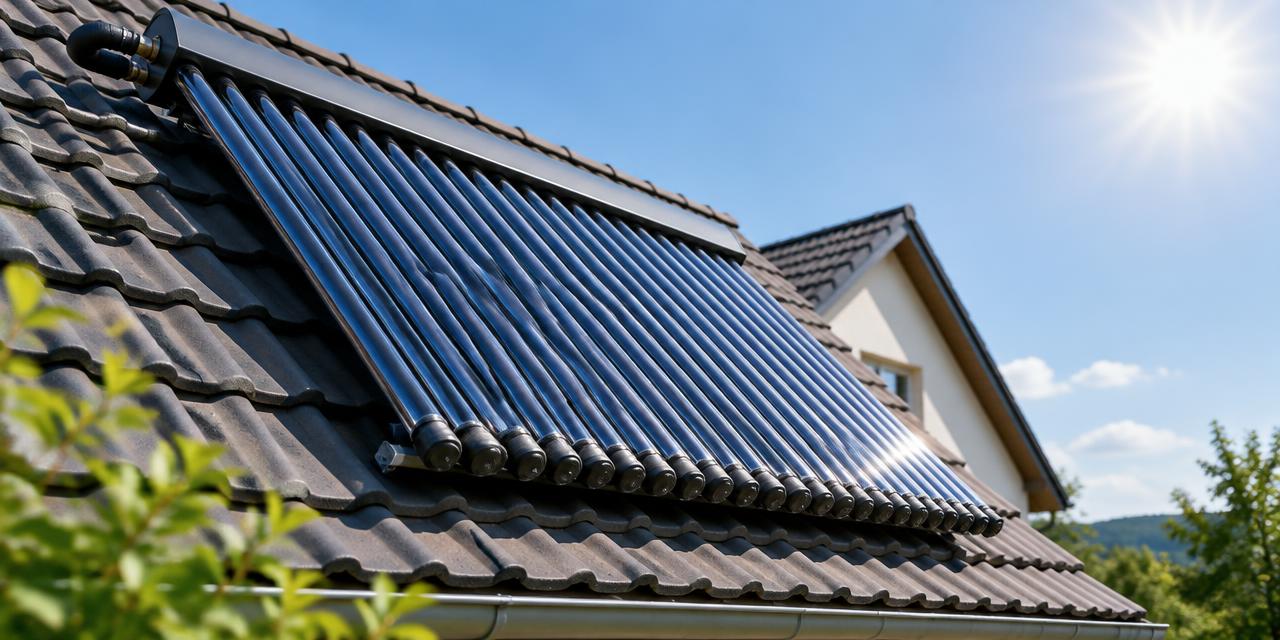
The choice of the type of thermal collector is decisive. Flat-plate collectors are often preferred for standard household needs, offering a good performance-to-cost ratio.
Vacuum tube collectors, although more expensive, provide better efficiency during cold periods or when sunlight is diffuse. The sizing of the hot water tank (boiler) must be calculated based on the number of occupants and the installed collector surface.
A rigorous sizing study is necessary, especially if you plan to couple your collectors with a heat pump, to ensure perfect hydraulic compatibility.
There are mounting options : integrated into the roof for optimal aesthetics or mounted above the cover. Each solution involves specifics in terms of waterproofing.
The regulation system is the brain of the installation; it optimizes heat transfer to the tank based on actual solar input.
Solar thermal collectors generally cover a large part of summer hot water, which considerably reduces the need for backup energy during this season.
Finally, the quality of heat transfer fluids and hydraulic components ensures the durability of your investment in the face of Lancy's climatic variations.
Lancy's real estate stock is diverse. For older buildings built before the 1990s, an asbestos diagnostic must be carried out before any intervention on the roof or distribution network.
The insulation of pipes is a critical point : in old networks, heat losses can be significant if pipes are not properly insulated. Upgrading pipe insulation during solar installation is highly recommended to maximize system efficiency.
The condition of the roof frame must also be assessed by a professional. The weight of the collectors and the fixings must comply with safety standards.
For newer buildings, integration is easier, but it must be ensured that the connection to the existing boiler does not degrade the performance of the overall system.
Solar thermal installations require a clean interface with existing heating systems to avoid circulation loop problems.
If in doubt, a comprehensive thermal analysis of the house makes it possible to identify whether prior insulation work would not be more profitable than the solar installation alone.
If your building is not subject to special heritage protection, a building permit is not required if the general installation conditions are met: for example, not exceeding the roof slopes by more than 20 cm, not being reflective, and forming a grouped unit for pitched roofs.
On flat roofs, collectors must not exceed the top edge by more than 1 meter and must not be visible from below at a 45-degree angle.
For buildings located in heritage protection areas, the rules are stricter. If your property is listed, registered in the inventory, or located in a sector of high heritage value, a building permit will be systematically required.
In these cases, installations must generally be laid flat on roof sections, flat roofs, or outbuildings. It is highly recommended to contact the Office de l'urbanisme before submitting any project to clarify your specific situation.
A complete file respecting these criteria will allow for rapid processing of your application by the competent authorities.
It is essential to respect the order of steps : you must absolutely submit your aid request before the start of work. An application submitted after the installation is completed will not be eligible for financial support.
To obtain details of the award criteria and view official forms, you can refer directly to the official energy website of the Canton of Geneva.
Initial investment in a thermal installation can also have interesting tax implications. In many cases, renovation costs aimed at improving the efficiency of your home can be deducted from your taxable income.
This possibility allows for reducing the net cost of your investment in the medium term. It is recommended to carefully keep all invoices related to the installation, materials, and assembly.
We advise you to consult a tax expert or the cantonal tax services to confirm the deductions applicable to your personal situation following the completion of solar work.
A solar thermal project follows several key steps. It all starts with a feasibility study and the choice of a qualified installer.
Once quotes are validated, the administrative step consists of submitting the aid request, and then, if necessary, the building permit application to the Office de l'urbanisme. Once authorizations are obtained, the material ordering phase is launched.
The actual execution of the project depends on the weather : it is preferable to avoid periods of deep freeze.
Although Lancy experiences about 66 frost days, the optimal period is in the spring or autumn to ensure safe working conditions for installers on the roof.
The project generally starts with setting up the mounting structure, followed by the installation of the solar collectors themselves. Next comes the hydraulic connection to the boiler and integration into the control system.
Commissioning includes pressure tests, filling the circuit with heat transfer fluid, and configuring control parameters. Once these steps are completed, the system is ready to operate. A final compliance check is often performed to validate the installation.
By following this structured progression, you ensure an efficient start-up of your solar system.
To ensure the success of your project, avoid some common mistakes. Never neglect the sizing study, as an improperly calibrated system will be either inefficient or unnecessarily expensive.
Don't forget to check the compatibility of your existing boiler before signing a quote. It is also risky not to clarify the building permit conditions with the municipality beforehand. Ensure that the installer offers durable components and a full warranty.
Never start work before receiving a positive response for your grant application.
Checklist before requesting quotes : Check the condition of your roof and its ability to support the weight of the collectors. Have a comprehensive energy audit of your building performed.
Ensure you have identified the best location for the collectors, ideally oriented towards the south. Gather all necessary documents regarding the cadastre of your plot. Check if your current boiler is ready for connection or if it requires replacement.
Systematically request several comparative quotes from certified local companies. Finally, ensure that each quote explicitly includes initial maintenance and commissioning of the system.
1. Estimate
Set a budget range with the estimator.
2. Grants
Apply before work starts.
3. Quotes
Compare at least 3 quotes.
4. Permit
Check with the municipality whether a permit is needed.
5. Works
Follow the site and do a written handover.
Depending on system sizing.
Geneva support for solar hot water production.
www.ge.chCheck amounts and conditions with the provider before signing: apply before work starts in most cases.
1212 Grand-Lancy · about 0 km
Thermex SA is a company specializing in heating, plumbing, ventilation, and air conditioning installations, with expertise in renewable energy.
thermex.ch1212 Grand-Lancy · about 0 km
Toitures 2000 Sàrl specializes in roof renovation, insulation, and solar equipment, as well as sheet metal work and roof windows.
toitures2000.ch1212 Grand-Lancy · about 0 km
Thermoptimum SA specializes in the installation, maintenance, and repair of heat pumps, solar thermal systems, and heating installations.
thermoptimum.ch1213 Petit-Lancy · about 0.9 km
DEM Technologies SA in Petit-Lancy installs and maintains plumbing, electrical, heating, ventilation and air-conditioning systems, as well as heat pumps, solar photovoltaic and solar thermal systems.
dem-technologies.chSuggestions from the commercial register by distance and activity. Not an endorsement or partnership.
It is possible if the installation meets precise criteria for landscape integration, such as not exceeding the roof slopes by more than 20 cm. The building must not be listed and the installation must be grouped on pitched roofs.
Solar thermal is primarily designed for sanitary hot water. In winter, efficiency decreases and it will always require a backup system, such as a boiler or a heat pump.
You must obtain a building permit. Panels often need to be laid flat and are limited to roof sections or flat roofs.
Yes, it is an excellent combination. However, it requires a rigorous sizing study to ensure optimal hydraulic compatibility.
Yes, this is an imperative rule. Any application sent after the start of work or completion of the project will be rejected.
Call a qualified heating engineer. He will check its age, its ability to receive a solar connection, and its thermal insulation.
Spring or autumn are recommended to avoid frost periods. This facilitates roof work and system commissioning.
Estimated solar yield
1'223 kWh/kWc/an
toit ~30° sud, PR 0.8, estimation
Altitude
421 m
Heating degree days
2'905 Kj/an
20/12 °C
Frost days
66 jours/an
Solar irradiation
1'390 kWh/m²/an
horizontal
Winter design temperature
-5.5 °C
1er percentile des minimales
Mean temperature
11.3 °C
Source : Open-Meteo Historical Weather API (réanalyse ERA5, moyenne 2015-2024) · swisstopo – service d'altitude (MNT)
Source : lancy.ch
These rules apply across the whole canton, not only in this town.
Permits
Source : Guide Installations Solaires et Thermopompes - Canton de Genève