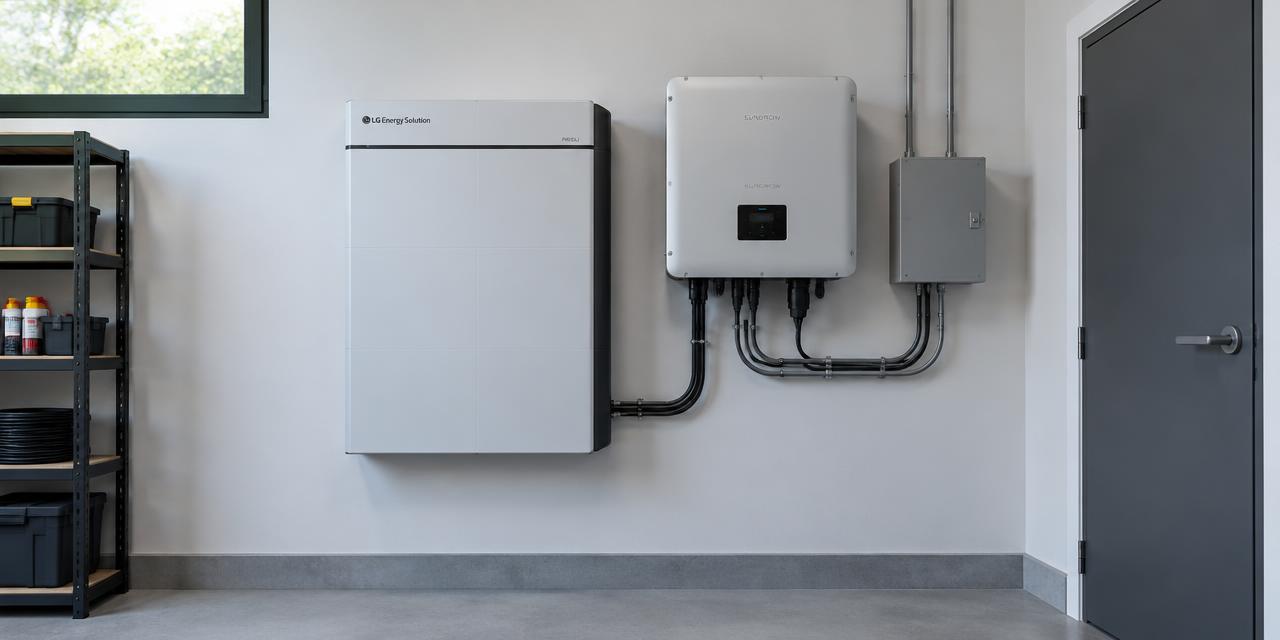
Solar storage battery in Yverdon-les-Bains: A comprehensive guide for homeowners
Installing a solar storage battery in Yverdon-les-Bains is a key step to optimize your solar self-consumption. This guide helps you navigate local requirements and the opportunities offered by your rooftop.
At a glance
Typical budget
CHF 7'900 – CHF 16'900
Midpoint
CHF 11'600
Grants found
0
Nearby companies
4
Worked examples in Yverdon-les-Bains
Small project
CHF 4'400 – CHF 10'000
Typical project
CHF 7'900 – CHF 16'900
Large project
CHF 13'600 – CHF 28'000
Project
Quantity
Low
High
Per unit
Small project
5 kWh
CHF 4'400
CHF 10'000
CHF 1'300
Typical project
10 kWh
CHF 7'900
CHF 16'900
CHF 1'200
Large project
18 kWh
CHF 13'600
CHF 28'000
CHF 1'100
Computed with our estimator for Yverdon-les-Bains (regional factor included), standard finish. Only the project size changes.
Cost split (typical project)
Labour :CHF 2'300(20 %)
Materials :CHF 8'100(70 %)
Other costs :CHF 1'200(10 %)
What the price covers
Included
Supply and installation
VAT
Battery, charge management and standard connection; options according to answers
Not included
Permits and architect fees
Unexpected structural issues
Possible subsidies
Solar panels and complete electrical refurbishment
Yverdon-les-Bains's housing stock in figures
In Yverdon-les-Bains, the federal building register lists 2'992 residential buildings and 15'846 dwellings. These municipal benchmarks help put your home in context, but do not replace an individual assessment.
68 %built before 1980
88 %heated by oil or gas
7.9 %electric hot water
9.3 %with declared solar thermal
Age of residential buildings
68 % built before 1980
Before 191918 %
1919–194519 %
1946–196016 %
1961–19708 %
1971–19807 %
1981–199011 %
1991–20006 %
2001–20107 %
Since 20119 %
Construction year does not reveal past renovations: check the current insulation condition.
Main heating energy
60 % · Gas
Gas60 %
Heating oil28 %
Heat pump6 %
Electricity3 %
District heating2 %
Wood2 %
This distribution describes recorded buildings, not your system's consumption or efficiency.
Heating and hot water: which energies?
Energy
Heating
Hot water
Gas
60 %
45.9 %
Heating oil
28 %
25.4 %
District heating
2 %
0.8 %
Heat pump
6 %
5.4 %
Electricity
3 %
7.9 %
Wood
2 %
1 %
Solar thermal
0 %
6.9 %
Each line gives the share of buildings using that energy, separately for heating and for hot water. The two columns do not always reach 100%: some buildings combine two systems, or reported none.
Type of heating system
Boiler (unspecified)64.5 %
Condensing boiler12.6 %
Heat pump10.6 %
Standard boiler6.5 %
Central electric heating2.4 %
Heat exchanger (district)1.5 %
Stove1.1 %
A standard non-condensing boiler is usually older and less efficient.
Houses or apartment buildings?
Single-family houses45.2 %
Two-dwelling houses10.1 %
Apartment buildings (3+)38.3 %
Other6.4 %
16.7 % of buildings mix housing with shops or offices.
The typical building
storeys (median)
3
median footprint
124 m²
median dwelling area
75 m²
Renovations, heritage and volumes
In Yverdon-les-Bains, RegBL data provides crucial insights for your renovation project. With 1 building officially protected out of 167 known entries, homeowners must engage with municipal authorities early regarding heritage permits. Regarding size, the median house volume is 808 m3 based on the SIA 416 standard, which is vital for calculating insulation or heating requirements. Please note that data coverage is partial, as only 244 houses have been measured out of 1352. Consequently, you should verify your property’s specific dimensions to ensure accurate cost estimations and appropriate planning for your building's scale.
1
buildings flagged as protected
status known for 167 of 2'803 buildings; check with the municipality
Why and when to undertake these works in Yverdon-les-Bains
With an altitude of 435 meters and significant annual solar irradiation of 1332 kWh/m², Yverdon-les-Bains offers an advantageous solar potential.
The city, certified as an Energy City and committed to an ambitious climate plan aiming for carbon neutrality by 2050, actively encourages the energy transition of its real estate stock.
Installing a battery becomes relevant as soon as your photovoltaic electricity production exceeds your daytime domestic consumption.
The local climate context, characterized by significant heating needs (2845 Kj/year) and about 49 frost days per year, underscores the importance of intelligent energy management.
Undertaking these works is ideal when you are renovating your heating system or electrical installations, to ensure optimal compatibility between your production and storage equipment.
Technical choices that influence the project
The choice of a battery depends primarily on the match between its capacity and your actual consumption, not just on the power of your solar panels.
A battery is particularly useful if your solar production significantly exceeds your daytime consumption, allowing you to cover your needs in the evening. It is essential to check technical compatibility with your existing inverter before any purchase.
In the market, lithium-ion technologies dominate, offering long life cycles and high energy density. Options vary depending on the type of inverter, either hybrid or AC-coupled.
Product ranges also differ by their discharge capacity and their ability to provide backup power in the event of a grid outage.
It is recommended to precisely define your annual consumption profile to properly size the installation and avoid over-investment that would not be cost-effective.
Specifics of the local building stock according to the construction period
In Yverdon-les-Bains, the real estate stock presents varied configurations, ranging from historical buildings to recent constructions.
For older buildings, it is crucial to check the condition of electrical installations, which are not always adapted to the integration of a modern storage system. A prior diagnosis is necessary to identify the need for upgrades.
For constructions before 1990, specific precautions must be taken, particularly regarding the potential presence of harmful substances like asbestos in structural or insulating elements.
Furthermore, the integration of batteries in basements or technical rooms must comply with strict ventilation and fire safety standards.
In areas where housing faces high pressure, as observed in Yverdon-les-Bains, any renovation must also be thought of in terms of sustainable energy optimization, taking into account building insulation to maximize the overall efficiency of the solar system.
Authorizations, rules and heritage in Yverdon-les-Bains
This guide does not establish a permit exemption. If your building or area is protected, check the constraints specific to your project.
Financial aid and taxation
This concerns the replacement of outdated installations and the addition of new elements in existing buildings. Note that if public subsidies are received, only the portion remaining at your expense is deductible.
The taxpayer has the choice, for each property and each tax period, between the deduction of actual costs and the flat-rate deduction.
However, if you choose actual costs (especially for your energy investments), you cannot claim the flat-rate deduction for that year.
If your investment costs exceed your net income for the year, the balance can be carried forward to the following two tax periods. It is imperative to carry out these steps before starting work to confirm the eligibility of your investments.
Calendar: Typical project schedule
The planning of a solar installation with a battery must take into account seasonal and administrative constraints.
Although Yverdon-les-Bains has about 49 frost days per year, indoor work for the inverter and battery is less sensitive to weather, but rooftop panel mounting is ideally carried out outside of extreme winter weather periods.
The process begins with a technical analysis and a quote request, followed by the validation of municipal administrative aspects if necessary. Once the components are validated, ordering and delivery precede the actual installation.
Electricians then proceed with the connection to the home network and the commissioning of the system.
It is recommended to provide a flexible schedule, as material supply and electrical compliance checks may vary, requiring close coordination between your installer and local authorities to ensure optimal startup before the peak summer production period.
Common errors to avoid and checklist before requesting quotes
A common mistake is sizing the battery based on the peak power of solar panels instead of basing it on your actual consumption during periods of low production. Ensure you have a clear view of your daily consumption, especially in the evening.
Another mistake is forgetting to verify compatibility with your existing inverter, which can make the project much more complex and expensive than expected.
Before requesting quotes, check the following points : determine if your current solar installation requires an update to support storage; ask your installer to confirm compatibility with the inverter; check with the municipality if heritage-related restrictions apply; ensure your installation location is secure, dry, and well-ventilated; compare the guaranteed lifespans of the batteries; and require a profitability calculation based on your actual consumption habits rather than optimistic theoretical simulations.
Your project in 5 steps
1. Estimate
Set a budget range with the estimator.
2. Grants
Apply before work starts.
3. Quotes
Compare at least 3 quotes.
4. Permit
Check with the municipality whether a permit is needed.
5. Works
Follow the site and do a written handover.
Grants and subsidies
No specific grant listed for this work. Maintenance tax deductions may still apply.
Companies in the area
Sedelec Yverdon-les-Bains, succursale de Sedelec SA Lausanne
1400 Yverdon-les-Bains · about 0 km
Specialist in electrotechnics, telecommunications, and security for individuals and businesses since 1981, member of the Burkhalter Group.
Note : La Ville d'Yverdon-les-Bains s'est dotée d'un Plan climat de 1ère génération en janvier 2023, suite à la déclaration d'urgence climatique par le Conseil communal en décembre 2019. Ce document vise à réduire les émissions de gaz à effet de serre et à renforcer la résilience du territoire. La Municipalité s'est engagée à réduire les émissions du territoire de 60% d'ici 2030 et à atteindre le zéro émission nette d'ici 2050. Pour l'administration communale, l'ambition est d'atteindre le zéro émission nette d'ici 2040. La ville a obtenu sa première certification Cité de l'Energie en 2010 et la recertification est en cours en 2023 avec un pourcentage de 81.8%.
Targets : Objectif climatique général:
- Réduction Territoire: Zéro émission net à 2050 (-60% émissions directes à 2030, -27% émissions indirectes à 2030).
- Réduction Administration: Zéro émission net à 2040 (-60% émissions directes à 2030).
- Adaptation: Dès maintenant Ville résiliente où il fait bon vivre. Protéger la population, les espèces vivantes et les biens face aux changements climatiques.
Climate plan : Plan climat de 1ère génération – Ville d’Yverdon-les-Bains
These rules apply across the whole canton, not only in this town.
Tax deductions
Note : Le contribuable peut choisir, lors de chaque période fiscale et pour chaque immeuble, entre la déduction des frais effectifs et la déduction forfaitaire. La déduction forfaitaire couvre les frais d'entretien, de remise en état d'immeubles acquis récemment, d'administration par des tiers, d'investissements énergétiques, de démolition et de primes d'assurances.
Carry-forward : Si les coûts d'investissement destinés à économiser l'énergie et à ménager l'environnement ou les frais de démolition en vue d'une construction de remplacement ne peuvent pas être entièrement pris en considération fiscalement durant l'année où ils ont été engagés, le solde peut être reporté sur les deux périodes fiscales suivantes. Les dépenses peuvent être reportées si le revenu net est négatif. Si des frais sont reportés, il n'est pas possible de faire valoir une déduction forfaitaire pendant cette période fiscale. En cas de déménagement en Suisse ou de transfert de la propriété de l'immeuble, le contribuable conserve le droit de déduire le solde des frais pouvant être reportés.
Maintenance costs : Le contribuable qui possède des immeubles privés peut déduire les frais nécessaires à leur entretien, les primes d'assurances relatives à ces immeubles et les frais d'administration par des tiers.
Energy investments : Sont réputés investissements destinés à économiser l'énergie et à ménager l'environnement les frais encourus en vue de rationaliser la consommation d'énergie ou de recourir aux énergies renouvelables. Ces investissements concernent le remplacement d'éléments de construction ou d'installations vétustes et l'adjonction d'éléments de construction ou d'installations dans des bâtiments existants. Si les mesures sont subventionnées par la collectivité publique, le contribuable ne peut déduire que les frais qu'il assume lui-même. Le taux de déduction est de 100%.