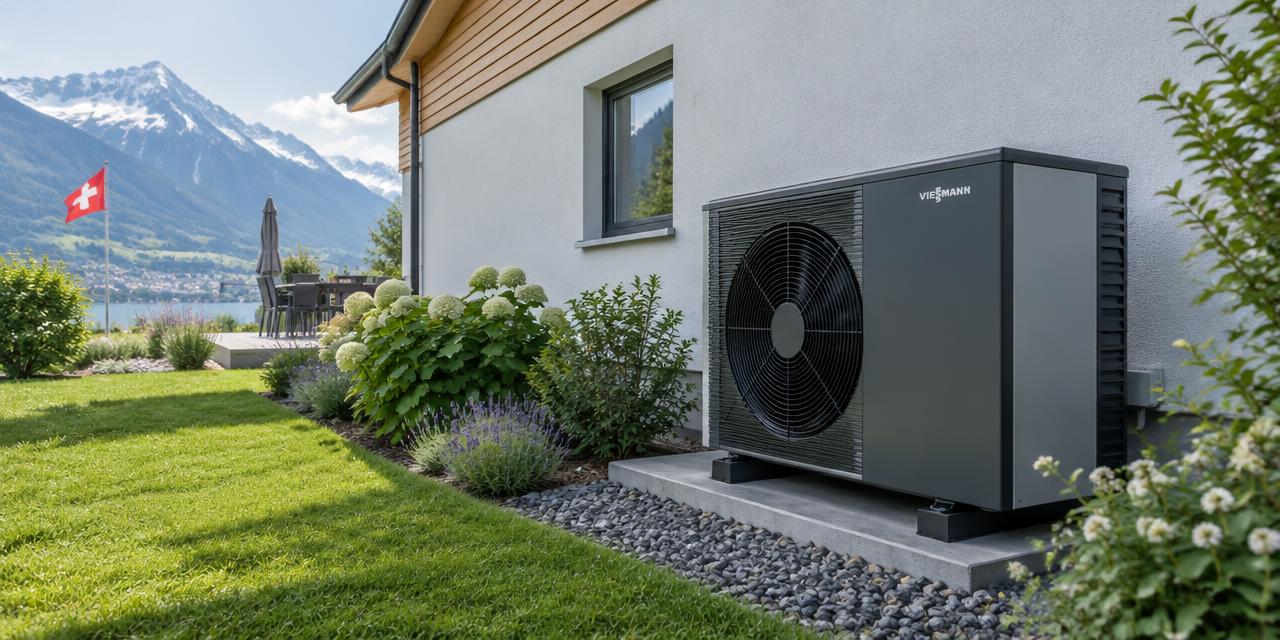
Successful heat pump installation in Yverdon-les-Bains requires rigorous planning in line with local climate goals. This guide supports homeowners through their technical and administrative steps.
At a glance
Typical budget
CHF 41'600 – CHF 77'500
Midpoint
CHF 58'200
Grants found
1
Nearby companies
4
Worked examples in Yverdon-les-Bains
Small project
CHF 32'900 – CHF 60'300
Typical project
CHF 41'600 – CHF 77'500
Large project
CHF 54'600 – CHF 103'300
Project
Quantity
Low
High
Per unit
Small project
80 m²
CHF 32'900
CHF 60'300
CHF 600
Typical project
160 m²
CHF 41'600
CHF 77'500
CHF 400
Large project
280 m²
CHF 54'600
CHF 103'300
CHF 300
Computed with our estimator for Yverdon-les-Bains (regional factor included), standard finish. Only the project size changes.
Cost split (typical project)
Labour :CHF 23'300(40 %)
Materials :CHF 29'100(50 %)
Other costs :CHF 5'800(10 %)
What the price covers
Included
Supply and installation
VAT
Heat pump and standard connections; removal and equipment only according to answers
Not included
Permits and architect fees
Unexpected structural issues
Possible subsidies
Drilling beyond 150 m, buried or contaminated tank, asbestos, insulation and new finishes
With air-to-air: hot water and ducts only if selected; adaptations beyond the options excluded
Yverdon-les-Bains's housing stock in figures
In Yverdon-les-Bains, the federal building register lists 2'992 residential buildings and 15'846 dwellings. These municipal benchmarks help put your home in context, but do not replace an individual assessment.
68 %built before 1980
88 %heated by oil or gas
7.9 %electric hot water
9.3 %with declared solar thermal
Age of residential buildings
68 % built before 1980
Before 191918 %
1919–194519 %
1946–196016 %
1961–19708 %
1971–19807 %
1981–199011 %
1991–20006 %
2001–20107 %
Since 20119 %
Construction year does not reveal past renovations: check the current insulation condition.
Main heating energy
60 % · Gas
Gas60 %
Heating oil28 %
Heat pump6 %
Electricity3 %
District heating2 %
Wood2 %
This distribution describes recorded buildings, not your system's consumption or efficiency.
Heating and hot water: which energies?
Energy
Heating
Hot water
Gas
60 %
45.9 %
Heating oil
28 %
25.4 %
District heating
2 %
0.8 %
Heat pump
6 %
5.4 %
Electricity
3 %
7.9 %
Wood
2 %
1 %
Solar thermal
0 %
6.9 %
Each line gives the share of buildings using that energy, separately for heating and for hot water. The two columns do not always reach 100%: some buildings combine two systems, or reported none.
Type of heating system
Boiler (unspecified)64.5 %
Condensing boiler12.6 %
Heat pump10.6 %
Standard boiler6.5 %
Central electric heating2.4 %
Heat exchanger (district)1.5 %
Stove1.1 %
A standard non-condensing boiler is usually older and less efficient.
Renovations, heritage and volumes
In Yverdon-les-Bains, RegBL data provides crucial insights for your renovation project. With 1 building officially protected out of 167 known entries, homeowners must engage with municipal authorities early regarding heritage permits. Regarding size, the median house volume is 808 m3 based on the SIA 416 standard, which is vital for calculating insulation or heating requirements. Please note that data coverage is partial, as only 244 houses have been measured out of 1352. Consequently, you should verify your property’s specific dimensions to ensure accurate cost estimations and appropriate planning for your building's scale.
1
buildings flagged as protected
status known for 167 of 2'803 buildings; check with the municipality
Why and when to undertake these works in Yverdon-les-Bains
Yverdon-les-Bains is committed to ambitious carbon neutrality by 2050, making the replacement of fossil fuel heating urgent. With an altitude of 435 meters and thermal requirements marked by 2845 heating degree-days, heating system performance is crucial.
The city, an Energy City label holder, actively promotes energy transition. Undertaking these works enhances your property value and aligns with the local climate plan.
It is recommended to plan your boiler replacement before a total failure forces a rushed decision. As the city focuses on sustainability, switching from oil to a heat pump is a logical step.
1 °C ensures a robust installation that withstands the 49 frost days per year, guaranteeing constant warmth.
Technical choices that influence the project
1 °C. This benchmark determines the necessary power. Several technologies exist: air-water heat pumps are common in urban areas.
It is essential to check if your neighborhood is connectable to the Y-CAD district heating network before choosing an individual system. If connection is impossible, the air-water HP must be selected according to its noise level to respect neighbors.
Choosing low-temperature emitters, such as underfloor heating, also affects overall performance. Coupling with PV panels is wise to use the 1332 kWh/m²/year of solar irradiation for self-consumption.
Compatibility with your current hydraulic network is needed for maximum efficiency.
Specifics of the local building stock according to the era of construction
The building stock in Yverdon-les-Bains is diverse. For older buildings, often less well-insulated, higher supply temperatures may be needed, which can lower the seasonal performance factor (SCOP).
Assessing the thermal envelope quality before installation is vital to avoid unnecessary oversizing. For buildings built before 1990, testing for hazardous substances like asbestos is highly advised before interfering with heating circuits.
Retrofitting obsolete hydraulic networks is often mandatory. Newer buildings often offer ideal configurations for high-performance air-water heat pumps.
In historic districts, maintain the exterior appearance; installations must be discreet to respect local heritage while meeting energy goals.
Authorizations, rules, and heritage in Yverdon-les-Bains
This guide does not establish a permit exemption. If your building or area is protected, check the constraints specific to your project.
Financial aid and taxation
Tax-wise, energy investments are 100% deductible from taxable income. You can choose between a flat-rate deduction or effective costs.
If investments are not fully deductible in the year of completion, the balance can be carried forward to the following two tax periods, provided you do not use the flat-rate deduction during those years.
Keep all invoices, as only costs borne by you after subsidies are tax-deductible.
Schedule: typical project flow
Planning a heat pump project includes several steps. Starting with a heat demand analysis and clarifying permits, the construction begins after subsidy approval. Installation involves dismantling the old system and installing new components.
Commissioning should ideally take place outside of extreme cold periods. Given the 49 frost days per year in Yverdon-les-Bains, efficient heating switching is important. The process ends with regulation parameter settings.
A structured schedule minimizes heating downtime. Plan for administrative deadlines and equipment availability in advance.
Common errors to avoid and checklist
A common error is neglecting insulation before installation, leading to inefficient systems. Always check if a district heating connection is possible. Never start without written subsidy approval. Respect noise limits for the outdoor unit.
Checklist before requesting quotes : check the age of your heat emitters; request a SCOP estimate; check electrical capacity; choose qualified contractors; plan for oil tank removal.1 °C. Careful preparation ensures a durable and efficient installation.
Your project in 5 steps
1. Estimate
Set a budget range with the estimator.
2. Grants
Apply before work starts.
3. Quotes
Compare at least 3 quotes.
4. Permit
Check with the municipality whether a permit is needed.
5. Works
Follow the site and do a written handover.
Grants and subsidies
Canton
Heat pump grant — Buildings Programme
Amount varies by heat pump type and capacity (typically several thousand francs).
Support for replacing fossil or electric heating with a heat pump via the Swiss Buildings Programme and the canton of Vaud.
Suggestions from the commercial register by distance and activity. Not an endorsement or partnership.
Frequently asked questions
What is the average lifespan of a heat pump in Yverdon-les-Bains?
A well-maintained heat pump generally lasts between 15 and 20 years. Rigorous annual maintenance helps maximize this longevity.
Do I need to replace my radiators to install a heat pump?
It is not always necessary, but low-temperature radiators or underfloor heating significantly improve the pump's efficiency.
Is the heat pump efficient during frost days in Yverdon?
Yes, if correctly sized for the external temperature of -5.1 °C, it will cover your thermal needs even in extreme cold.
Can I combine solar panels with my heat pump?
Absolutely, it is an excellent strategy to use self-consumption and reduce your annual electricity bills.
How to check if my neighborhood is connectable to district heating?
Contact the industrial services or the Y-CAD network manager directly to find out about connection possibilities in your area.
Is the permit procedure long?
In Yverdon-les-Bains, it is often a simplified procedure, but the duration depends on the completeness of your file and the specifics of your building.
What aid can I get for my heat pump?
You can benefit from grants from the Vaud Buildings Program. Do not forget to send your application before starting the works.
Note : La Ville d'Yverdon-les-Bains s'est dotée d'un Plan climat de 1ère génération en janvier 2023, suite à la déclaration d'urgence climatique par le Conseil communal en décembre 2019. Ce document vise à réduire les émissions de gaz à effet de serre et à renforcer la résilience du territoire. La Municipalité s'est engagée à réduire les émissions du territoire de 60% d'ici 2030 et à atteindre le zéro émission nette d'ici 2050. Pour l'administration communale, l'ambition est d'atteindre le zéro émission nette d'ici 2040. La ville a obtenu sa première certification Cité de l'Energie en 2010 et la recertification est en cours en 2023 avec un pourcentage de 81.8%.
Targets : Objectif climatique général:
- Réduction Territoire: Zéro émission net à 2050 (-60% émissions directes à 2030, -27% émissions indirectes à 2030).
- Réduction Administration: Zéro émission net à 2040 (-60% émissions directes à 2030).
- Adaptation: Dès maintenant Ville résiliente où il fait bon vivre. Protéger la population, les espèces vivantes et les biens face aux changements climatiques.
Climate plan : Plan climat de 1ère génération – Ville d’Yverdon-les-Bains
These rules apply across the whole canton, not only in this town.
Tax deductions
Note : Le contribuable peut choisir, lors de chaque période fiscale et pour chaque immeuble, entre la déduction des frais effectifs et la déduction forfaitaire. La déduction forfaitaire couvre les frais d'entretien, de remise en état d'immeubles acquis récemment, d'administration par des tiers, d'investissements énergétiques, de démolition et de primes d'assurances.
Carry-forward : Si les coûts d'investissement destinés à économiser l'énergie et à ménager l'environnement ou les frais de démolition en vue d'une construction de remplacement ne peuvent pas être entièrement pris en considération fiscalement durant l'année où ils ont été engagés, le solde peut être reporté sur les deux périodes fiscales suivantes. Les dépenses peuvent être reportées si le revenu net est négatif. Si des frais sont reportés, il n'est pas possible de faire valoir une déduction forfaitaire pendant cette période fiscale. En cas de déménagement en Suisse ou de transfert de la propriété de l'immeuble, le contribuable conserve le droit de déduire le solde des frais pouvant être reportés.
Maintenance costs : Le contribuable qui possède des immeubles privés peut déduire les frais nécessaires à leur entretien, les primes d'assurances relatives à ces immeubles et les frais d'administration par des tiers.
Energy investments : Sont réputés investissements destinés à économiser l'énergie et à ménager l'environnement les frais encourus en vue de rationaliser la consommation d'énergie ou de recourir aux énergies renouvelables. Ces investissements concernent le remplacement d'éléments de construction ou d'installations vétustes et l'adjonction d'éléments de construction ou d'installations dans des bâtiments existants. Si les mesures sont subventionnées par la collectivité publique, le contribuable ne peut déduire que les frais qu'il assume lui-même. Le taux de déduction est de 100%.
Legal basis : LATC et RLATC (BLV 700.11 et 700.11.1)
Competent authority : Commune concernée, avec consultation des services cantonaux selon le projet
Heat pump : Pour certaines pompes à chaleur desservant un bâtiment existant, une procédure d’annonce est prévue par l’article 68c RLATC, sous conditions. Si les conditions ne sont pas remplies, une procédure de permis de construire est nécessaire. Vérifiez votre cas auprès de la commune.
Procedure : La procédure dépend de la nature des travaux et de la situation du bâtiment ; la commune confirme la procédure applicable.