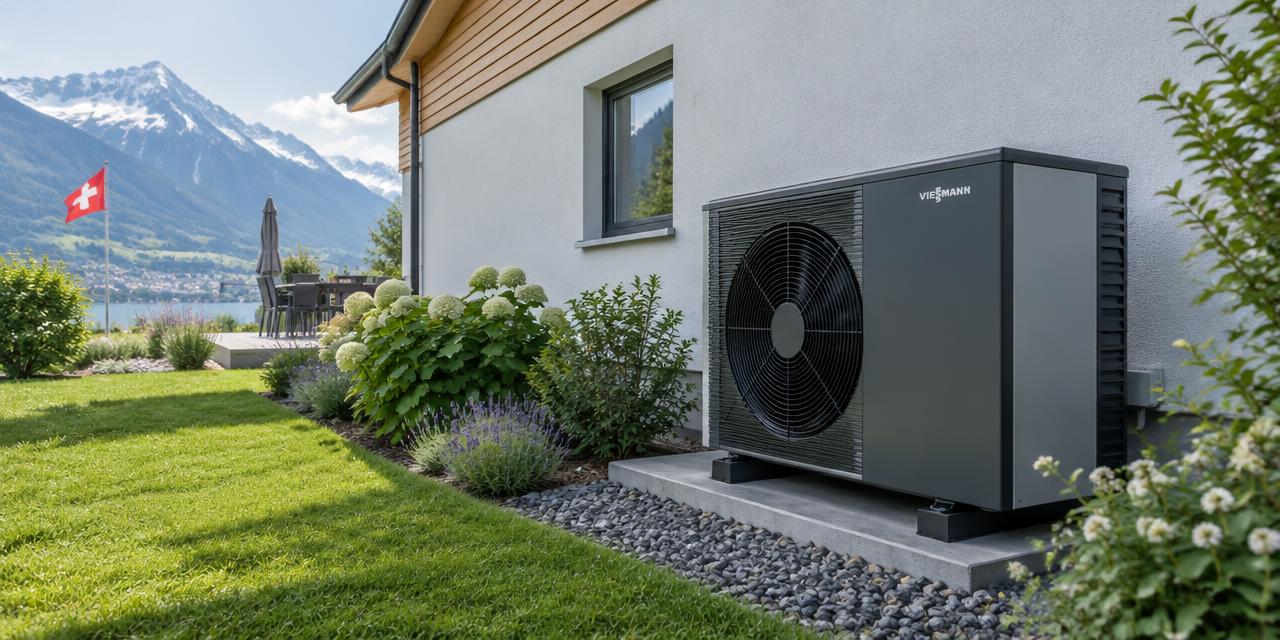
Heat pump installation in Lausanne: A comprehensive guide for homeowners
Are you considering upgrading your heating system in Lausanne? This guide details the essential steps for a successful heat pump installation while complying with local standards.
At a glance
Typical budget
CHF 41'600 – CHF 77'500
Midpoint
CHF 58'200
Grants found
2
Nearby companies
4
Worked examples in Lausanne
Small project
CHF 32'900 – CHF 60'300
Typical project
CHF 41'600 – CHF 77'500
Large project
CHF 54'600 – CHF 103'300
Project
Quantity
Low
High
Per unit
Small project
80 m²
CHF 32'900
CHF 60'300
CHF 600
Typical project
160 m²
CHF 41'600
CHF 77'500
CHF 400
Large project
280 m²
CHF 54'600
CHF 103'300
CHF 300
Computed with our estimator for Lausanne (regional factor included), standard finish. Only the project size changes.
Cost split (typical project)
Labour :CHF 23'300(40 %)
Materials :CHF 29'100(50 %)
Other costs :CHF 5'800(10 %)
What the price covers
Included
Supply and installation
VAT
Heat pump and standard connections; removal and equipment only according to answers
Not included
Permits and architect fees
Unexpected structural issues
Possible subsidies
Drilling beyond 150 m, buried or contaminated tank, asbestos, insulation and new finishes
With air-to-air: hot water and ducts only if selected; adaptations beyond the options excluded
Lausanne's housing stock in figures
In Lausanne, the federal building register lists 9'079 residential buildings and 82'705 dwellings. These municipal benchmarks help put your home in context, but do not replace an individual assessment.
76 %built before 1980
75 %heated by oil or gas
4.4 %electric hot water
6.6 %with declared solar thermal
Age of residential buildings
76 % built before 1980
Before 191923 %
1919–194522 %
1946–196017 %
1961–19709 %
1971–19805 %
1981–19906 %
1991–20004 %
2001–20106 %
Since 20118 %
Construction year does not reveal past renovations: check the current insulation condition.
Main heating energy
43 % · Gas
Gas43 %
Heating oil32 %
District heating19 %
Heat pump3 %
Electricity2 %
Wood2 %
This distribution describes recorded buildings, not your system's consumption or efficiency.
Heating and hot water: which energies?
Energy
Heating
Hot water
Gas
43 %
35.6 %
Heating oil
32 %
29.7 %
District heating
19 %
18.3 %
Heat pump
3 %
2.3 %
Electricity
2 %
4.4 %
Wood
2 %
1.3 %
Solar thermal
0 %
4.7 %
Each line gives the share of buildings using that energy, separately for heating and for hot water. The two columns do not always reach 100%: some buildings combine two systems, or reported none.
Type of heating system
Boiler (unspecified)53.6 %
Heat exchanger (district)18.6 %
Condensing boiler10.9 %
Standard boiler7.8 %
Heat pump6.9 %
Central electric heating1.2 %
Stove0.6 %
A standard non-condensing boiler is usually older and less efficient.
Renovations, heritage and volumes
For your renovation projects in Lausanne, RegBL data provides essential insights. With 867 buildings under heritage protection out of 1951 identified, verifying your property's status and contacting the municipality early for permit requirements is vital. Additionally, the median house volume for the 2328 buildings is 850 m3, calculated using the SIA 416 standard. These volumetric figures, based on a measured sample of 350 units, are crucial for scaling your upcoming insulation or heating system upgrades. Please note that data coverage is partial for these indicators, so careful planning remains necessary for your specific renovation goals.
867
buildings flagged as protected
status known for 1'951 of 8'708 buildings; check with the municipality
Lausanne demonstrates a strong commitment to carbon neutrality by 2050, supported by its European Energy Award Gold label. Replacing a fossil fuel or electric heating system with a heat pump is becoming a priority to reduce your environmental footprint.
8°C, the Lausanne climate requires high-performance equipment capable of operating effectively despite these rigorous conditions.
The local housing stock, which includes about 24% of single-family homes, offers significant renovation potential. Planning this transition early, especially if your current installation is nearing its end-of-life, allows for a smooth upgrade.
Before starting, systematically check if your neighborhood is not already prioritized for connection to the Lausanne district heating network, managed by SiL, an alternative solution often favored in dense urban areas.
Technical options for your installation
The choice of heat pump model depends largely on your building's configuration and existing heat distribution system. An air-to-water heat pump is often chosen to replace an oil boiler, as it can be adapted to conventional radiators.
It is crucial to note that the local winter design temperature determines the power required by the heat pump to ensure optimal thermal comfort during the coldest periods of the year.
Among the options, outdoor air-to-water heat pumps require careful attention regarding noise. You must strictly comply with noise limits imposed on neighbors.
It is also advisable to consider a combination with photovoltaic panels, as the solar potential in Lausanne is estimated at approximately 1199 kWh/kWc/year.
Finally, the equipment grade will influence not only its annual efficiency but also its durability and remote control features, thus optimizing your energy consumption in the long term.
Specifics of Lausanne's building stock and precautions
Lausanne's building stock is diverse, relying on strict cantonal and municipal architectural inventories.
For buildings constructed before 1990, particular attention is required regarding the potential presence of asbestos in old heating systems or pipe insulation.
Before any intervention, it is imperative to conduct a comprehensive diagnostic to avoid releasing dangerous substances during the dismantling of the old installation.
The quality of overall thermal insulation is also decisive. A heat pump is more efficient when the building is well insulated. If your home is older, consider coupling the heating replacement with improvements to the thermal envelope.
The diversity of Lausanne's buildings, including protected areas, also requires checking whether aesthetic constraints apply to the location of the outdoor unit, especially if it alters the external appearance of your building.
Authorizations and heritage regulations
This guide does not establish a permit exemption. If your building or area is protected, check the constraints specific to your project.
Financial aid and taxation
The amount varies depending on the type of heat pump and the installed power. In Lausanne, the City also offers coverage of 50% of the Energy Project Management Assistance (AMOén) mandate, up to 10,000 CHF, thus facilitating your technical support.
Regarding taxes, investments aimed at saving energy are 100% deductible. If these costs cannot be fully deducted in the year they are incurred, the balance can be carried forward to the following two tax periods.
Note that if public subsidies are received, you can only deduct the costs actually assumed by yourself. Important: all subsidy applications must be submitted before the start of the work to be eligible.
Schedule and construction process
The execution of such a project requires rigorous planning. The first step is to carry out an energy audit or to commission a professional to evaluate the necessary power, taking into account the local design temperature.
Once the technical choice is validated and subsidy applications have been submitted, the phase of obtaining quotes and administrative authorization can begin. It is crucial to wait for the validation of the grants before signing any firm contract.
The construction site itself includes dismantling the old installation, preparing the hydraulic and electrical connections, and installing the new heat pump. Commissioning and adjusting the unit are decisive steps to guarantee the promised energy efficiency.
To avoid periods of extreme cold, it is often preferable to plan the work outside the winter season, although the total duration will depend on the complexity of the necessary adaptations to your internal heating network.
Common errors and checklist before quotes
Never neglect the energy audit step before choosing the power of your heat pump, as an oversized machine loses efficiency. Systematically check if your neighborhood does not depend on a priority district heating network before incurring costs.
Ensure that the outdoor location complies with noise standards, as neighborhood complaints are a frequent source of conflict. Finally, do not forget to submit your grant applications before signing a quote, otherwise you will lose your eligibility.
Checklist before requesting quotes : Check the state of your current thermal insulation. Identify the ideal location for the outdoor unit, taking into account distances to neighbors. Contact SiL to check eligibility for district heating.
Obtain an asbestos diagnostic for older buildings. Request at least three detailed quotes from qualified companies. Ensure the sizing of the heat pump takes into account Lausanne's frost days. Check the conditions for obtaining cantonal subsidies.
Your project in 5 steps
1. Estimate
Set a budget range with the estimator.
2. Grants
Apply before work starts.
3. Quotes
Compare at least 3 quotes.
4. Permit
Check with the municipality whether a permit is needed.
5. Works
Follow the site and do a written handover.
Grants and subsidies
Canton
Heat pump grant — Buildings Programme
Amount varies by heat pump type and capacity (typically several thousand francs).
Support for replacing fossil or electric heating with a heat pump via the Swiss Buildings Programme and the canton of Vaud.
Lausanne - Accompagnement Rénovations & AMO Énergie
Jusqu'à 10'000 CHF (50% de l'audit/AMO)
Prise en charge par la Ville de Lausanne de 50% du mandat d'Assistance à Maîtrise d'Ouvrage Énergie (AMOén) jusqu'à 10'000 CHF, et accompagnement technique GROUP-IT pour la sortie des énergies fossiles vers la PAC.
Check amounts and conditions with the provider before signing: apply before work starts in most cases.
Companies in the area
AZ ingénieurs SA
1010 Lausanne · about 0.5 km
AZ ingénieurs SA in Lausanne is an engineering consultancy specialising in building services design and project delivery, building physics and energy optimisation.
Suggestions from the commercial register by distance and activity. Not an endorsement or partnership.
Frequently asked questions
What aid is available in Lausanne?
You can benefit from cantonal subsidies via the Building Program for replacing fossil fuel heating. The City of Lausanne also covers up to 10,000 CHF, or 50% of the project management assistance for your project.
Is a building permit mandatory?
Generally, the installation is subject to a simplified procedure or an exemption from a permit. However, you must consult the municipality, especially if the building is protected or in a sensitive zone.
Must I connect to district heating?
Lausanne's territorial energy planning prioritizes connection to district heating when eligible. Check this priority with the Services Industriels de Lausanne before making any other decision.
Is it possible to deduct these works from my taxes?
Yes, investments aimed at saving energy are 100% deductible. The non-deducted balance can be carried forward to the following two tax periods.
What to do if my building dates from before 1990?
An asbestos diagnostic is imperative to secure the site. You must also check the efficiency of your current thermal insulation to guarantee the performance of the heat pump.
What are the noise constraints?
Air-to-water heat pumps must strictly respect the noise limits imposed on neighbors. A thoughtful location is crucial to avoid any conflict.
When is the best time to replace my heating?
It is preferable to plan the work outside the winter season. Also anticipate the process by requesting aid before signing any contract.
Note : Lausanne est la première ville européenne à obtenir le label European Energy Award® GOLD en 2004. Elle confirme sa place parmi les villes suisses les plus engagées en matière de politique énergétique et climatique avec 89,9% des objectifs atteints.
Targets : Labellisée Cité de l'énergie depuis 1996, Lausanne renouvelle en 2026 sa distinction Gold avec un résultat de 89,9%. Cette nouvelle évaluation repose sur un catalogue de mesures adapté aux enjeux de la neutralité carbone à l'horizon 2050. Il intègre notamment le développement de la mobilité électrique et la prise en compte de l'énergie grise dans les bâtiments.
These rules apply across the whole canton, not only in this town.
Tax deductions
Note : Le contribuable peut choisir, lors de chaque période fiscale et pour chaque immeuble, entre la déduction des frais effectifs et la déduction forfaitaire. La déduction forfaitaire couvre les frais d'entretien, de remise en état d'immeubles acquis récemment, d'administration par des tiers, d'investissements énergétiques, de démolition et de primes d'assurances.
Carry-forward : Si les coûts d'investissement destinés à économiser l'énergie et à ménager l'environnement ou les frais de démolition en vue d'une construction de remplacement ne peuvent pas être entièrement pris en considération fiscalement durant l'année où ils ont été engagés, le solde peut être reporté sur les deux périodes fiscales suivantes. Les dépenses peuvent être reportées si le revenu net est négatif. Si des frais sont reportés, il n'est pas possible de faire valoir une déduction forfaitaire pendant cette période fiscale. En cas de déménagement en Suisse ou de transfert de la propriété de l'immeuble, le contribuable conserve le droit de déduire le solde des frais pouvant être reportés.
Maintenance costs : Le contribuable qui possède des immeubles privés peut déduire les frais nécessaires à leur entretien, les primes d'assurances relatives à ces immeubles et les frais d'administration par des tiers.
Energy investments : Sont réputés investissements destinés à économiser l'énergie et à ménager l'environnement les frais encourus en vue de rationaliser la consommation d'énergie ou de recourir aux énergies renouvelables. Ces investissements concernent le remplacement d'éléments de construction ou d'installations vétustes et l'adjonction d'éléments de construction ou d'installations dans des bâtiments existants. Si les mesures sont subventionnées par la collectivité publique, le contribuable ne peut déduire que les frais qu'il assume lui-même. Le taux de déduction est de 100%.
Legal basis : LATC et RLATC (BLV 700.11 et 700.11.1)
Competent authority : Commune concernée, avec consultation des services cantonaux selon le projet
Heat pump : Pour certaines pompes à chaleur desservant un bâtiment existant, une procédure d’annonce est prévue par l’article 68c RLATC, sous conditions. Si les conditions ne sont pas remplies, une procédure de permis de construire est nécessaire. Vérifiez votre cas auprès de la commune.
Procedure : La procédure dépend de la nature des travaux et de la situation du bâtiment ; la commune confirme la procédure applicable.