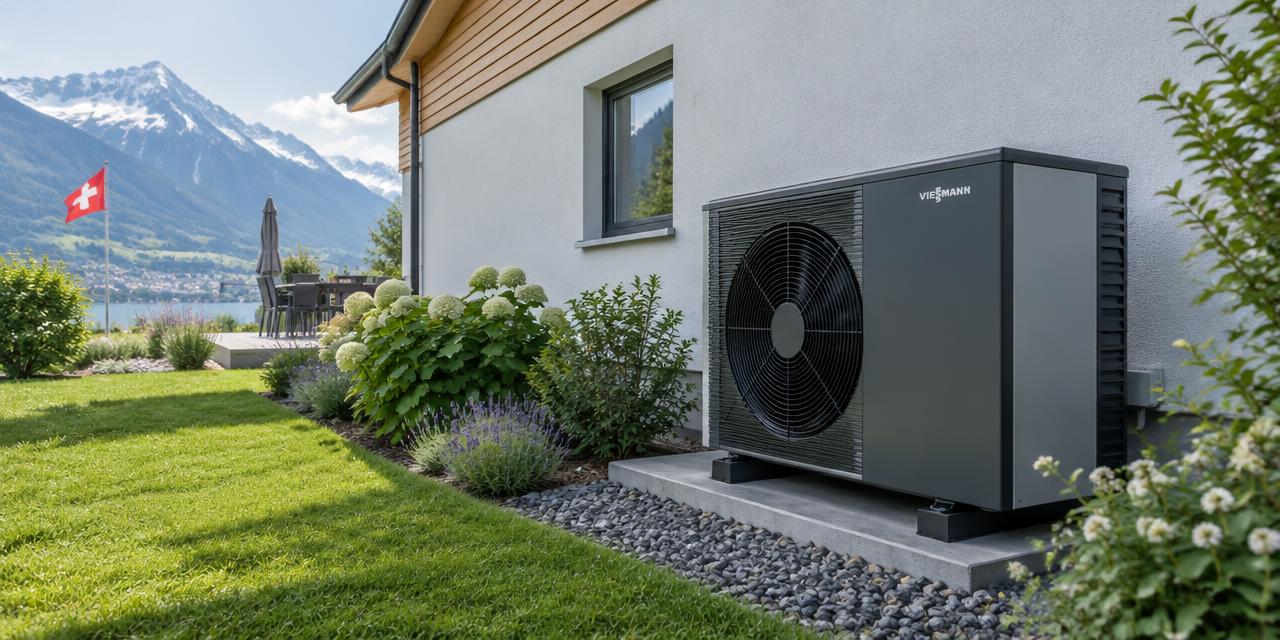
Heat Pump Installation in Vevey: A Comprehensive Guide for Homeowners
Are you planning to replace your aging heating system with a heat pump in Vevey? This guide will support you step-by-step in achieving a successful energy transition while respecting local specificities.
At a glance
Typical budget
CHF 41'600 – CHF 77'500
Midpoint
CHF 58'200
Grants found
1
Nearby companies
4
Worked examples in Vevey
Small project
CHF 32'900 – CHF 60'300
Typical project
CHF 41'600 – CHF 77'500
Large project
CHF 54'600 – CHF 103'300
Project
Quantity
Low
High
Per unit
Small project
80 m²
CHF 32'900
CHF 60'300
CHF 600
Typical project
160 m²
CHF 41'600
CHF 77'500
CHF 400
Large project
280 m²
CHF 54'600
CHF 103'300
CHF 300
Computed with our estimator for Vevey (regional factor included), standard finish. Only the project size changes.
Cost split (typical project)
Labour :CHF 23'300(40 %)
Materials :CHF 29'100(50 %)
Other costs :CHF 5'800(10 %)
What the price covers
Included
Supply and installation
VAT
Heat pump and standard connections; removal and equipment only according to answers
Not included
Permits and architect fees
Unexpected structural issues
Possible subsidies
Drilling beyond 150 m, buried or contaminated tank, asbestos, insulation and new finishes
With air-to-air: hot water and ducts only if selected; adaptations beyond the options excluded
Vevey's housing stock in figures
In Vevey, the federal building register lists 1'246 residential buildings and 11'124 dwellings. These municipal benchmarks help put your home in context, but do not replace an individual assessment.
84 %built before 1980
89 %heated by oil or gas
5.1 %electric hot water
6.2 %with declared solar thermal
Age of residential buildings
84 % built before 1980
Before 191930 %
1919–194520 %
1946–196020 %
1961–19709 %
1971–19805 %
1981–19905 %
1991–20003 %
2001–20105 %
Since 20114 %
Construction year does not reveal past renovations: check the current insulation condition.
Main heating energy
63 % · Gas
Gas63 %
Heating oil26 %
District heating5 %
Heat pump4 %
Wood2 %
Electricity1 %
This distribution describes recorded buildings, not your system's consumption or efficiency.
Heating and hot water: which energies?
Energy
Heating
Hot water
Gas
63 %
56.4 %
Heating oil
26 %
24.6 %
District heating
5 %
3.3 %
Heat pump
4 %
3.3 %
Electricity
1 %
5.1 %
Wood
2 %
1.8 %
Solar thermal
0 %
3.5 %
Each line gives the share of buildings using that energy, separately for heating and for hot water. The two columns do not always reach 100%: some buildings combine two systems, or reported none.
Type of heating system
Boiler (unspecified)60.7 %
Condensing boiler17.3 %
Standard boiler8.3 %
Heat pump6.5 %
Heat exchanger (district)4.5 %
Stove1.7 %
A standard non-condensing boiler is usually older and less efficient.
Renovations, heritage and volumes
For renovation planning in Vevey, official building register data shows only partial coverage, with 9 protected buildings identified among 196 known structures out of 1171 total entries, necessitating early consultation with local authorities regarding permits. Furthermore, the median house volume is 958.5 cubic meters based on the SIA 416 standard, derived from 62 measurements among 298 recorded houses. Understanding this volume is vital for homeowners, as it dictates the scale of necessary heating and insulation works.
9
buildings flagged as protected
status known for 196 of 1'171 buildings; check with the municipality
The city of Vevey, which holds the GOLD Energy City label, pursues an ambitious climate policy.3 °C and approximately 22 frost days per year, the local building stock requires high-performance systems.
Replacing a fossil fuel heating system with a heat pump allows you to sustainably reduce your carbon footprint while enhancing the value of your real estate in a municipality that actively encourages renovation through the 'Vevey Rénove' program.
The ideal time to act is generally when your current boiler reaches the end of its life. By planning ahead, you avoid hasty decisions.
Additionally, it is crucial to first verify whether your neighborhood can be connected to the Vevey district heating network, managed by Groupe E, as a connection obligation may apply according to Art. 25 para. 2 LVLEne for major transformations.
Technical choices that influence the project
The choice of heat pump system depends mainly on the configuration of your home. Air-to-water heat pumps are common but require particular attention regarding noise, as they must comply with limits towards neighbors.
A precise thermal study allows for the determination of the necessary power while taking into account the local design outdoor temperature.
There are different quality levels and options, such as coupling with photovoltaic panels, favored by a global irradiation of 1352 kWh/m²/year in Vevey.
The use of geothermal probes or more compact systems will depend on your available space and the nature of your soil.
Regardless of your choice, ensure that the equipment is sized for the region's specific climatic conditions to optimize the seasonal performance factor of your future installation.
Specificities of the local building stock according to the construction era
Vevey has a diverse building heritage. For buildings constructed before 1990, particular attention must be paid to the potential presence of pollutants, such as asbestos, during demolition or transformation work.
Before installing a heat pump, it is recommended to carry out an energy audit to assess whether your current insulation allows for optimal operation of the low-temperature system.
The Vevey district heating network offers an interesting alternative for certain buildings, especially if a major thermal renovation is technically difficult to achieve.
In ISOS-listed areas, as is the case for a large part of the city center, aesthetic and conservation constraints may limit exterior modifications.
It is therefore essential to check the specific rules of the communal land use plan for your area before starting work that impacts the exterior appearance of your building, in order to avoid any intervention that does not comply with the site requirements.
Authorizations, rules, and heritage in Vevey
This guide does not establish a permit exemption. If your building or area is protected, check the constraints specific to your project.
Financial aid and taxation
It is mandatory to submit your grant application before starting the work, otherwise you may lose your right to this aid. This step is a priority to reduce the cost of your investment.
From a tax perspective, investments intended to save energy are 100% deductible. In the case of high costs, the balance can be carried forward to the two following tax periods if the expenses cannot be fully taken into account in the year they were incurred.
Note, however, that by opting for this deduction, you cannot benefit from the flat-rate deduction for the maintenance of your property that year.
Consult your tax administration regarding the conditions for combining these deductions, as the choice depends on your personal situation and other work carried out on your property.
Schedule: Typical workflow of the project
The execution of a heat pump project follows several structured steps. Everything begins with a feasibility study and the choice of the installer, followed by the submission of the necessary permit applications to the municipality.
Once permits are obtained and subsidies approved, work can begin. It is preferable to plan the installation outside of periods of extreme cold so as not to penalize the thermal comfort of your home during the transition.
The project itself generally includes decommissioning the old installation, connection work, installation of the outdoor unit, and setting up the regulation.
The total duration will depend on technical complexity, especially if hydraulic distribution work needs to be adapted. A final commissioning is essential to verify the performance of the installation and its proper operation.
Anticipate these steps several months in advance to be ready before the winter season.
Common mistakes to avoid and checklist before requesting quotes
To make your project a success, avoid neglecting the insulation of your home, as a heat pump will be less efficient in a poorly insulated building.
Never choose an oversized capacity, which would lead to premature wear of the compressor and unnecessary consumption.
Also, make sure to carefully check the noise level of the outdoor unit so as not to disturb the tranquility of the neighborhood, in accordance with local recommendations.
Before requesting quotes, check if your neighborhood can be connected to the priority district heating system. Request several comparative quotes detailing costs and services.
Verify that the installer provides a thermal study based on Vevey's design temperatures. Ensure that the subsidy application is ready to be sent before signing any contract.
Finally, list your precise needs for domestic hot water and heating, and do not forget to include future maintenance aspects in your discussions with the providers.
Your project in 5 steps
1. Estimate
Set a budget range with the estimator.
2. Grants
Apply before work starts.
3. Quotes
Compare at least 3 quotes.
4. Permit
Check with the municipality whether a permit is needed.
5. Works
Follow the site and do a written handover.
Grants and subsidies
Canton
Heat pump grant — Buildings Programme
Amount varies by heat pump type and capacity (typically several thousand francs).
Support for replacing fossil or electric heating with a heat pump via the Swiss Buildings Programme and the canton of Vaud.
Based in Vevey, Roth SA designs, installs and maintains heating, ventilation and air conditioning systems, focusing on air treatment in the cantons of Vaud, Valais and Fribourg.
Suggestions from the commercial register by distance and activity. Not an endorsement or partnership.
Frequently asked questions
What aid is available in Vevey?
You can apply for subsidies via the 'Buildings Program' for the replacement of your fossil fuel heating with a heat pump. It is essential to submit the application before signing any quote.
Is a building permit required?
The installation is generally subject to a simplified procedure in the canton of Vaud. Contact the municipality to confirm the requirements specific to your zone.
Is district heating mandatory?
Yes, according to Art. 25 para. 2 LVLEne, connection is mandatory in certain zones if the network passes nearby during a boiler replacement.
How to manage heat pump noise with neighbors?
Vevey enforces rules on noise nuisances. Choose a quiet model and position the outdoor unit away from your neighbors' windows.
Can heat pump costs be deducted from taxes?
Yes, energy investments are 100% deductible. If necessary, you can carry forward the balance to the following two years.
What is the design temperature in Vevey?
The local design temperature is -2.3 °C. Your installer must use this to ensure adequate power.
Which zones are protected in Vevey?
The city center of Vevey is ISOS-listed. Exterior modifications are strictly regulated there to preserve heritage.
Note : La Ville de Vevey a reçu son 7ème label Cité de l'énergie en 2025 (pour la période à partir de 2026), avec un score de 87% (81.6% lors du ré-audit précédent en 2021). Elle a obtenu le label GOLD dès 2012. Le rapport d'audit 2025 met en évidence une politique énergétique et climatique ambitieuse s'appuyant sur un Plan directeur communal, un Plan climat communal et une Planification énergétique territoriale. La Ville a également lancé le programme "Vevey Rénove" en 2022 pour augmenter le taux de rénovation du parc bâti.
These rules apply across the whole canton, not only in this town.
Tax deductions
Note : Le contribuable peut choisir, lors de chaque période fiscale et pour chaque immeuble, entre la déduction des frais effectifs et la déduction forfaitaire. La déduction forfaitaire couvre les frais d'entretien, de remise en état d'immeubles acquis récemment, d'administration par des tiers, d'investissements énergétiques, de démolition et de primes d'assurances.
Carry-forward : Si les coûts d'investissement destinés à économiser l'énergie et à ménager l'environnement ou les frais de démolition en vue d'une construction de remplacement ne peuvent pas être entièrement pris en considération fiscalement durant l'année où ils ont été engagés, le solde peut être reporté sur les deux périodes fiscales suivantes. Les dépenses peuvent être reportées si le revenu net est négatif. Si des frais sont reportés, il n'est pas possible de faire valoir une déduction forfaitaire pendant cette période fiscale. En cas de déménagement en Suisse ou de transfert de la propriété de l'immeuble, le contribuable conserve le droit de déduire le solde des frais pouvant être reportés.
Maintenance costs : Le contribuable qui possède des immeubles privés peut déduire les frais nécessaires à leur entretien, les primes d'assurances relatives à ces immeubles et les frais d'administration par des tiers.
Energy investments : Sont réputés investissements destinés à économiser l'énergie et à ménager l'environnement les frais encourus en vue de rationaliser la consommation d'énergie ou de recourir aux énergies renouvelables. Ces investissements concernent le remplacement d'éléments de construction ou d'installations vétustes et l'adjonction d'éléments de construction ou d'installations dans des bâtiments existants. Si les mesures sont subventionnées par la collectivité publique, le contribuable ne peut déduire que les frais qu'il assume lui-même. Le taux de déduction est de 100%.
Legal basis : LATC et RLATC (BLV 700.11 et 700.11.1)
Competent authority : Commune concernée, avec consultation des services cantonaux selon le projet
Heat pump : Pour certaines pompes à chaleur desservant un bâtiment existant, une procédure d’annonce est prévue par l’article 68c RLATC, sous conditions. Si les conditions ne sont pas remplies, une procédure de permis de construire est nécessaire. Vérifiez votre cas auprès de la commune.
Procedure : La procédure dépend de la nature des travaux et de la situation du bâtiment ; la commune confirme la procédure applicable.