
Canton
Facade insulation — Buildings Programme (VD)
Contribution per insulated m², depending on energy requirements met.
Grants for thermal insulation of the building envelope (walls, roof) via the Buildings Programme.
www.leprogrammebatiments.chFacade insulation · Montreux
At a glance
Small project
CHF 20'000 – CHF 41'400
Typical project
CHF 36'800 – CHF 73'000
Large project
CHF 62'100 – CHF 120'400
| Project | Quantity | Low | High | Per unit |
|---|---|---|---|---|
| Small project | 110 m² | CHF 20'000 | CHF 41'400 | CHF 300 |
| Typical project | 220 m² | CHF 36'800 | CHF 73'000 | CHF 200 |
| Large project | 385 m² | CHF 62'100 | CHF 120'400 | CHF 200 |
Computed with our estimator for Montreux (regional factor included), standard finish. Only the project size changes.
Included
Not included
In Montreux, the federal building register lists 3'447 residential buildings and 15'871 dwellings. These municipal benchmarks help put your home in context, but do not replace an individual assessment.
75 % built before 1980
Construction year does not reveal past renovations: check the current insulation condition.
54 % · Gas
This distribution describes recorded buildings, not your system's consumption or efficiency.
13.7 % of buildings mix housing with shops or offices.
For your renovation plans in Montreux, RegBL data provides essential guidance. With 103 protected buildings out of 412 known, heritage status is significant; contact the municipality early to secure necessary permits. Regarding the scale of work for heating or insulation, the median house volume of 560 measured properties is 875.5 m3 according to SIA 416 standards. Please note that data coverage is partial, as there are 1716 houses registered in total. Understanding these specific figures ensures you can better plan your renovation budget and navigate local requirements effectively.
Source : Registre fédéral des bâtiments et des logements (RegBL), OFS, 2026. Existing residential buildings; percentages of recorded values.
Montreux, located at an altitude of 382 meters, has a climate that requires particular attention in terms of thermal insulation.8 °C, heating accounts for a major part of household expenses.
The 31 frost days recorded annually underscore the need for a high-performance building envelope to avoid excessive heat loss. Insulating your facade is a logical response to the harsh winters and thermal variations.
The municipality is actively committed to sustainability with its 'Energy City Gold' label and its 'Montreux Climate Plan'. The goal is to reduce greenhouse gas emissions per capita by 70% by 2040.
By renovating your facade, you contribute directly to this goal while increasing the value of your property.
The ideal time to undertake these works is often during a comprehensive renovation of the building envelope, including the roof and windows, to ensure long-term technical consistency and to optimize costs related to scaffolding.
External thermal insulation is the preferred method to treat thermal bridges in a continuous manner. The choice of insulation materials influences not only energy performance but also durability and acoustic comfort.
There are different ranges of materials, from mineral insulators (rock wool, glass wool) to synthetic or bio-sourced materials (wood fiber, hemp).
Each material has distinct thermal capacities that must be adapted to the building's exposure and architectural constraints.
In addition to the insulation, the choice of exterior finish is crucial. A mineral render, wood cladding, or composite panels modify the aesthetic appearance of your facade. It is also recommended to group insulation work with window replacement.
Scaffolding represents a significant part of the cost; pooling them allows for substantial savings.
By planning these interventions in a synchronized manner, you ensure better thermal homogeneity while reducing the number of interventions on the building, thus limiting the inconvenience related to construction work.
The real estate stock in Montreux is varied, ranging from historic villas to more recent buildings. For buildings constructed before 1990, it is imperative to include an asbestos diagnostic before any intervention.
This material, once present in certain insulation, seals, or adhesives, requires specific professional treatment if discovered during demolition or drilling work on the facade.
Older constructions often have structural thermal bridges related to the design of the time, requiring particular attention so as not to trap moisture.
Conversely, recent buildings may integrate complex technical networks (such as double-flow ventilation) that should not be obstructed when installing insulation. In any case, a detailed analysis of the existing structure is essential.
Consulting a local expert helps to identify whether the walls are made of solid masonry, reinforced concrete, or timber framing, in order to adapt the insulation fixings.
A tailored approach prevents building pathologies, such as the formation of internal mold, often linked to poor management of air tightness during the work.
This guide does not establish a permit exemption. If your building or area is protected, check the constraints specific to your project.
Financial support for energy renovation works is primarily structured around the Building Program (VD). For the insulation of your facade, contributions per square meter insulated can be granted, subject to compliance with the energy requirements in force.
The golden rule is imperative : a grant application must generally be submitted before the start of the work. Any intervention started without prior validation could result in the refusal of financial support.
Regarding taxation, the canton of Vaud offers advantageous deduction possibilities. The taxpayer can choose, each year and for each property, between the deduction of actual costs and the flat-rate deduction.
Investments aimed at saving energy and protecting the environment, such as insulation, benefit from a 100% deduction rate.
If investment costs cannot be fully considered in the year of commitment, the balance can be carried forward to the next two tax periods.
Be careful, however : if measures are subsidized by the public authority, you can only deduct the expenses actually assumed by yourself. This tax strategy optimizes the return on investment of your energy works.
The execution of a facade insulation is a project that requires rigorous planning. The first step is to obtain an energy diagnostic, followed by the submission of grant applications and, if necessary, municipal authorizations.
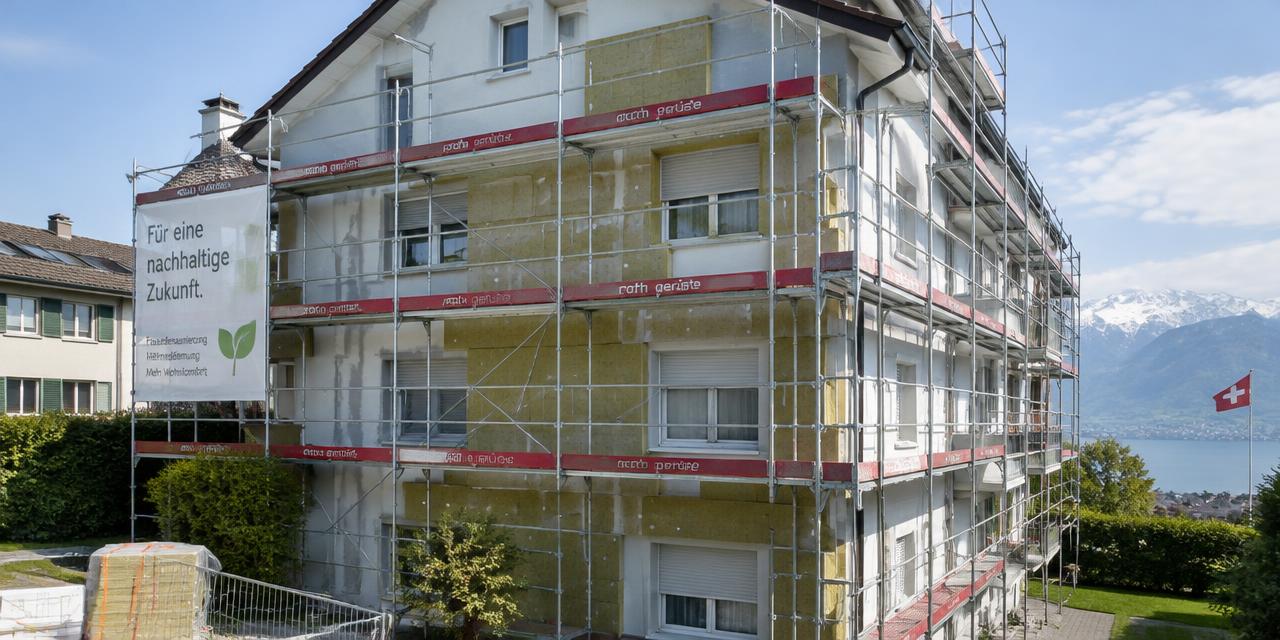
Once these documents are validated, construction preparation can begin. Installing scaffolding is the essential technical prerequisite, often set up all around the building to allow fluid intervention.
Seasonality plays an important role in choosing the execution period. Although the work can be scheduled at different times, it is best to avoid periods of extreme cold.
Montreux has about 31 frost days per year; working during these periods complicates the application of renders and the drying of materials. An ideal project therefore takes place during temperate seasons.
The classic process follows a precise order : cleaning the substrate, installing insulation panels, treating joints, applying the finishing layer, and dismantling scaffolding.
By anticipating your administrative steps, you ensure that you can book the slots of specialized companies at the most favorable time of the year.
Before requesting quotes, ensure you have correctly identified the current state of your facade. Never neglect to submit your grant applications before starting the site, as this is a sine qua non condition for obtaining public aid.
Also, ensure you have grouped your renovation works, especially windows and the roof, to optimize costs related to scaffolding. Do not choose insulation solely based on price, but consider its thermal performance and durability against the local climate.
Checklist before requesting quotes : 1. Check with the municipality if your building is protected or in a protected area to avoid unforeseen constraints. 2. Conduct an asbestos diagnostic if your house was built before 1990. 3.
Identify the type of masonry of your facade to choose the right fixing system. 4. Get an energy study to validate the expected gains and the requirements to be met for subsidies. 5.
List all desired interventions on the building envelope to group the scaffolding assembly. 6. Check the validity date of your authorizations. 7. Compare quotes including the same technical services.
1. Estimate
Set a budget range with the estimator.
2. Grants
Apply before work starts.
3. Quotes
Compare at least 3 quotes.
4. Permit
Check with the municipality whether a permit is needed.
5. Works
Follow the site and do a written handover.
Contribution per insulated m², depending on energy requirements met.
Grants for thermal insulation of the building envelope (walls, roof) via the Buildings Programme.
www.leprogrammebatiments.chCheck amounts and conditions with the provider before signing: apply before work starts in most cases.
1820 Montreux · about 0 km
Specialized company for painting, plastering, and general renovation works for both new constructions and renovation projects in Montreux.
peinture-renovation.ch1820 Montreux · about 0 km
Architectural firm in Bulle specialized in construction, renovation, energy retrofitting, and transformation of residential and public buildings.
pg-archi.ch1820 Montreux · about 0 km
Specialized firm in plastering, painting, and interior design for residential and hospitality sectors, blending Swiss expertise with Italian design.
linea-lombardo.ch1820 Territet · about 0 km
Based in Territet, Antonio Lombardo Sàrl carries out painting, plasterwork, interior decoration, and facade insulation and renovation.
antoniolombardo-peinture.chSuggestions from the commercial register by distance and activity. Not an endorsement or partnership.
Yes, as it changes the exterior appearance. Check with the municipality if you are in a protected area or if a simplified permit is sufficient.
You must submit your application to the Building Program before starting work. No grant is awarded retroactively.
Yes, for buildings constructed before 1990. A diagnostic must be carried out by a professional before any drilling or demolition intervention.
Yes, energy investments are 100% deductible. If the balance is significant, it can be carried forward to the next two tax years.
Absolutely, as it optimizes the use of scaffolding. It also ensures better consistency of the thermal envelope.
It reflects the city's commitment to the energy transition. Owners are encouraged to adopt high-performance standards.
It is best to avoid frost periods. Favor temperate seasons to ensure proper application and drying of materials.
Altitude
382 m
Heating degree days
2'560 Kj/an
20/12 °C
Frost days
31 jours/an
Solar irradiation
1'349 kWh/m²/an
horizontal
Winter design temperature
-4.8 °C
1er percentile des minimales
Mean temperature
12.1 °C
Source : swisstopo – service d'altitude (MNT) · Open-Meteo Historical Weather API (réanalyse ERA5, moyenne 2015-2024)
Source : montreux.ch
Source : 24 heures
These rules apply across the whole canton, not only in this town.
Permits
Tax deductions
Source : Règlement sur la déduction des frais relatifs aux immeubles privés (RDFIP)