
Canton
Solar PV — one-off payment and Vaud support
One-off payment calculated on installed capacity (kWp).
Federal one-off payment for PV installations, sometimes topped up by cantonal or municipal grants.
www.pronovo.chSolar panels · Montreux
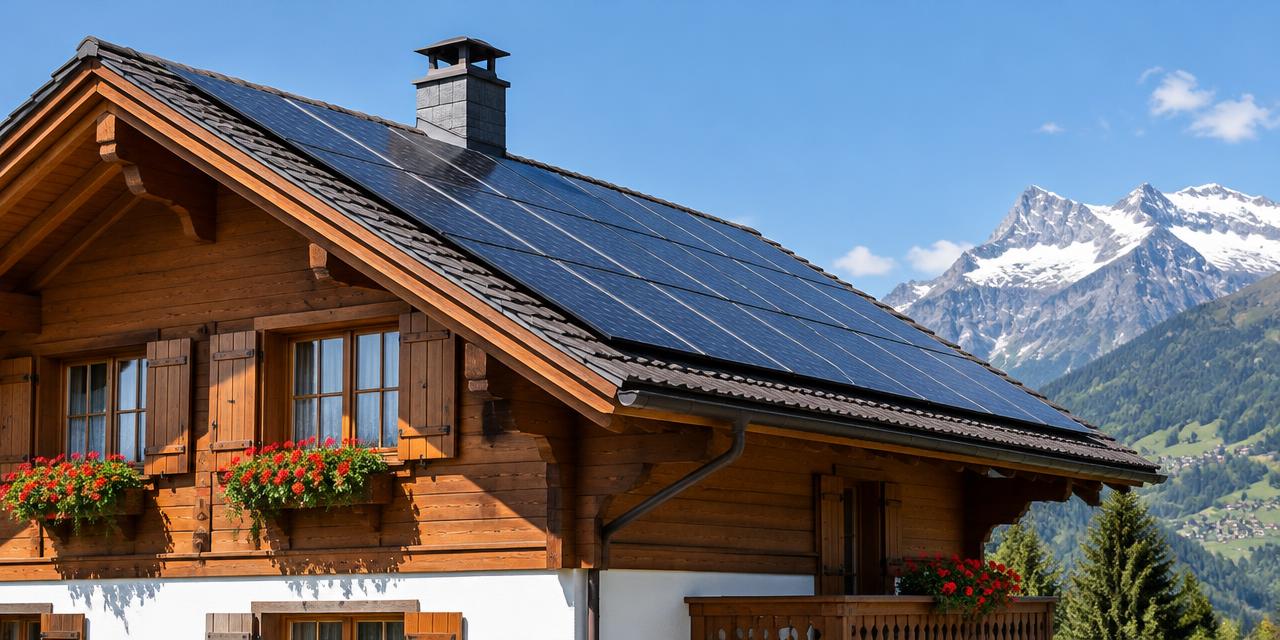
At a glance
Small project
CHF 9'800 – CHF 18'500
Typical project
CHF 18'100 – CHF 32'900
Large project
CHF 31'400 – CHF 55'800
| Project | Quantity | Low | High | Per unit |
|---|---|---|---|---|
| Small project | 5 kWc | CHF 9'800 | CHF 18'500 | CHF 2'800 |
| Typical project | 10 kWc | CHF 18'100 | CHF 32'900 | CHF 2'500 |
| Large project | 18 kWc | CHF 31'400 | CHF 55'800 | CHF 2'400 |
Computed with our estimator for Montreux (regional factor included), standard finish. Only the project size changes.
Included
Not included
In Montreux, the federal building register lists 3'447 residential buildings and 15'871 dwellings. These municipal benchmarks help put your home in context, but do not replace an individual assessment.
75 % built before 1980
Construction year does not reveal past renovations: check the current insulation condition.
54 % · Gas
This distribution describes recorded buildings, not your system's consumption or efficiency.
| Energy | Heating | Hot water |
|---|---|---|
| Gas | 54 % | 47.7 % |
| Heating oil | 30 % | 26.1 % |
| District heating | 1 % | 0.9 % |
| Heat pump | 5 % | 4.1 % |
| Electricity | 3 % | 10.2 % |
| Wood | 8 % | 3.5 % |
| Solar thermal | 0 % | 5.8 % |
Each line gives the share of buildings using that energy, separately for heating and for hot water. The two columns do not always reach 100%: some buildings combine two systems, or reported none.
A standard non-condensing boiler is usually older and less efficient.
13.7 % of buildings mix housing with shops or offices.
For your renovation plans in Montreux, RegBL data provides essential guidance. With 103 protected buildings out of 412 known, heritage status is significant; contact the municipality early to secure necessary permits. Regarding the scale of work for heating or insulation, the median house volume of 560 measured properties is 875.5 m3 according to SIA 416 standards. Please note that data coverage is partial, as there are 1716 houses registered in total. Understanding these specific figures ensures you can better plan your renovation budget and navigate local requirements effectively.
Source : Registre fédéral des bâtiments et des logements (RegBL), OFS, 2026. Existing residential buildings; percentages of recorded values.
With favorable sunlight and a global irradiation of 1349 kWh/m²/year, Montreux possesses undeniable solar potential.
Installing photovoltaic panels aligns directly with the communal climate plan, which aims for a drastic reduction in greenhouse gas emissions and an increase in renewable energy by 2040.
Considering these works allows you to secure your energy autonomy while enhancing your property's value within the context of a sustainable transition.
The best time to act is when your roof requires repair or during a comprehensive energy renovation.1 °C and a winter with about 31 frost days, planning a robust system allows for long-term yield optimization.
Anticipating the replacement of your roof covering avoids double installation costs and optimizes the technical schedule of your building.
The choice of material directly influences performance and aesthetics. You can opt for monocrystalline modules, widely used for their high performance, or building-integrated solutions (BIPV) for a more discreet look on historical roofs.
The range of panels, their inclination, and orientation are determining factors. With an estimated yield of 1187 kWh/kWp/year for a south-facing roof with a 30° pitch, the sizing must be rigorous.
It is also appropriate to assess the usefulness of a storage battery or intelligent self-consumption management. Profitability depends mainly on the share of electricity consumed on-site.8 °C.
Montreux's building stock is diverse, ranging from older villas to modern constructions. For buildings dating from before 1990, it is imperative to carry out an asbestos diagnosis before any intervention on the roof or structural elements.
Thermal insulation of the roof should be checked beforehand : installing solar panels on a non-insulated roof is a strategic error, as you would miss the opportunity to improve the thermal envelope while generating energy.
The structural integrity of the roof frame must also be validated by a professional. In the canton of Vaud, older buildings often require adjustments to support the weight of photovoltaic systems.
Check the state of existing electrical networks, as a standard upgrade of the electrical panel is frequently necessary to integrate decentralized production.
An analysis of the building's general condition helps avoid surprises during installation and ensures the longevity of the investment over several decades.
You will need to provide a notification form, a site plan, a cadastral extract, as well as an aerial photo and a photo of your building to illustrate the project.
This process with the municipality or prefect aims to verify the harmonious integration of the panels into the landscape.
It is crucial to verify whether your building is part of a protected zone or is listed. For protected buildings, specific constraints may apply, limiting the choice of materials or visual aspect.
Never start work without having obtained the necessary validation or confirmation that the project complies with the simplified procedure.
This preventive dialogue with communal authorities is essential to ensure the project's serenity and avoid any site stoppage due to heritage non-compliance.
It is essential to submit this request before the start of work to guarantee your eligibility. Cantonal or communal supplements may also exist depending on the period; check directly on dedicated portals.
Tax-wise, the canton of Vaud allows a tax deduction for investments aimed at saving energy. These installation costs can be deducted at 100%.
If the costs exceed your net income for the year, you have the possibility to carry forward the balance to the following two tax periods. Note that you can choose between deducting actual costs or the flat-rate deduction for each building.
However, choosing the actual energy cost deduction excludes the use of the flat-rate deduction for the same tax year.
The project starts with a feasibility study and a request for quotes from qualified professionals. Once the partner is selected, the application for aid from Pronovo must be submitted strictly before the start of work.
At the same time, you start the administrative notification procedure with the municipality. Once authorizations are received, technical planning is finalized based on material availability.
The installation phase on the roof generally takes a few days. The ideal season is outside of peak frost periods, although Montreux's climate remains temperate. Winter, with its estimated 31 frost days, can make roof work less comfortable, but not impossible.
Once the panels are installed, the steps of electrical connection and final commissioning by the network manager complete the process. Anticipate these steps to allow commissioning before the summer peak sunshine.
Avoid the error of neglecting the condition of your roof before installing panels, as replacing a cracked tile afterwards is very expensive.
Do not rush into a quote without having compared at least two detailed offers including connection and commissioning fees. Ensure the installer includes administrative procedures in their service.
Above all, check if your roof is thermally insulated so as not to waste energy.
Checklist before requesting quotes : Confirm that the asbestos diagnosis has been carried out for older buildings. Check the age and condition of your current roof covering. Ensure you have correctly identified your electrical consumption needs.
Ask the installer for an estimate of the self-consumption share. Check your heritage zone constraints with the municipality. Confirm that the application for one-off remuneration will be made before work starts.
Ensure the company has the necessary certifications to work on the electrical grid.
1. Estimate
Set a budget range with the estimator.
2. Grants
Apply before work starts.
3. Quotes
Compare at least 3 quotes.
4. Permit
Check with the municipality whether a permit is needed.
5. Works
Follow the site and do a written handover.
One-off payment calculated on installed capacity (kWp).
Federal one-off payment for PV installations, sometimes topped up by cantonal or municipal grants.
www.pronovo.chCheck amounts and conditions with the provider before signing: apply before work starts in most cases.
1820 Montreux · about 0 km
NAO Energy SA is a company specializing in energy transition solutions, installing solar panels, heat pumps, and storage systems across French-speaking Switzerland.
naoenergy.ch1816 Chailly-Montreux · about 3.5 km
André Rothen S.A. is a Swiss company specializing in electrical installations, home automation, and photovoltaic solutions for residential and commercial clients.
rothen-sa.ch1815 Clarens · about 3.7 km
Fernandes & Fils Sàrl is a family business specializing in roofing, sheet metal work, sanitary installations, and heating and solar systems.
fernandes-fils.ch1815 Clarens · about 3.7 km
Jean Meyer SA is a company based in Montreux specializing in sheet metal work, roofing, waterproofing, and solar installations.
jeanmeyer.chSuggestions from the commercial register by distance and activity. Not an endorsement or partnership.
A photovoltaic installation generally lasts between 25 and 30 years. The panels retain high efficiency well beyond this period with minimal maintenance.
No, for most projects in Montreux, a simplified procedure or a permit waiver is sufficient. However, verify your situation with the municipality.
The panels are designed to support heavy loads such as snow. The inclination of the panels often allows snow to slide off naturally.
It is possible but strictly regulated by authorities. Strong aesthetic constraints apply to preserve heritage.
Use your energy-intensive appliances during the day. Adding a home battery or an energy manager can also improve your utilization rate.
The one-off remuneration is a right subject to compliance. It is imperative to submit the application before work starts.
You can deduct 100% of energy investment costs. The balance can be carried forward over two tax periods if necessary.
Estimated solar yield
1'187 kWh/kWc/an
toit ~30° sud, PR 0.8, estimation
Altitude
382 m
Heating degree days
2'560 Kj/an
20/12 °C
Frost days
31 jours/an
Solar irradiation
1'349 kWh/m²/an
horizontal
Winter design temperature
-4.8 °C
1er percentile des minimales
Mean temperature
12.1 °C
Source : Open-Meteo Historical Weather API (réanalyse ERA5, moyenne 2015-2024) · swisstopo – service d'altitude (MNT)
Source : 24 heures
Source : montreux.ch
These rules apply across the whole canton, not only in this town.
Permits
Tax deductions
Source : Règlement sur la déduction des frais relatifs aux immeubles privés (RDFIP)