
Canton
Solar thermal — Buildings Programme (VD)
Flat contribution or per m² of collectors.
Grants for solar thermal systems (hot water, heating support).
www.leprogrammebatiments.chSolar water heating · Morges
At a glance
Small project
CHF 10'100 – CHF 23'600
Typical project
CHF 13'000 – CHF 30'200
Large project
CHF 17'800 – CHF 41'000
| Project | Quantity | Low | High | Per unit |
|---|---|---|---|---|
| Small project | 3 m² | CHF 10'100 | CHF 23'600 | CHF 5'500 |
| Typical project | 6 m² | CHF 13'000 | CHF 30'200 | CHF 3'500 |
| Large project | 11 m² | CHF 17'800 | CHF 41'000 | CHF 2'600 |
Computed with our estimator for Morges (regional factor included), standard finish. Only the project size changes.
Included
Not included
In Morges, the federal building register lists 1'346 residential buildings and 9'499 dwellings. These municipal benchmarks help put your home in context, but do not replace an individual assessment.
70 % built before 1980
Construction year does not reveal past renovations: check the current insulation condition.
55 % · Gas
This distribution describes recorded buildings, not your system's consumption or efficiency.
| Energy | Heating | Hot water |
|---|---|---|
| Gas | 55 % | 41.5 % |
| Heating oil | 27 % | 27.1 % |
| District heating | 2 % | 1.3 % |
| Heat pump | 6 % | 5.7 % |
| Electricity | 9 % | 12.9 % |
| Wood | 2 % | 1.3 % |
| Solar thermal | 0 % | 5.5 % |
Each line gives the share of buildings using that energy, separately for heating and for hot water. The two columns do not always reach 100%: some buildings combine two systems, or reported none.
A standard non-condensing boiler is usually older and less efficient.
19 % of buildings mix housing with shops or offices.
For homeowners planning renovations in Morges, official register figures identify 24 buildings under heritage protection. It is essential to contact the municipality early to secure required permits. Regarding building volume, data is available for 86 buildings measured via the SIA 416 standard, showing a median of 934 m3, which helps determine the scale for heating and insulation upgrades. However, note that data coverage is partial, as 441 buildings do not report volume under this standard and no renovation year data exists. Always verify your specific building status with local authorities before initiating your renovation project.
Source : Registre fédéral des bâtiments et des logements (RegBL), OFS, 2026. Existing residential buildings; percentages of recorded values.
With an interesting global irradiation of 1371 kWh/m²/year, Morges offers significant solar potential for homeowners. Undertaking solar thermal work is fully aligned with the municipal Climate Plan, which aims to reduce CO2 emissions per capita.
As an Energy City, Morges encourages the local production of renewable energy. The ideal time to act is during the renovation of your roof, in order to integrate the collectors harmoniously and limit labor costs.
9 °C, promotes good efficiency of thermal systems, while withstanding winter rigors with only 43 frost days on average.
Anticipating your work allows you to better plan your building's energy transition before your current heating installations become obsolete.
Sizing is the key to your project. Solar thermal collectors generally cover a large part of the summer hot water needs, but their ability to provide heating support depends on the storage tank volume and the collector area.
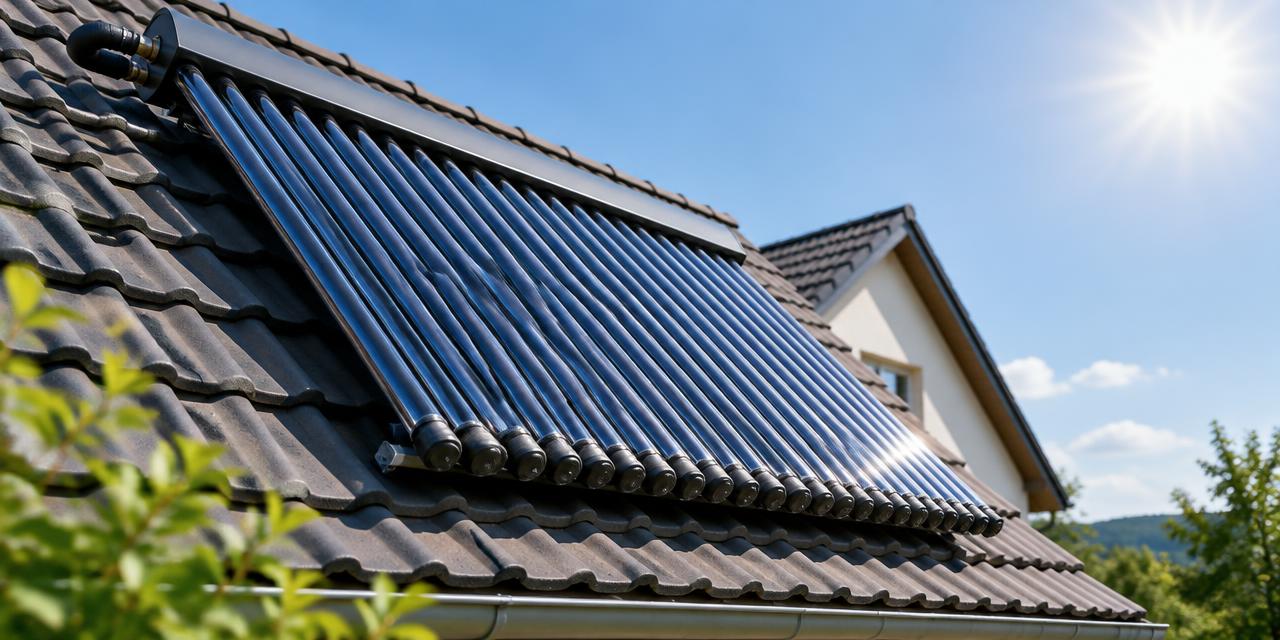
There are two main types of collectors : flat plate collectors, robust and well-suited for summer needs, and vacuum tube collectors, which are more efficient in cold or diffuse weather.
For owners looking for a hybrid solution, combining collectors and a heat pump is a relevant option, but it requires a rigorous sizing study.
The choice between these technologies will depend on your hot water needs, the number of occupants, and the available roof surface.
It is crucial to evaluate the slope and orientation of your roof, although the installation remains possible on a majority of existing buildings, provided that the inclination is optimized to best capture local radiation.
Morges has a varied heritage, with many older dwellings.
If your building dates from before 1990, special attention must be paid when opening the roof or handling distribution networks, due to the potential presence of asbestos in construction materials or insulation of the time.
In addition, older buildings often have high-temperature hydraulic heating networks, which may require adaptation to optimize heat exchange with the collectors.
In dense urban areas or historic districts, it is important to check the condition of the roof structure before adding the weight of panels.
The thermal insulation of the dwelling also influences the overall efficiency of the system: if your house is poorly insulated, solar thermal energy will be less effective for heating your living spaces.
It is recommended to evaluate the general condition of your roof and its covering elements to avoid any structural surprises during the installation of the supports.
It is strongly recommended to consult the Morges Construction Police Office before any work.
If your building is in the old town or a protected sector, the creation of openings or the integration of collectors may require the approval of the Service for Buildings, Heritage and Logistics (SIPAL) of the Canton of Vaud.
Solar installations generally require simple municipal authorization but may fall under a public inquiry procedure if the scale of the work is deemed significant or if the external appearance is significantly modified.
Never assume there are no constraints, especially in areas of high historical value where preserving the appearance of roofs is a priority for local authorities.
The order of steps is imperative : you must submit your subsidy application before the start of the work, otherwise you risk losing your rights to the aid.
On the tax front, the canton of Vaud allows a deduction of investments intended to save energy up to 100%. If these costs exceed your net income during the current year, the balance can be carried forward to the two following tax periods.
Note, however, that you can only deduct the costs actually borne by yourself (net costs after deduction of subsidies).
It is possible to choose each year between the deduction of actual expenses and the flat-rate deduction for maintenance, but once you have engaged in a strategy of carrying forward energy investment deductions, you will have to be attentive to the exclusion conditions related to the flat-rate deduction.
A solar project takes place in several key phases. Everything starts with a feasibility study and an application for authorization from the municipality of Morges. Once the authorizations are obtained and the aid validated, the technical planning is finalized.
The construction phase begins with the preparation of the roof and the installation of fixing systems. It is better to avoid periods of deep frost (43 days per year on average) to ensure the safety of workers on the roof and the quality of the installation.
Then, the collectors are installed and connected to the existing hydraulic circuit or a new storage tank. The last step consists of commissioning and hydraulic and electronic settings.
The whole process requires patience, especially for the coordination of different trades, such as the roofer for waterproofing and the heating engineer for the connection. Rigor at each stage guarantees the lasting performance of your installation.
Avoid classic errors by ensuring your needs are well defined before contacting companies. Never neglect the sizing study, because an oversized system loses efficiency and profitability.
A common error is forgetting to check the condition of the roof before installation, which can lead to unforeseen repair costs. Before requesting quotes, check that your roof is in good general condition.
Ensure you have consulted local authorities regarding heritage constraints. Confirm that your current heating system is compatible with solar thermal support. Check that you have understood the conditions for granting subsidies.
Request comparative quotes detailing the components, estimated lifespan, and warranty. Finally, make sure to plan the work outside of frost periods to optimize the site.
By following these steps, you secure your investment and ensure a lasting installation that meets current energy performance standards while respecting the local living environment.
1. Estimate
Set a budget range with the estimator.
2. Grants
Apply before work starts.
3. Quotes
Compare at least 3 quotes.
4. Permit
Check with the municipality whether a permit is needed.
5. Works
Follow the site and do a written handover.
Flat contribution or per m² of collectors.
Grants for solar thermal systems (hot water, heating support).
www.leprogrammebatiments.chCheck amounts and conditions with the provider before signing: apply before work starts in most cases.
1110 Morges · about 0 km
ID GO Management is a global energy renovation company specializing in decarbonization, planning, and the execution of sustainable building projects.
afco-management.ch1131 Tolochenaz · about 2.6 km
A group of companies specializing in sanitary installations, heating systems (heat pumps, gas, solar), tinsmithing, and waterproofing.
csenergie.ch1026 Denges · about 4.3 km
DOLEFAR SA, based in Denges, installs and maintains heating, solar PV, solar thermal and plumbing systems in French-speaking Switzerland, with tiling also listed in its registered business purpose.
dolefar.com1162 St-Prex · about 4.9 km
Chauffarex SA provides sanitary and heating installations for new builds and renovations, installs solar systems, pellet boilers and heat pumps, and maintains water heaters.
chauffarex.chSuggestions from the commercial register by distance and activity. Not an endorsement or partnership.
Thermal collectors capture diffuse radiation even in cloudy weather. However, the yield is optimal with direct sunlight.
Most solar installations benefit from a simplified procedure. Contact the building police as a precaution anyway.
No, the application must be submitted before the start of the work. Any late application will be rejected by the Buildings Program.
Old materials may contain asbestos, requiring professional diagnosis before any intervention. It is essential for safety.
Well maintained, solar thermal systems have a long lifespan, often estimated at over 20 years. Regular maintenance preserves this performance.
Yes, if your energy investments are not fully deductible in the year of the work, the balance can be carried forward over two years.
It is quite possible, but requires a rigorous sizing study. This allows optimizing hot water production.
Estimated solar yield
1'206 kWh/kWc/an
toit ~30° sud, PR 0.8, estimation
Altitude
375 m
Heating degree days
2'681 Kj/an
20/12 °C
Frost days
43 jours/an
Solar irradiation
1'371 kWh/m²/an
horizontal
Winter design temperature
-4.2 °C
1er percentile des minimales
Mean temperature
11.9 °C
Source : Open-Meteo Historical Weather API (réanalyse ERA5, moyenne 2015-2024) · swisstopo – service d'altitude (MNT)
Source : morges.ch
These rules apply across the whole canton, not only in this town.
Permits
Tax deductions
Source : Règlement sur la déduction des frais relatifs aux immeubles privés (RDFIP)