
Canton
Solar thermal — Buildings Programme (VD)
Flat contribution or per m² of collectors.
Grants for solar thermal systems (hot water, heating support).
www.leprogrammebatiments.chSolar water heating · Écublens
At a glance
Small project
CHF 10'100 – CHF 23'600
Typical project
CHF 13'000 – CHF 30'200
Large project
CHF 17'800 – CHF 41'000
| Project | Quantity | Low | High | Per unit |
|---|---|---|---|---|
| Small project | 3 m² | CHF 10'100 | CHF 23'600 | CHF 5'500 |
| Typical project | 6 m² | CHF 13'000 | CHF 30'200 | CHF 3'500 |
| Large project | 11 m² | CHF 17'800 | CHF 41'000 | CHF 2'600 |
Computed with our estimator for Écublens (regional factor included), standard finish. Only the project size changes.
Included
Not included
In Écublens, the federal building register lists 1'082 residential buildings and 6'364 dwellings. These municipal benchmarks help put your home in context, but do not replace an individual assessment.
49 % built before 1980
Construction year does not reveal past renovations: check the current insulation condition.
48 % · Gas
This distribution describes recorded buildings, not your system's consumption or efficiency.
| Energy | Heating | Hot water |
|---|---|---|
| Gas | 48 % | 35.8 % |
| Heating oil | 32 % | 29.6 % |
| District heating | 6 % | 4.3 % |
| Heat pump | 6 % | 4.9 % |
| Electricity | 5 % | 9.1 % |
| Wood | 2 % | 0.8 % |
| Solar thermal | 1 % | 13.6 % |
Each line gives the share of buildings using that energy, separately for heating and for hot water. The two columns do not always reach 100%: some buildings combine two systems, or reported none.
A standard non-condensing boiler is usually older and less efficient.
9.5 % of buildings mix housing with shops or offices.
For renovation planning in Écublens, official RegBL figures provide vital guidance. With 319 buildings listed as heritage protected out of 1021, contacting local authorities early is essential for permit compliance. Data coverage regarding building volume is partial, covering 209 of 507 houses under the SIA 416 standard with a median of 932 m3, which is critical for scaling heating and insulation upgrades accurately. Currently, no historical data is recorded regarding past renovation years for these properties. Please incorporate these insights when assessing your project requirements to ensure a smooth transition through the renovation process in this municipality.
Source : Registre fédéral des bâtiments et des logements (RegBL), OFS, 2026. Existing residential buildings; percentages of recorded values.
Ecublens, situated at 426 meters above sea level, has a significant energy demand of 2759 Kj/year. With a global annual irradiation of 1371 kWh/m², the potential for solar thermal energy is substantial.
Adopting this technology supports the goals of the Climate Plan, which aims for carbon neutrality by 2050 and a 35% reduction in GHG emissions by 2030.
The ideal time to install solar thermal collectors often coincides with the replacement of your domestic hot water system or a comprehensive roof renovation.
Solar collectors typically cover a large portion of summer hot water demand, reducing the load on your main boiler during periods of low heating demand.
By integrating this work into an energy renovation, you optimize your investment and improve your building's energy rating while anticipating future municipal energy requirements.
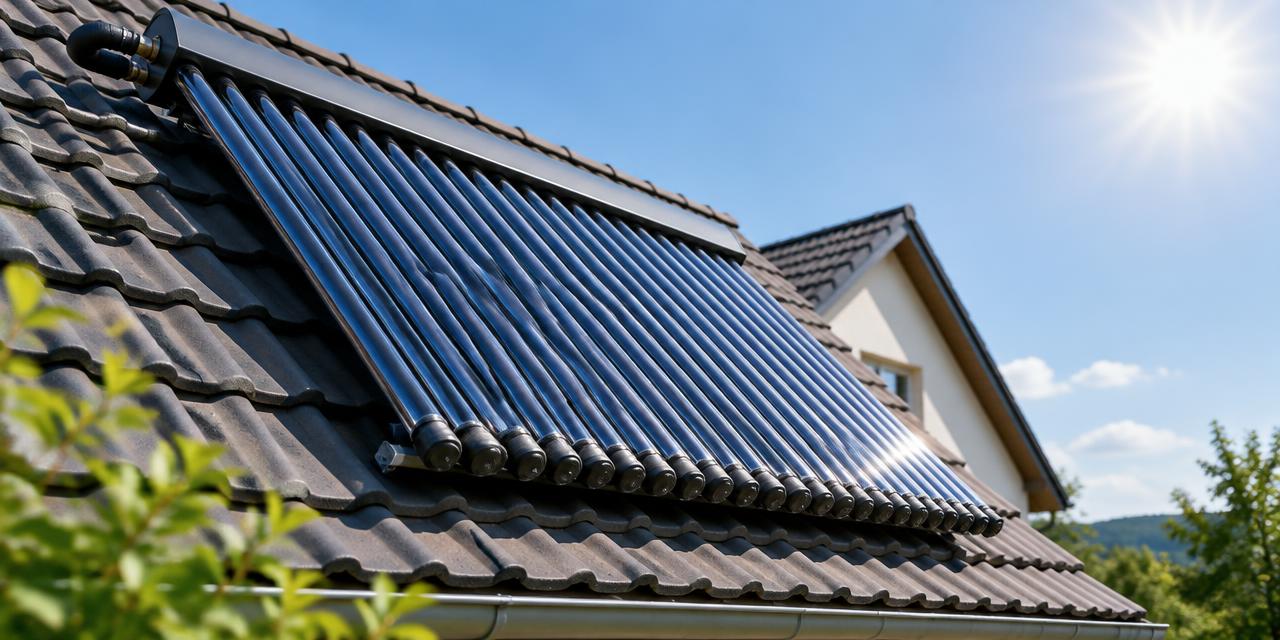
The choice of equipment depends on the collector technology, primarily between flat-plate and vacuum tube collectors. Flat-plate collectors are robust and suitable for summer and spring use.
Vacuum tube collectors offer better efficiency, especially on less sunny days. It is advisable to accurately assess your actual hot water needs to correctly size the collector area. Incorrect sizing can limit system efficiency.
Furthermore, coupling with your existing heating system is crucial. Combining collectors and heat pumps requires a rigorous sizing study. You will need to choose a suitable storage tank capable of retaining the thermal energy produced during the day.
The choice between an in-roof integrated system or one mounted on supports is also a matter of aesthetics and budget.
Remember to check the compatibility of your existing roof structure to support the additional weight of the collectors, especially if your roof is several decades old.
The municipality of Écublens has a diverse building stock, ranging from old farmhouses to houses built between 1960 and 1990. If your building was built before 1990, be vigilant about the possible presence of asbestos in insulation or roof components.
A technical inspection is recommended before any work begins to ensure site safety and the longevity of your solar installation.
The building's thermal insulation also directly impacts the profitability of the solar system; a well-insulated roof limits heat loss during energy transfer to the tank.
Regarding networks, check the condition of your existing pipes. Installing solar collectors often requires adding piping between the roof and the boiler room. In older buildings, routing conduits can be complex.
It is sometimes necessary to create new conduits or modernize the heat distribution network to optimize the circulation of the heat transfer fluid.
An analysis of the existing situation by a professional helps avoid budget surprises and ensures that your new solar installation works in perfect harmony with the existing central heating system.
This guide does not establish a permit exemption. If your building or area is protected, check the constraints specific to your project.
It is imperative to submit your subsidy application before starting work; no aid will be granted for projects already completed. The official portal link allows you to check updated amounts and technical requirements for eligibility.
Regarding taxation, investments intended to save energy are fully deductible from taxable income. Expenses incurred to replace obsolete installations or add renewable building elements benefit from a 100% deduction rate.
If your costs exceed your income, you have the possibility to carry over the balance to the two following tax periods. Note that if you receive a public subsidy, only the portion you personally pay is tax-deductible.
This smart tax management helps to significantly reduce the actual cost of your solar project in Écublens.
The flow of a solar thermal project follows a rigorous logic. The first phase consists of conducting a feasibility study and applying for financial aid before signing any quotes.
Once the grant agreement is received and any administrative permits are obtained, the equipment can be ordered.
The site itself often begins with preparing the roof and installing the collector fixing system, followed by installing the panels and the hydraulic connection to the storage tank.
the best season to undertake this work is spring or summer, to avoid weather-related issues.
In Écublens, with an average of 48 frost days per year, it is essential to schedule the work outside these periods to ensure optimal commissioning without the risk of freezing fluids. Indoor connection work can be carried out during the cooler months.
A final commissioning allows checking the tightness of the circuits and the proper functioning of the thermal regulator, thus ensuring your installation is ready to produce energy from the first day of sun.
The most frequent error is underestimating the thermal storage need, which limits the use of solar energy. It is imperative to check the general condition of the roof, as installing solar collectors on a roof at the end of its life is not recommended.
Another error is omitting to apply for subsidies before signing contracts. Finally, ensure the chosen company has proven experience in solar thermal energy.
Before requesting quotes, follow this checklist : check the age and condition of your roof; have an assessment of your current hot water consumption carried out; ensure the compatibility of your central heating; confirm your building's zone with the municipality; submit your subsidy application to the Buildings Program; demand a precise sizing plan including the tank; compare several detailed offers on equipment and installation.
By following these steps, you minimize risks and ensure the success of your project.
1. Estimate
Set a budget range with the estimator.
2. Grants
Apply before work starts.
3. Quotes
Compare at least 3 quotes.
4. Permit
Check with the municipality whether a permit is needed.
5. Works
Follow the site and do a written handover.
Flat contribution or per m² of collectors.
Grants for solar thermal systems (hot water, heating support).
www.leprogrammebatiments.chCheck amounts and conditions with the provider before signing: apply before work starts in most cases.
1024 Ecublens VD · about 0 km
Specialist in technical insulation for heating, plumbing, and ventilation systems, providing thermal, acoustic, and fire protection solutions.
ipsa-isolations.ch1026 Denges · about 1.7 km
DOLEFAR SA, based in Denges, installs and maintains heating, solar PV, solar thermal and plumbing systems in French-speaking Switzerland, with tiling also listed in its registered business purpose.
dolefar.com1020 Renens VD · about 2.5 km
Chauffage-tech is a company specializing in the installation of heating, ventilation, air conditioning systems, and solar solutions.
technibat-chauffage.ch1030 Bussigny · about 2.8 km
Chauffatec SA is a company specializing in the installation, maintenance, and repair of heating systems, heat pumps, and renewable energy solutions in the Lake Geneva region.
chauffatecsa.chSuggestions from the commercial register by distance and activity. Not an endorsement or partnership.
A well-maintained installation has an average lifespan of 20 to 25 years. Regular maintenance helps optimize performance over the long term.
No, solar thermal is a supplement. It provides hot water and complements heating, but a boiler remains necessary for days without sun.
Most solar projects benefit from a simplified procedure or a permit exemption. However, check your status with the municipality.
Yes, it is imperative. Any grant application must be submitted before the start of work to be taken into consideration.
East or west orientation is perfectly feasible, although efficiency is slightly lower. Correct sizing compensates for this difference.
This depends on the number of residents and hot water needs. A professional study is essential to size the ideal area.
Yes, investments to save energy are 100% deductible. However, you can only deduct the portion remaining at your expense.
Estimated solar yield
1'206 kWh/kWc/an
toit ~30° sud, PR 0.8, estimation
Altitude
426 m
Heating degree days
2'759 Kj/an
20/12 °C
Frost days
48 jours/an
Solar irradiation
1'371 kWh/m²/an
horizontal
Winter design temperature
-4.5 °C
1er percentile des minimales
Mean temperature
11.6 °C
Source : Open-Meteo Historical Weather API (réanalyse ERA5, moyenne 2015-2024) · swisstopo – service d'altitude (MNT)
Source : Ecublens.ch - Plan climat
These rules apply across the whole canton, not only in this town.
Permits
Tax deductions
Source : Règlement sur la déduction des frais relatifs aux immeubles privés (RDFIP)