
Canton
Solar PV — one-off payment and Vaud support
One-off payment calculated on installed capacity (kWp).
Federal one-off payment for PV installations, sometimes topped up by cantonal or municipal grants.
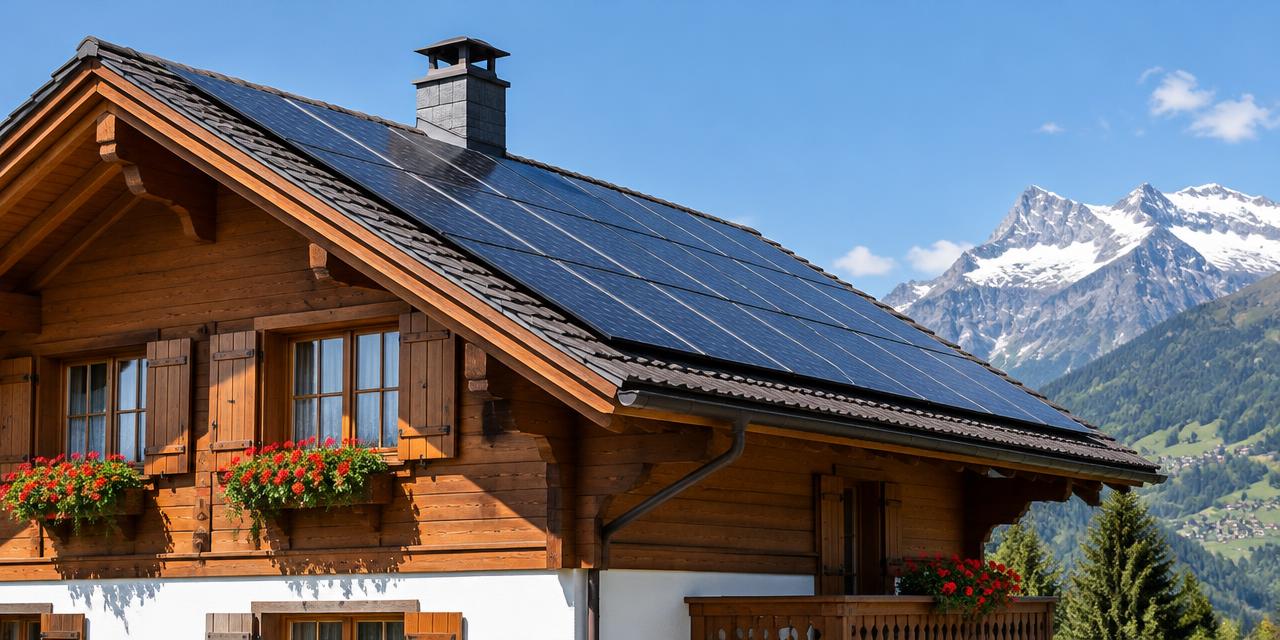
www.pronovo.chSolar panels · Pully
At a glance
Small project
CHF 9'800 – CHF 18'500
Typical project
CHF 18'100 – CHF 32'900
Large project
CHF 31'400 – CHF 55'800
| Project | Quantity | Low | High | Per unit |
|---|---|---|---|---|
| Small project | 5 kWc | CHF 9'800 | CHF 18'500 | CHF 2'800 |
| Typical project | 10 kWc | CHF 18'100 | CHF 32'900 | CHF 2'500 |
| Large project | 18 kWc | CHF 31'400 | CHF 55'800 | CHF 2'400 |
Computed with our estimator for Pully (regional factor included), standard finish. Only the project size changes.
Included
Not included
In Pully, the federal building register lists 1'930 residential buildings and 10'205 dwellings. These municipal benchmarks help put your home in context, but do not replace an individual assessment.
69 % built before 1980
Construction year does not reveal past renovations: check the current insulation condition.
53 % · Gas
This distribution describes recorded buildings, not your system's consumption or efficiency.
| Energy | Heating | Hot water |
|---|---|---|
| Gas | 53 % | 45.5 % |
| Heating oil | 37 % | 34.8 % |
| District heating | 1 % | 0.4 % |
| Heat pump | 6 % | 5.2 % |
| Electricity | 2 % | 4.2 % |
| Wood | 1 % | 0.8 % |
| Solar thermal | 0 % | 6.1 % |
Each line gives the share of buildings using that energy, separately for heating and for hot water. The two columns do not always reach 100%: some buildings combine two systems, or reported none.
A standard non-condensing boiler is usually older and less efficient.
11.8 % of buildings mix housing with shops or offices.
For your renovation projects in Pully, RegBL figures provide essential benchmarks. With 6 buildings identified as protected heritage out of 126 known properties, contacting the municipality early is vital to secure your permits. The median house volume is 1165 m3 according to SIA 416, which is crucial for scaling your insulation works or heating system upgrades. Please note that data coverage is partial, as the volume is only measured for 126 houses out of 612 recorded in the municipality. These metrics help you assess the scale of your construction work and accurately estimate renovation costs for your home.
Source : Registre fédéral des bâtiments et des logements (RegBL), OFS, 2026. Existing residential buildings; percentages of recorded values.
At an altitude of 426 meters, Pully benefits from favorable sunshine with significant annual global irradiation for photovoltaic production.6 °C, panel efficiency is optimized, as they lose effectiveness during excessive heat.
Undertaking these works not only reduces your dependence on the grid but also fully aligns with the municipality's energy policy, active for 25 years and Energy City labeled since 2017.
The Ecowatt program, launched in 2019, demonstrates the municipality's strong commitment to supporting renewable energy development. The ideal time to act is when your roof is being refurbished, allowing you to combine roofing work with panel installation.
This allows for pooling scaffolding and safety costs while ensuring optimal long-term waterproofing.
The real estate stock in Pully, marked by heating needs represented by 2776 degree-days per year, requires smart energy management. Installing photovoltaics helps anticipate the growing energy demand for heating.
By valorizing your roof, you turn a passive surface into a productive asset. The yield estimate of approximately 1199 kWh/kWp per year for a south-facing roof clearly illustrates the local potential.
Acting now also means benefiting from a mature, reliable technology capable of meeting the objectives of the Confederation's 2050 Energy Strategy, which is actively supported locally.
The success of your photovoltaic installation depends on technical choices adapted to your actual needs and your configuration.
The first parameter is module technology : monocrystalline cells are known for their superior yield and are particularly suitable for limited surfaces.
The mounting system is equally crucial; there are on-roof solutions, placed above existing tiles, or in-roof systems, where panels replace the roof covering. Integration is aesthetically more discreet but requires careful waterproofing.
Profitability depends primarily on the share of electricity consumed on-site, which makes adding a storage battery an interesting option for storing surplus produced during the day.
However, battery capacity must be evaluated based on your nighttime consumption profile. Likewise, the choice of the inverter, which transforms direct current into alternating current, must be precisely sized.
Finally, component quality and manufacturer warranties influence your system's durability.
It is essential to favor certified equipment to guarantee performance over several decades, while ensuring the installation is properly ventilated to avoid overheating, which reduces overall electrical efficiency.
In Pully, as in much of the Canton of Vaud, the real estate stock has varied characteristics. Buildings constructed before 1990 require special attention regarding the condition of the roof.
Before installing panels, check the robustness of the framework, which must be able to support the additional weight of the modules.
An in-depth diagnosis is recommended for older buildings to identify the possible presence of asbestos in roofing materials, which imposes specific precautions during removal or support preparation.
Attic thermal insulation must also be examined, as a photovoltaic roof does not replace failing insulation; it is often more economical to combine thermal refurbishment with solar installation.
For more recent dwellings, interior electrical networks are generally adapted to integrate solar production. However, in older constructions, it may be necessary to bring the electrical panel up to standard to ensure secure injection into the grid.
Each type of structure, whether detached villas or small buildings, presents specific span and wind constraints. The structure must allow for robust fixing that guarantees the installation's stability in adverse weather.
By working with professionals who are familiar with the Vaudois building stock, you will avoid unpleasant surprises related to the hidden state of the framework or networks, thus ensuring the sustainability of your solar investment.
This guide does not establish a permit exemption. If your building or area is protected, check the constraints specific to your project.
In addition, cantonal or municipal aid may be added depending on the policies in force at the time of your project.
The profitability of your installation depends primarily on the share of electricity you consume directly within your home; therefore, prioritize using your household appliances when the sun is shining.
Regarding taxation, the Canton of Vaud allows advantageous management of energy investments. Investment costs aimed at rationalizing energy consumption or using renewable energy are 100% deductible.
Note that you can choose between deducting actual costs or a flat-rate deduction (calculated on rental value or gross yield depending on the building's age).
If costs cannot be fully deducted in the year of the work, the balance can be carried forward to the following two tax periods. Note: if you receive public subsidies, only the part you finance yourself is tax-deductible.
Check these points carefully with your tax advisor before validating your overall budget.
The deployment of a solar installation follows logical steps that guarantee safety and compliance. The first phase consists of technical feasibility analysis and permit applications to the municipality.
Once permits are obtained and grants reserved, the equipment is ordered. The site begins with the installation of roof safety and scaffolding. Then comes the installation of mounting rails, followed by electrical wiring and the actual placement of the panels.
Connections to the inverter and the general electrical panel complete the physical installation. Finally, commissioning tests are performed to verify compliance with grid injection.
Regarding seasonality, it is preferable to avoid periods of intense frost. With an average of 44 frost days per year in Pully, planning work between spring and autumn is ideal for workers and to ensure good adhesion of joints and seals.
Working in fair weather also facilitates handling components on sometimes steep roofs. Although no fixed duration can be guaranteed, meticulous preparation upstream limits the duration of the site.
The final acceptance step, with mandatory electrical inspection, closes the process, thus allowing you to start producing your own renewable electricity from the official commissioning.
To successfully manage your solar project, avoid neglecting the analysis of your actual consumption. Installing too much power without optimizing self-consumption reduces overall profitability.
Never sign a quote before checking that the authorization request is ready and that federal grants are properly integrated into the financing plan.
Avoid choosing a company based solely on the lowest price without comparing component quality and the warranties offered on the inverter and modules. Ensure the selected company has documented experience in the Canton of Vaud.
Before requesting quotes, follow this checklist : check the age and condition of your roof to avoid upcoming refurbishment. Confirm the absence of permanent shaded areas (trees, neighboring buildings, chimneys) that drastically reduce yield.
Evaluate your annual consumption profile in kWh to correctly size the installation. Ask the municipality if your building is subject to specific heritage restrictions. Ensure your electrical panel complies with current standards to support injection.
Finally, compare at least three detailed quotes specifying expected yield, type of equipment, warranties, and planned maintenance services. Rigorous preparation guarantees a durable and profitable project.
A photovoltaic installation is designed to last for several decades, but it requires minimal maintenance to maintain optimal yield.
Although rain naturally cleans the panels, it may be necessary to perform a light cleaning in case of significant accumulation of dust, pollen, or bird droppings, especially on low-slope roofs.
Never use a high-pressure cleaner or harsh chemicals that could scratch the glass or damage seals; simple lukewarm water with a soft brush is usually sufficient.
It is advisable to entrust this task to a professional if access to the roof presents safety risks.
Beyond cleaning, the durability of your system relies on technical monitoring. An inverter usually has a shorter lifespan than the panels and may need to be replaced after about fifteen years.
Regularly monitor performance indicators via your tracking app to detect any production anomalies.
If you observe an unusual drop in production compared to previous years, it is recommended to have the inverter and electrical connections inspected by a specialist.
Finally, during your periodic inspection of the building's electrical installation, take the opportunity to request a complete diagnosis of the condition of the panel fixings, thus ensuring that your installation remains efficient and safe over time.
1. Estimate
Set a budget range with the estimator.
2. Grants
Apply before work starts.
3. Quotes
Compare at least 3 quotes.
4. Permit
Check with the municipality whether a permit is needed.
5. Works
Follow the site and do a written handover.
One-off payment calculated on installed capacity (kWp).
Federal one-off payment for PV installations, sometimes topped up by cantonal or municipal grants.
www.pronovo.chCheck amounts and conditions with the provider before signing: apply before work starts in most cases.
1009 Pully · about 0 km
Belet Toiture Sàrl is a company based in Pully specializing in roofing, tinsmithing, ventilated facades, and solar installations.
belet-ferblanterie-sanitaire.ch1009 Pully · about 0 km
Bonnet Électricité SA is a family-owned business specializing in electrical installations, home automation, computer networks, and the installation of solar panels.
bonnet-electricite.ch1006 Lausanne · about 1.6 km
Founded in Lausanne in 1934, Amaudruz SA provides electrical, solar, security and building automation installations for private and institutional clients.
amaudruz.ch1095 Lutry · about 2.5 km
Lutry-based company specializing in electrical installations, home automation, security systems, IT networks, and solar photovoltaic systems.
feusi-electricite.chSuggestions from the commercial register by distance and activity. Not an endorsement or partnership.
Most solar installations benefit from a simplified procedure or permit exemption. However, a work notice is always recommended, especially if your building has heritage value.
There is a federal one-off payment via Pronovo. It is essential to submit your request before starting work to be eligible.
Yes, Pully benefits from good sunshine. Profitability depends primarily on your ability to self-consume the electricity produced on-site.
Solar panels generally last several decades. The inverter, however, often requires replacement after about 15 years.
It is possible but under strict conditions, often with flat installation on the roof. Contact the urban planning department before taking any steps.
Prioritize using energy-intensive appliances like the washing machine during the day. Adding a battery can also help store surplus for the night.
Yes, energy investments are 100% deductible. The amount can be carried forward over two tax periods if necessary.
Estimated solar yield
1'199 kWh/kWc/an
toit ~30° sud, PR 0.8, estimation
Altitude
426 m
Heating degree days
2'776 Kj/an
20/12 °C
Frost days
44 jours/an
Solar irradiation
1'363 kWh/m²/an
horizontal
Winter design temperature
-4.2 °C
1er percentile des minimales
Mean temperature
11.6 °C
Source : Open-Meteo Historical Weather API (réanalyse ERA5, moyenne 2015-2024) · swisstopo – service d'altitude (MNT)
Source : Pully.ch - Energie
These rules apply across the whole canton, not only in this town.
Permits
Tax deductions
Source : Règlement sur la déduction des frais relatifs aux immeubles privés (RDFIP)