
HyperSolaire Sàrl
2718 Lajoux JU · about 16.5 km
Jura-based specialist in photovoltaic panel installation and energy storage solutions with AI-driven optimization.
hypersolaire.chHome solar battery · Porrentruy
At a glance
Small project
CHF 4'000 – CHF 9'100
Typical project
CHF 7'200 – CHF 15'400
Large project
CHF 12'400 – CHF 25'400
| Project | Quantity | Low | High | Per unit |
|---|---|---|---|---|
| Small project | 5 kWh | CHF 4'000 | CHF 9'100 | CHF 1'200 |
| Typical project | 10 kWh | CHF 7'200 | CHF 15'400 | CHF 1'100 |
| Large project | 18 kWh | CHF 12'400 | CHF 25'400 | CHF 1'000 |
Computed with our estimator for Porrentruy (regional factor included), standard finish. Only the project size changes.
Included
Not included
In Porrentruy, the federal building register lists 1'687 residential buildings and 4'294 dwellings. These municipal benchmarks help put your home in context, but do not replace an individual assessment.
65 % built before 1980
Construction year does not reveal past renovations: check the current insulation condition.
36 % · Heating oil
This distribution describes recorded buildings, not your system's consumption or efficiency.
| Energy | Heating | Hot water |
|---|---|---|
| Heating oil | 36 % | 29 % |
| District heating | 33 % | 31.5 % |
| Heat pump | 23 % | 19.3 % |
| Electricity | 4 % | 17.1 % |
| Wood | 2 % | 1.4 % |
| Solar thermal | 0 % | 1.4 % |
Each line gives the share of buildings using that energy, separately for heating and for hot water. The two columns do not always reach 100%: some buildings combine two systems, or reported none.
A standard non-condensing boiler is usually older and less efficient.
13 % of buildings mix housing with shops or offices.
For renovation planning in Porrentruy, official records show that out of 1554 buildings, 71 have heritage status, with 10 specifically protected. It is essential to contact the municipality early to navigate permit requirements for such properties. Regarding scale, data for 1025 houses indicates a median volume of 600 cubic meters according to SIA 416 standards, though data coverage remains partial for this metric. These official figures provide a necessary foundation for homeowners to estimate the scope of heating or insulation works accurately, ensuring that renovation plans align with the specific building characteristics of this municipality.
Source : Registre fédéral des bâtiments et des logements (RegBL), OFS, 2026. Existing residential buildings; percentages of recorded values.
In Porrentruy, the photovoltaic potential is real with a global irradiation of 1278 kWh/m²/year.9°C winter design temperature) require intelligent management.
Installing a battery becomes relevant when your production exceeds your direct daytime consumption, allowing you to use free energy in the evening.
The 2025–2028 communal energy plan strongly encourages local electricity production as part of a strategy to reduce building consumption.
The ideal time for this work is during the overhaul of your PV system or when considering thermal renovation aimed at autonomy.2°C, storage helps regulate overall energy demand, especially in months when solar production is lower.
A battery is useful if your solar production significantly exceeds your daytime consumption. By anticipating your future needs, you actively contribute to local energy transition goals while adding value to your property.
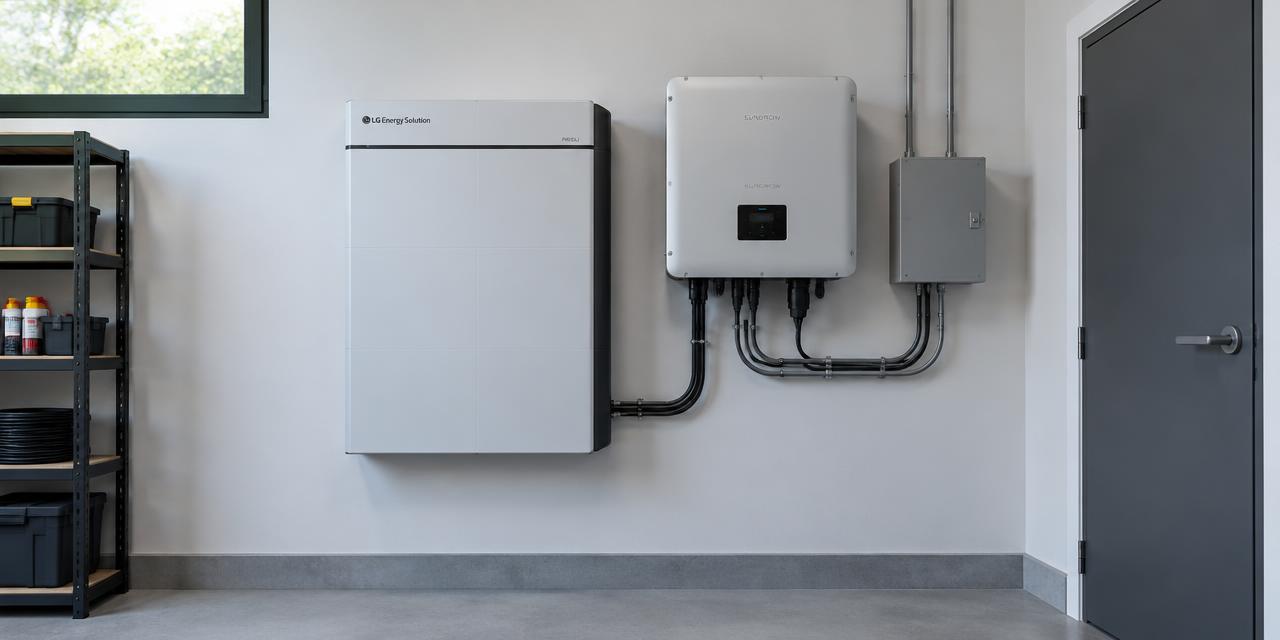
Sizing is the crucial step : base the capacity on your regular nighttime consumption rather than the total power of your solar panels. The market offers various systems, from Lithium-Iron-Phosphate (LFP) batteries to more modular solutions.
Compatibility with your existing inverter is a mandatory check before any purchase, as a high-performance hybrid system requires smooth communication between components.
Also, consider the charge and discharge power, which must match your consumption peaks, such as using large appliances in the evening.
Intelligent control options now allow charging management based on weather forecasts or dynamic tariffs. Durability depends on the number of charge cycles, although modern systems are designed for varied local conditions.
By investing in certified high-end equipment, you ensure greater longevity for your installation.
Keep in mind that the match between the chosen technology and your lifestyle is more decisive than the simple theoretical storage capacity shown by the manufacturer.
Porrentruy has varied building heritage. For older houses, it is essential to assess the internal electrical network, which may require upgrading before integrating a storage system.
Risks related to old materials, such as asbestos in building components from before 1990, must be considered when routing cables or mounting equipment.
Ensure the battery location is dry, tempered, and well-ventilated, avoiding extreme variations linked to Jura winters.
Building insulation impacts the overall workload of your energy management systems. A prior renovation of the thermal envelope often makes battery installation more relevant by better controlling global needs.
If your home is listed or in a protected area, external cable routing must be studied to preserve building aesthetics.
A technical inspection by a competent professional verifies that the supporting structure can bear the equipment weight and identifies any electrical reinforcement needed at the main distribution board.
Even if the battery itself does not require a building permit, its integration often depends on the compliance of the overall photovoltaic installation.
It is essential to check whether your project requires a simple notification procedure or a full permit application, especially if you modify the exterior appearance of your roof or facade during the installation of new solar panels.
We strongly advise you to contact the municipal planning department before any commitment. This service will be able to inform you about specific constraints linked to Porrentruy's building heritage.
Respecting cantonal rules is crucial to validating your installation with the competent authorities. By inquiring in advance, you avoid administrative blocks and ensure your project meets local standards.
This preliminary step is key to a smooth realization, in harmony with urban planning rules in force in your sector.
Regarding buildings older than 10 years, it is possible to deduct these costs either through a maintenance flat rate of 20% of gross yield or via the effective costs regime. For newer buildings, this flat rate is 10%.
It is crucial to follow a precise order : any request must be initiated before the start of work.
Keep all invoices and work certificates carefully, as they will serve as supporting documents for your tax return. Although aid may vary, deductions for energy investments constitute long-term financial support in Jura.
Check with the cantonal tax authorities for the specifics of your file to optimize your deductions.
Since investing in a storage battery is considered a measure promoting energy efficiency, ensure you document the nature of your work when submitting your returns. Rigorous tax planning, in advance, is essential to benefit from these advantages.
The workflow for a battery installation project begins with an in-depth technical diagnostic of your existing solar installation and your electrical panel. Once needs are identified, equipment is chosen and ordered.
Planning must take into account the seasonal constraints specific to Porrentruy. Although most work is carried out indoors, external wiring and commissioning can be influenced by the 57 days of frost per year.
Prioritizing frost-free periods facilitates external technical interventions and ensures better safety for installers.
The next step is the physical installation of the storage modules, their connection to the energy management system, and software configuration. Final commissioning includes charge and discharge tests to verify adequacy with your actual needs.
An adjustment period may be necessary after commissioning to optimize self-consumption performance. Anticipate these steps several months in advance to allow for local administrative procedures and coordination with qualified artisans working on your site.
Avoid common errors by preparing rigorously before requesting offers. Never size your battery solely according to the peak power of your solar panels, but according to your evening consumption.
Always check the technical compatibility between the chosen battery and your current inverter before signing. Ensure the storage location meets the manufacturer's temperature and humidity conditions.
Checklist before requesting quotes : 1. Check the age and condition of your existing photovoltaic installation. 2. Identify your nighttime consumption to size the useful capacity. 3.
Check the compliance of your electrical panel for the addition of new equipment. 4. Ask for a qualification certificate from your installer to ensure work quality. 5. Check with the municipality about mandatory notification procedures. 6.
Plan a feasibility study for cable routing in an old house. 7. Ensure the quote includes commissioning and intelligent configuration costs. 8. Clarify warranty conditions and the expected lifespan of the system.
1. Estimate
Set a budget range with the estimator.
2. Grants
Apply before work starts.
3. Quotes
Compare at least 3 quotes.
4. Permit
Check with the municipality whether a permit is needed.
5. Works
Follow the site and do a written handover.
No specific grant listed for this work. Maintenance tax deductions may still apply.
2718 Lajoux JU · about 16.5 km
Jura-based specialist in photovoltaic panel installation and energy storage solutions with AI-driven optimization.
hypersolaire.ch2350 Saignelégier · about 19.9 km
Eco6therm is a company specializing in heating solutions and renewable energy systems, including solar photovoltaics and heat pumps, serving the Jura region.
eco6therm.ch2350 Saignelégier · about 19.9 km
Sedelec SA is a Swiss company specializing in electrical installations, telecommunications, security, and smart home systems with 24/7 maintenance.
sedelec-lsne.ch2345 Les Breuleux · about 25.1 km
Solartech Group provides comprehensive renewable energy solutions, including the installation of photovoltaic panels, batteries, and heat pumps.
swiss-solartech.chSuggestions from the commercial register by distance and activity. Not an endorsement or partnership.
A quality battery generally offers a lifespan between 10 and 15 years. This figure depends heavily on the number of charge cycles and temperature conditions.
Yes, an integration often requires upgrading the electrical panel and wiring. A qualified electrician must ensure compliance with current standards.
Yes, if it is installed in a tempered and dry place. Frost does not affect internal operation as long as the ambient temperature is maintained above the critical threshold.
It is technically possible to store electricity from the grid, but not very profitable. The main interest is to value your own renewable production.
Mandatorily contact the Porrentruy planning department. Procedures depend on your specific project and cantonal solar directives.
Size it according to your nighttime needs and use programmable appliances. Intelligent management allows charging during off-peak or solar hours.
Yes, energy-saving expenses are deductible as effective costs. Consult your tax return for details specific to your situation.
Estimated solar yield
1'125 kWh/kWc/an
toit ~30° sud, PR 0.8, estimation
Source : Open-Meteo Historical Weather API (réanalyse ERA5, moyenne 2015-2024)
Source : Municipalité de Porrentruy
These rules apply across the whole canton, not only in this town.
Tax deductions
Source : S0