
Canton
Solar thermal — Jura
Per current schedule.
Jura support for solar thermal.
www.leprogrammebatiments.chSolar water heating · Porrentruy
At a glance
Small project
CHF 9'200 – CHF 21'500
Typical project
CHF 11'800 – CHF 27'400
Large project
CHF 16'200 – CHF 37'300
| Project | Quantity | Low | High | Per unit |
|---|---|---|---|---|
| Small project | 3 m² | CHF 9'200 | CHF 21'500 | CHF 5'000 |
| Typical project | 6 m² | CHF 11'800 | CHF 27'400 | CHF 3'200 |
| Large project | 11 m² | CHF 16'200 | CHF 37'300 | CHF 2'300 |
Computed with our estimator for Porrentruy (regional factor included), standard finish. Only the project size changes.
Included
Not included
In Porrentruy, the federal building register lists 1'687 residential buildings and 4'294 dwellings. These municipal benchmarks help put your home in context, but do not replace an individual assessment.
65 % built before 1980
Construction year does not reveal past renovations: check the current insulation condition.
36 % · Heating oil
This distribution describes recorded buildings, not your system's consumption or efficiency.
| Energy | Heating | Hot water |
|---|---|---|
| Heating oil | 36 % | 29 % |
| District heating | 33 % | 31.5 % |
| Heat pump | 23 % | 19.3 % |
| Electricity | 4 % | 17.1 % |
| Wood | 2 % | 1.4 % |
| Solar thermal | 0 % | 1.4 % |
Each line gives the share of buildings using that energy, separately for heating and for hot water. The two columns do not always reach 100%: some buildings combine two systems, or reported none.
A standard non-condensing boiler is usually older and less efficient.
13 % of buildings mix housing with shops or offices.
For renovation planning in Porrentruy, official records show that out of 1554 buildings, 71 have heritage status, with 10 specifically protected. It is essential to contact the municipality early to navigate permit requirements for such properties. Regarding scale, data for 1025 houses indicates a median volume of 600 cubic meters according to SIA 416 standards, though data coverage remains partial for this metric. These official figures provide a necessary foundation for homeowners to estimate the scope of heating or insulation works accurately, ensuring that renovation plans align with the specific building characteristics of this municipality.
Source : Registre fédéral des bâtiments et des logements (RegBL), OFS, 2026. Existing residential buildings; percentages of recorded values.
With an altitude of 423 meters and significant annual solar irradiation, the climate of Porrentruy is conducive to harnessing solar radiation for domestic hot water production.
9 °C and about 57 frost days per year, the local building stock benefits from a 2025–2028 municipal energy plan that actively encourages the use of renewable energy.
Undertaking work now allows you to align with these decarbonization goals while improving your property's energy autonomy.
The ideal time to install a solar thermal system often arises when replacing an old heating system or during roof renovation.
Since solar thermal collectors generally cover a large part of the summer hot water demand, their installation immediately reduces the load on your main boiler during the warmest months.
This extends the lifespan of your existing equipment while increasing the value of your property in a context where demand for energy-efficient buildings is growing.
The choice of system depends primarily on your hot water needs and your roof configuration.
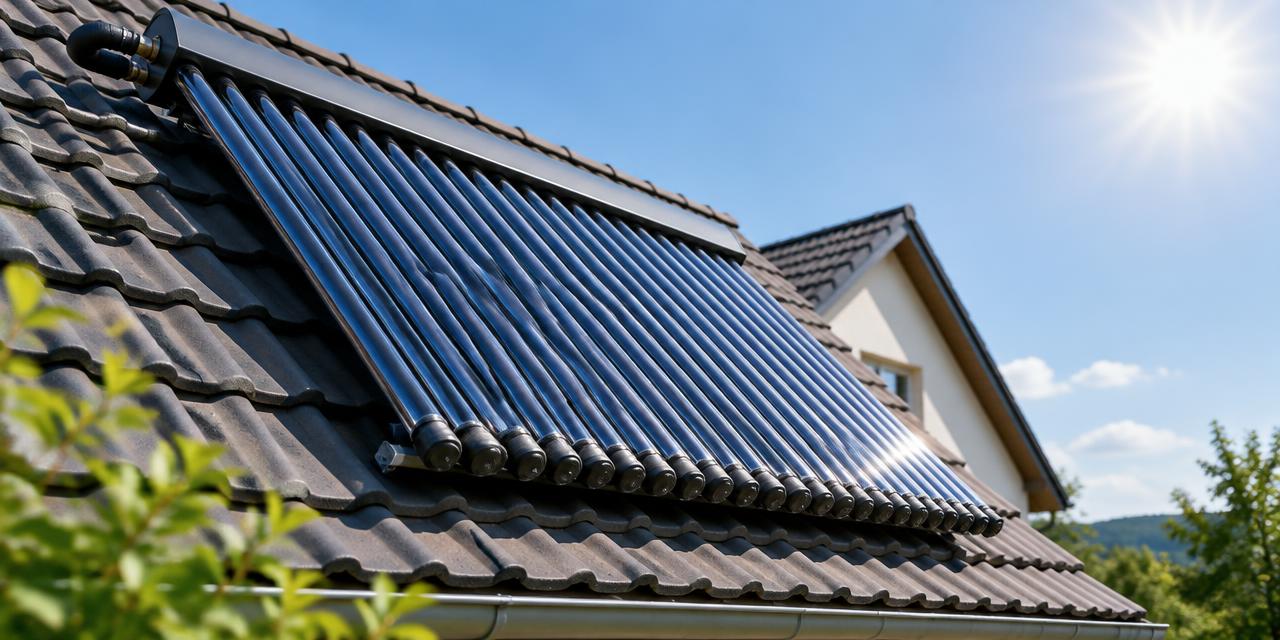
There are two main types of collectors : glazed flat plate collectors, which are robust and versatile, and vacuum tube collectors, which are more efficient in cold weather or low sunlight, albeit more expensive.
Combining collectors with a heat pump or an existing boiler requires a rigorous sizing study to ensure that both systems work in synergy rather than in opposition, thus optimizing the overall efficiency of the installation.
Beyond the collector type, the storage tank capacity is decisive. A volume that is too small does not allow for storing excess solar energy, while a volume that is too large risks water stagnation.
It is advisable to discuss with your installer intelligent control options that allow production to be managed based on weather forecasts.
These technical choices influence not only the energy efficiency but also the sustainability and future maintenance of your solar installation.
The building stock of Porrentruy is varied and requires special attention when integrating solar equipment.
For buildings constructed before 1990, the risk of asbestos in roof insulation or conduits must be systematically assessed before any drilling or fastening.
A prior thermal analysis of the building is often recommended, as installing solar thermal on an uninsulated structure is counterproductive.
The state of the internal hydraulic network must also be checked, as adding a new solar circuit can cause overpressure or require pressure balancing.
For more recent buildings, integration is often facilitated by better accessibility of attics and technical installations. However, care should be taken to ensure that the roof structure supports the weight of the collectors and heat transfer fluids.
In all cases, an inspection of the roof's watertightness is essential. The insertion of solar panels into the roof plane must be planned to avoid any thermal bridging or water infiltration, using mounting systems adapted to the specificities of local roofing.
Depending on the characteristics of your project, you will have to comply with either a simple notification procedure or a building permit application.
It is imperative to check the protection status of your building with the Porrentruy urban planning department before ordering any equipment.
If your building is listed or located in a special protection zone, restrictions on the integration of panels (color, position, inclination) may apply.
These rules aim to harmonize the aesthetics of the roofs with the historical character of the site while enabling the energy transition.
Never start work without having received written authorization from the municipal authorities, otherwise you risk having to dismantle the installation at your own expense in case of non-compliance with local rules.
It is essential to follow a precise order : the subsidy application must be submitted and validated before the start of work. Any installation started before obtaining this agreement risks losing eligibility for financial aid.
Visit the Building Program website for details on the amounts and forms specific to the canton of Jura.
Regarding taxation, investments aimed at energy saving are deductible as actual expenses from your taxable income.
For buildings over 10 years old, a flat-rate deduction of 20% of the gross yield can be applied for maintenance costs, or you can opt for the deduction of actual expenses.
This advantageous taxation constitutes a major financial lever for amortizing the cost of your installation over the long term. Remember to keep all invoices and supporting documents for future tax returns.
A solar project takes place in several key stages. Everything starts with an in-depth technical study and project validation by the municipality.
Once authorizations are obtained and aid reserved, the work begins with roof preparation, including any necessary structural reinforcement.
Installers then mount the solar collectors, connect the hydraulic circuits, and install the storage tank as well as the control systems.
It is advisable to schedule this work during a favorable period, ideally outside the months of extreme cold, to avoid constraints related to frost days and ensure optimal safety for workers on the roof.
The commissioning phase is the final step where the system is filled with heat transfer fluid, purged, and configured according to your specific needs. Temperature rise tests allow for verifying proper fluid circulation and heat exchange efficiency.
Training on the use of the control panel is also planned to allow you to monitor solar production. Once these steps are completed, the system is ready to operate, ensuring clean energy production for years to come.
To ensure the success of your project in Porrentruy, avoid some common mistakes. Never neglect the analysis of your roof's condition before installation, as any subsequent leak would be expensive to repair.
Avoid sizing the installation based solely on theoretical estimates without considering your actual consumption. Ensure that quotes explicitly include maintenance and commissioning.
Finally, never validate work without having verified its compliance with the municipal energy plan.
Here is your checklist before requesting quotes : 1. Have the structural condition and watertightness of your roof assessed. 2. Check with the urban planning department if aesthetic constraints apply to your zone. 3.
Identify your annual hot water consumption for precise sizing. 4. Ensure that the consulted companies have the necessary certifications. 5. List the financial aid you can claim by following the mandatory steps. 6.
Request a demonstration of the installation's control system. 7. Check that the warranty on collectors and equipment is clearly mentioned in the quote.
1. Estimate
Set a budget range with the estimator.
2. Grants
Apply before work starts.
3. Quotes
Compare at least 3 quotes.
4. Permit
Check with the municipality whether a permit is needed.
5. Works
Follow the site and do a written handover.
Per current schedule.
Jura support for solar thermal.
www.leprogrammebatiments.chCheck amounts and conditions with the provider before signing: apply before work starts in most cases.
2933 Lugnez · about 6.8 km
Müller Energie- und Haustechnik AG provides services in sanitary systems, heating, and renewable energy solutions.
mueller-energie.ch2350 Saignelégier · about 19.9 km
Eco6therm is a company specializing in heating solutions and renewable energy systems, including solar photovoltaics and heat pumps, serving the Jura region.
eco6therm.ch2800 Delémont · about 20.4 km
The Alvazzi Group provides comprehensive technical building services, including heating, plumbing, electrical, ventilation, and renewable energy solutions.
alvazzigroupe.com2800 Delémont · about 20.4 km
Construction and renovation company in Delémont, specializing in masonry, sanitary facilities, heating, and turnkey projects in the Jura region.
adsconstruction.chSuggestions from the commercial register by distance and activity. Not an endorsement or partnership.
A well-maintained solar thermal system can operate efficiently for 20 to 25 years. Regular maintenance helps preserve the performance of hydraulic components over the long term.
It is possible subject to obtaining the necessary authorizations from the municipality. Specific requirements regarding visual integration will likely be imposed by the urban planning department.
Yes, the system continues to capture radiation, even in cold weather. However, hot water production is then supplemented by your main boiler.
It is mandatory to submit the aid application and obtain approval before starting the work. Any prior intervention cancels eligibility for subsidies.
No, solar thermal is a supplementary solution for hot water. It cannot cover all heating needs of a building in winter on its own.
A professional installer will be able to assess the orientation, inclination, and structure of your roof. These factors directly determine the efficiency of your future installation.
Energy expenses are deductible as actual expenses. For buildings over 10 years old, you can also choose a flat rate of 20% of the gross yield.
Estimated solar yield
1'125 kWh/kWc/an
toit ~30° sud, PR 0.8, estimation
Altitude
423 m
Heating degree days
2'851 Kj/an
20/12 °C
Frost days
57 jours/an
Solar irradiation
1'278 kWh/m²/an
horizontal
Winter design temperature
-6.9 °C
1er percentile des minimales
Mean temperature
11.2 °C
Source : Open-Meteo Historical Weather API (réanalyse ERA5, moyenne 2015-2024) · swisstopo – service d'altitude (MNT)
Source : Municipalité de Porrentruy
These rules apply across the whole canton, not only in this town.
Tax deductions
Source : S0