
YB SANITAIRE YAHIAOUI
2502 Biel/Bienne · about 2.8 km
Biel-based company specializing in bathroom installation and renovation, water heater replacement, and heat pump installation.
yb-sanitaire.chHeat pump installation · Nidau
At a glance
Small project
CHF 30'000 – CHF 54'800
Typical project
CHF 37'800 – CHF 70'500
Large project
CHF 49'600 – CHF 93'900
| Project | Quantity | Low | High | Per unit |
|---|---|---|---|---|
| Small project | 80 m² | CHF 30'000 | CHF 54'800 | CHF 500 |
| Typical project | 160 m² | CHF 37'800 | CHF 70'500 | CHF 300 |
| Large project | 280 m² | CHF 49'600 | CHF 93'900 | CHF 300 |
Computed with our estimator for Nidau (regional factor included), standard finish. Only the project size changes.
Included
Not included
In Nidau, the federal building register lists 855 residential buildings and 3'707 dwellings. These municipal benchmarks help put your home in context, but do not replace an individual assessment.
82 % built before 1980
Construction year does not reveal past renovations: check the current insulation condition.
38 % · Gas
This distribution describes recorded buildings, not your system's consumption or efficiency.
| Energy | Heating | Hot water |
|---|---|---|
| Gas | 38 % | 28.7 % |
| Heating oil | 30 % | 25.7 % |
| District heating | 18 % | 17.6 % |
| Heat pump | 9 % | 6.6 % |
| Electricity | 2 % | 17.1 % |
| Wood | 3 % | 1.9 % |
| Solar thermal | 0 % | 2 % |
Each line gives the share of buildings using that energy, separately for heating and for hot water. The two columns do not always reach 100%: some buildings combine two systems, or reported none.
A standard non-condensing boiler is usually older and less efficient.
For your renovation projects in Nidau, RegBL data provides key insights. The median building volume is 1052 m3, which is essential for planning insulation or heating work, though this figure covers only a portion of the 409 houses measured according to the SIA 416 standard. Regarding heritage, one building is officially protected out of the 13 recorded cases. If your property is affected, you must contact municipal authorities early to discuss permit requirements. These structural figures help you anticipate specific constraints and project scales, ensuring that your renovation plans align with the local regulatory framework in Nidau.
Source : OFS — RegBL (export communal complet). Existing residential buildings; percentages of recorded values.
Before investing in a heat pump, the first essential step is to check whether your area can connect to a priority district heating network. In many urban areas, district heating is preferred due to its high energy efficiency.
Check with local authorities or utility providers to learn about the energy development plans for your sector.
Such an alternative could simplify your energy transition while offering a durable and robust heating solution for decades to come, potentially saving you from managing individual system maintenance.
The capacity of your heat pump must be tailored to the actual thermal needs of your building, which are set by the local design outdoor temperature.
This technical parameter is crucial to ensure winter comfort while avoiding unnecessary electricity consumption. An oversized or undersized installation can lead to premature compressor wear or a lack of heat during very cold weather.
Consult a qualified heating engineer to perform a precise calculation of heating needs based on the specific configuration and insulation of your home.
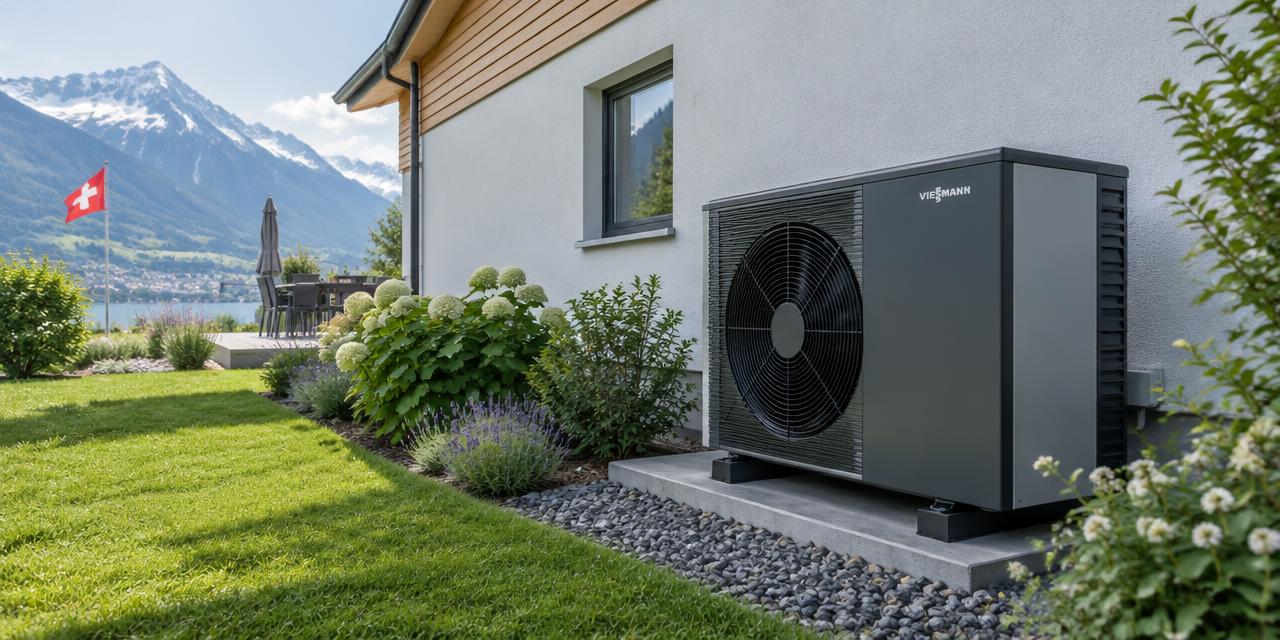
Outdoor air-water heat pumps generate a certain level of noise during operation. To ensure harmonious cohabitation, it is imperative that this equipment meets noise limits towards neighbours.
The location of the outdoor unit must be chosen carefully, avoiding placement in the immediate vicinity of neighbours' bedroom windows or living areas.
Various technical solutions exist, such as acoustic covers or optimized positioning, to reduce noise pollution to an absolute minimum and prevent potential conflicts.
Switching to a heat pump represents a significant investment, but one that adds value to your property.
Beyond equipment costs, you must account for connection works, adjustments to the existing heat distribution system, and potential insulation improvements to maximize energy savings. To get a clear view of your investment, use our RenoIndex tool.
Our simulator will provide a price range in CHF tailored to your project, helping you structure your budget effectively and move forward confidently with your renovation steps.
1. Estimate
Set a budget range with the estimator.
2. Grants
Apply before work starts.
3. Quotes
Compare at least 3 quotes.
4. Permit
Check with the municipality whether a permit is needed.
5. Works
Follow the site and do a written handover.
No specific grant listed for this work. Maintenance tax deductions may still apply.
2502 Biel/Bienne · about 2.8 km
Biel-based company specializing in bathroom installation and renovation, water heater replacement, and heat pump installation.
yb-sanitaire.ch2504 Biel/Bienne · about 4.8 km
FJUConsulting specializes in the design and installation of HVAC, plumbing, and refrigeration systems for buildings.
fjuconsulting.ch2504 Biel/Bienne · about 4.8 km
Operating in Biel/Bienne since 1948, E. Vauclair SA provides plumbing, heating and solar installations, architectural sheet metalwork, roofing and flat roof renovation.
vauclair.ch2605 Sonceboz-Sombeval · about 8.5 km
Solar conseil Sàrl specializes in the installation of photovoltaic power plants, energy storage solutions, and energy efficiency consulting in the Jura and Bernese Jura regions.
solarconseil.chSuggestions from the commercial register by distance and activity. Not an endorsement or partnership.
Use the free RenoIndex simulator to get an accurate estimate in the form of a price range in CHF. This will help you anticipate your total budget for a heat pump installation.
It is generally not mandatory, but often prioritized. Check with your municipality if your area is slated for district heating to avoid investing in a heat pump if a collective solution is planned.
Air-water heat pumps must meet strict noise limits towards neighbours. Careful positioning and the use of acoustic covers are recommended to ensure compliance and maintain good relations.
The local design outdoor temperature allows for the precise calculation of your heat pump's required capacity. This ensures optimal thermal comfort while avoiding excessive energy consumption.