
Canton
Solar thermal — Jura
Per current schedule.
Jura support for solar thermal.
www.leprogrammebatiments.chSolar water heating · Delémont
At a glance
Small project
CHF 9'200 – CHF 21'500
Typical project
CHF 11'800 – CHF 27'400
Large project
CHF 16'200 – CHF 37'300
| Project | Quantity | Low | High | Per unit |
|---|---|---|---|---|
| Small project | 3 m² | CHF 9'200 | CHF 21'500 | CHF 5'000 |
| Typical project | 6 m² | CHF 11'800 | CHF 27'400 | CHF 3'200 |
| Large project | 11 m² | CHF 16'200 | CHF 37'300 | CHF 2'300 |
Computed with our estimator for Delémont (regional factor included), standard finish. Only the project size changes.
Included
Not included
In Delémont, the federal building register lists 2'439 residential buildings and 7'748 dwellings. These municipal benchmarks help put your home in context, but do not replace an individual assessment.
65 % built before 1980
Construction year does not reveal past renovations: check the current insulation condition.
41 % · Gas
This distribution describes recorded buildings, not your system's consumption or efficiency.
| Energy | Heating | Hot water |
|---|---|---|
| Gas | 41 % | 34.3 % |
| Heating oil | 34 % | 28.2 % |
| District heating | 2 % | 1.8 % |
| Heat pump | 18 % | 17.5 % |
| Electricity | 2 % | 10 % |
| Wood | 4 % | 2.5 % |
| Solar thermal | 0 % | 5.6 % |
Each line gives the share of buildings using that energy, separately for heating and for hot water. The two columns do not always reach 100%: some buildings combine two systems, or reported none.
A standard non-condensing boiler is usually older and less efficient.
10.3 % of buildings mix housing with shops or offices.
For your renovation projects in Delémont, RegBL figures provide essential benchmarks. With a median house volume of 680.5 m3 based on partial measurements according to SIA 416, you can better estimate the scale of heating or insulation works. While the register tracks 2270 buildings, data regarding the renovation year is unavailable. Regarding heritage protection, out of 58 identified buildings, none are listed as protected. Since the data coverage for heritage status is partial across the municipal housing stock, it is always recommended to contact the municipality early to clarify specific requirements and ensure your planning process proceeds smoothly.
Source : Registre fédéral des bâtiments et des logements (RegBL), OFS, 2026. Existing residential buildings; percentages of recorded values.
Delémont, located at an altitude of 418 meters, has climatic characteristics that directly influence the profitability of a solar thermal system.
With an average temperature of 11 °C and a frost period of about 62 days per year, it is imperative to optimize hot water production before winter temperatures drop.
The revised energy master plan of the Canton of Jura strongly encourages the transition to renewable heat solutions to achieve 2050 targets, making this a particularly favorable time for an energy upgrade.
The global annual irradiation of approximately 1270 kWh/m² offers interesting potential to cover a large portion of hot water needs, especially during the summer months.
Starting these works allows you to reduce dependence on conventional heating systems that are often put under strain during cold spells.
By replacing or supplementing your current boiler, you not only benefit from improved energy efficiency but also actively contribute to the decarbonization of the city's housing stock, while anticipating future Swiss energy requirements.
Material selection is a crucial step to ensure the durability of your solar investment in Delémont.
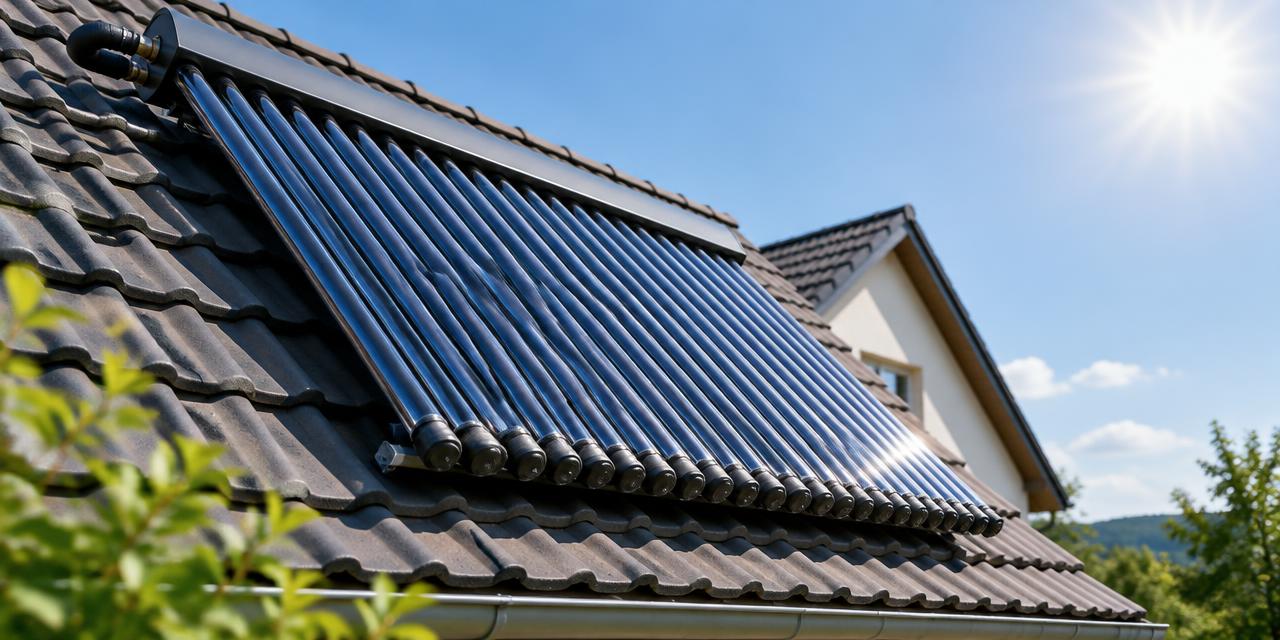
The market mainly offers two types of collectors : flat plate collectors, which are robust and suitable for constant summer production, and evacuated tube collectors, which perform better in low sunlight or at low temperatures.
The choice will depend on your roof configuration and your daily hot water needs. It should be remembered that solar collectors generally cover a large part of hot water in summer but require a backup system for the rest of the year.
Furthermore, the integration of the system into your current setup is decisive. If you plan to combine your thermal collectors with a heat pump, a rigorous sizing study is essential to avoid any functional conflicts between the technologies.
Mounting options, whether rooftop or integrated into the roof, vary according to the desired aesthetics and the technical constraints of the support.
Correct sizing prevents overheating during prolonged summer periods and ensures maximum longevity for your hydraulic circuit and heat transfer fluids.
The housing stock in Delémont is very diverse, including old buildings in the historical center and detached houses built during the urbanization waves from the 1970s to the 1990s.
For houses built before 1990, there is a risk of the presence of hazardous materials such as asbestos, particularly in roof coverings or old insulation, which must be diagnosed before attaching solar panels.
Adequate thermal insulation of your home is also an essential prerequisite before starting a solar project, so as not to lose the benefit of the energy produced in an energy-leaking structure.
The hydraulic distribution network of your home must also be inspected. In older homes, the compatibility of existing piping with new solar components may require compliance upgrades.
Similarly, the storage capacity of your hot water tank must be evaluated to match the expected yield.
A professional analysis of your roof structure is paramount to validate the weight of future installations, especially in areas of Delémont subject to heavy winter snow loads, even if these are becoming rarer over the years.
If your building is listed or located in the immediate vicinity of a historical monument, strict restrictions may limit the appearance, color, or layout of the collectors.
Before ordering equipment, it is essential to contact the municipality's urban planning department to check if your project is subject to a building permit or a simple prior notification procedure.
Municipal regulations evolve and the protection of local heritage remains a priority.
It is advisable to submit a complete file including photos of the existing site, location plans, as well as the technical characteristics of the chosen equipment.
This process secures your investment and avoids legal complications or the obligation of removal in case of non-compliance.
Don't forget to also check regulations related to safety distances from neighbors and property boundaries, especially if your installation affects the visual aspect of your neighborhood.
Dialogue with municipal authorities from the design phase is the best strategy to ensure compliance with current local standards.
Aid is granted according to the current scale, and it is imperative to submit the request before starting work to be eligible.
Property owners must consult the official Building Program website to know the precise allocation conditions and obtain the appropriate application form. This step is the sine qua non condition to benefit from cantonal subsidies aimed at energy renovation.
Tax-wise, the Canton of Jura allows a tax deduction for energy-saving investments. Expenses for these installations are deductible as effective costs.
In addition, for buildings older than 10 years, the maintenance flat rate can reach up to 20% of the gross yield, thus offering flexibility in the accounting management of your renovation.
It is recommended to carefully keep all invoices and supporting documents for the work done, as they will be required for the tax return of the relevant year.
Rigorous financial planning, by combining direct aid and tax benefits, significantly optimizes the overall cost of your project.
The execution of a solar thermal project follows a strict chronological logic.
The first step consists of the technical feasibility study and applying for permits from the municipality of Delémont, followed imperatively by the submission of the subsidy request before signing any contract.
Once authorizations are obtained, the choice of local artisans is crucial to ensure installation according to best practices.
It is preferable to avoid periods of extreme cold for the site, especially for roof work, to facilitate the work of technicians and ensure the safety of handling materials.
The site itself begins with the preparation of the roof structure, followed by the installation of brackets and collectors, then the hydraulic connection to the storage tank.
Commissioning includes filling the circuit with heat transfer fluid, setting the electronic control, and leak testing. A site acceptance is carried out to validate the proper functioning of the whole system.
This planning allows for the system to be delivered well before the most intense heating needs of the year, ensuring optimal commissioning and immediate comfort for the building's occupants.
To succeed in your project in Delémont, you must absolutely avoid signing quotes before having received confirmation of your eligibility for cantonal aid.
It is also strongly discouraged to neglect the condition of your roof: installing panels on an aging support is a source of future problems.
Never underestimate the importance of a serious sizing study, because an oversized system will risk summer overheating and an undersized system will not meet your needs.
Finally, ensure that the chosen company has proven experience in solar thermal and not just photovoltaic.
Before requesting quotes, check the following : have you consulted municipal regulations regarding landscape protection? Is your current hot water tank compatible with a solar extension?
Have you verified the absence of shadows cast by trees or neighboring buildings on your roof? Is your subsidy application file ready to be transmitted?
Ensure you have obtained at least two comparable quotes to evaluate the technical relevance of the proposed solutions. Dialogue with professionals should focus on the longevity of materials and future maintenance ease.
The durability of your solar thermal system depends directly on the quality of its periodic maintenance.
Although the system is designed to operate autonomously, it is recommended to have the hydraulic circuit and installation pressure checked every few years by a professional.
This check ensures that the heat transfer fluid has not aged prematurely and that the electronic control components are working correctly.
By combining collectors and heat pumps, regular preventive maintenance is even more essential to guarantee the overall performance of your hybrid system throughout its lifespan.
Collector cleanliness also plays a role, although rain generally helps to wash away accumulated dust. In an environment like that of Delémont, care should be taken to ensure that surrounding vegetation does not encroach on the collector area over time.
Finally, note that replacing wear parts, such as circulators or sensors, is a classic operation that, when performed by experts, significantly extends the operating life of your installation.
A well-maintained investment remains the best guarantee of long-term appreciation of your Jura real estate assets.
1. Estimate
Set a budget range with the estimator.
2. Grants
Apply before work starts.
3. Quotes
Compare at least 3 quotes.
4. Permit
Check with the municipality whether a permit is needed.
5. Works
Follow the site and do a written handover.
Per current schedule.
Jura support for solar thermal.
www.leprogrammebatiments.chCheck amounts and conditions with the provider before signing: apply before work starts in most cases.
2800 Delémont · about 0 km
The Alvazzi Group provides comprehensive technical building services, including heating, plumbing, electrical, ventilation, and renewable energy solutions.
alvazzigroupe.com2800 Delémont · about 0 km
Thermosan SA, based in Delémont and Moutier, specializes in heating systems, sanitary installations, and solar solutions, offering a 24/7 repair service.
thermo-san.ch2800 Delémont · about 0 km
Construction and renovation company in Delémont, specializing in masonry, sanitary facilities, heating, and turnkey projects in the Jura region.
adsconstruction.ch2822 Courroux · about 3.5 km
Sanit & Bilat Fils S.A. is a company specializing in sanitary installations, heating systems, and renewable energy solutions.
sanit.chSuggestions from the commercial register by distance and activity. Not an endorsement or partnership.
A well-maintained system can last between 20 and 25 years, with components like the tank potentially requiring earlier intervention. Regular maintenance by a professional is the key to achieving this longevity.
No, solar thermal is a backup system that primarily covers hot water needs in summer. It must always be coupled with a main heating system for winter needs.
Yes, it is essential to contact the urban planning department to check the procedure. Certain heritage zones impose specific aesthetic constraints.
The canton offers aid via the Building Program. You must consult their official website to know the applicable conditions and scales.
Yes, the Canton of Jura allows the deduction of energy-saving expenses. They are treated as effective costs.
The request must imperatively be submitted before the start of work. No aid is granted if the construction site has already started.
Yes, but this requires a rigorous sizing study. This allows for optimizing the overall efficiency of the system.
Estimated solar yield
1'118 kWh/kWc/an
toit ~30° sud, PR 0.8, estimation
Altitude
418 m
Heating degree days
2'931 Kj/an
20/12 °C
Frost days
62 jours/an
Solar irradiation
1'270 kWh/m²/an
horizontal
Winter design temperature
-7.9 °C
1er percentile des minimales
Mean temperature
11 °C
Source : Open-Meteo Historical Weather API (réanalyse ERA5, moyenne 2015-2024) · swisstopo – service d'altitude (MNT)
Source : Ville de Delémont
These rules apply across the whole canton, not only in this town.
Tax deductions
Source : S0