
Canton
Facade insulation — Jura
Per cantonal schedule.
Jura support for building envelope insulation.
www.leprogrammebatiments.chFacade insulation · Delémont
At a glance
Small project
CHF 18'200 – CHF 37'600
Typical project
CHF 33'500 – CHF 66'400
Large project
CHF 56'500 – CHF 109'500
| Project | Quantity | Low | High | Per unit |
|---|---|---|---|---|
| Small project | 110 m² | CHF 18'200 | CHF 37'600 | CHF 200 |
| Typical project | 220 m² | CHF 33'500 | CHF 66'400 | CHF 200 |
| Large project | 385 m² | CHF 56'500 | CHF 109'500 | CHF 200 |
Computed with our estimator for Delémont (regional factor included), standard finish. Only the project size changes.
Included
Not included
In Delémont, the federal building register lists 2'439 residential buildings and 7'748 dwellings. These municipal benchmarks help put your home in context, but do not replace an individual assessment.
65 % built before 1980
Construction year does not reveal past renovations: check the current insulation condition.
41 % · Gas
This distribution describes recorded buildings, not your system's consumption or efficiency.
10.3 % of buildings mix housing with shops or offices.
For your renovation projects in Delémont, RegBL figures provide essential benchmarks. With a median house volume of 680.5 m3 based on partial measurements according to SIA 416, you can better estimate the scale of heating or insulation works. While the register tracks 2270 buildings, data regarding the renovation year is unavailable. Regarding heritage protection, out of 58 identified buildings, none are listed as protected. Since the data coverage for heritage status is partial across the municipal housing stock, it is always recommended to contact the municipality early to clarify specific requirements and ensure your planning process proceeds smoothly.
Source : Registre fédéral des bâtiments et des logements (RegBL), OFS, 2026. Existing residential buildings; percentages of recorded values.
9 °C and about 62 frost days per year, the climate in Delémont, located at an altitude of 418 meters, places strict demands on thermal comfort.
The heating demand, illustrated by 2931 heating degree days per year, highlights the importance of an efficient building envelope to limit energy loss.
Undertaking insulation work is particularly relevant when your heating bills increase disproportionately or signs of discomfort, such as cold walls or mold, appear.
In line with the canton's revised energy master plan, these renovations are part of a global energy efficiency approach aimed at increased sobriety by 2050.
Taking action now sustainably increases the value of your property while reducing your long-term local environmental footprint.
The success of an insulation project depends on the choice of materials and the chosen technique. External thermal insulation systems (ETICS) eliminate thermal bridges, providing continuous protection for the building frame.
The choice between bio-based, mineral, or synthetic insulation will depend on your priorities: pure thermal performance, life cycle assessment, or budget.
There are different ranges of thicknesses and finishes, from traditional plasters to wood or metal siding. The finishing options are not just aesthetic; they also protect the insulation from the weather.
It is advisable to consult specialists to determine the compatibility of the system with the existing substrate.
Remember that scaffolding represents a significant part of the cost, so it is wise to couple facade insulation with window replacement or roof renovation to optimize your investment.
The building stock in Delémont presents varied characteristics requiring specific analysis. For older buildings, it is crucial to assess the state of the substrate before installing insulation, as moisture can be trapped if materials are not vapor-permeable.
A professional diagnosis helps avoid problems related to condensation.
For dwellings built before 1990, particular attention must be paid to the potential presence of pollutants, notably asbestos in certain adhesives or old insulation materials.
Before undertaking heavy work, check the condition of your electrical network and facade fixtures to anticipate compliance with regulations.
By understanding the construction era, you can choose insulation solutions that respect building physics while ensuring long-term performance.
A prior inspection by a certified expert ensures that your project meets current safety and energy efficiency standards without compromising the integrity of the structure.
It is imperative to check with the municipal administration for specific regulations related to external appearance, especially if your building is listed or located in a protected area.
Local authorities evaluate your project with regard to architectural heritage and distance regulations. Integration into the urban fabric is paramount. Never start work without having obtained the building permit issued by the competent authorities.
In case of doubt, a pre-application or informal consultation with the municipality's technical services can avoid costly refusals or modifications after the official filing of the file.
Ensure that architectural details, such as window frames, are correctly taken into account in your application, as they are often subject to special attention during the review of your file.
A golden rule must be followed : a grant application must generally be submitted before the start of work, or you risk losing your eligibility.ch.
Tax-wise, expenses for energy saving are deductible as effective expenses from your taxable income. For other maintenance costs, the canton applies a flat rate of 10% of the gross yield, or 20% if the building is over 10 years old.
This tax approach is a powerful lever to make your project profitable. Combine these aids and deductions with rigorous planning to optimize the overall financing of your work.
Keep all your invoices carefully, as they serve as supporting documents for your annual tax return.
The planning of a construction site in Delémont must take into account local climatic conditions, especially the 62 annual frost days.
The best season for external insulation is generally between spring and early autumn, a period during which temperatures allow optimal application of plasters and adhesives, guaranteeing better durability of the system.
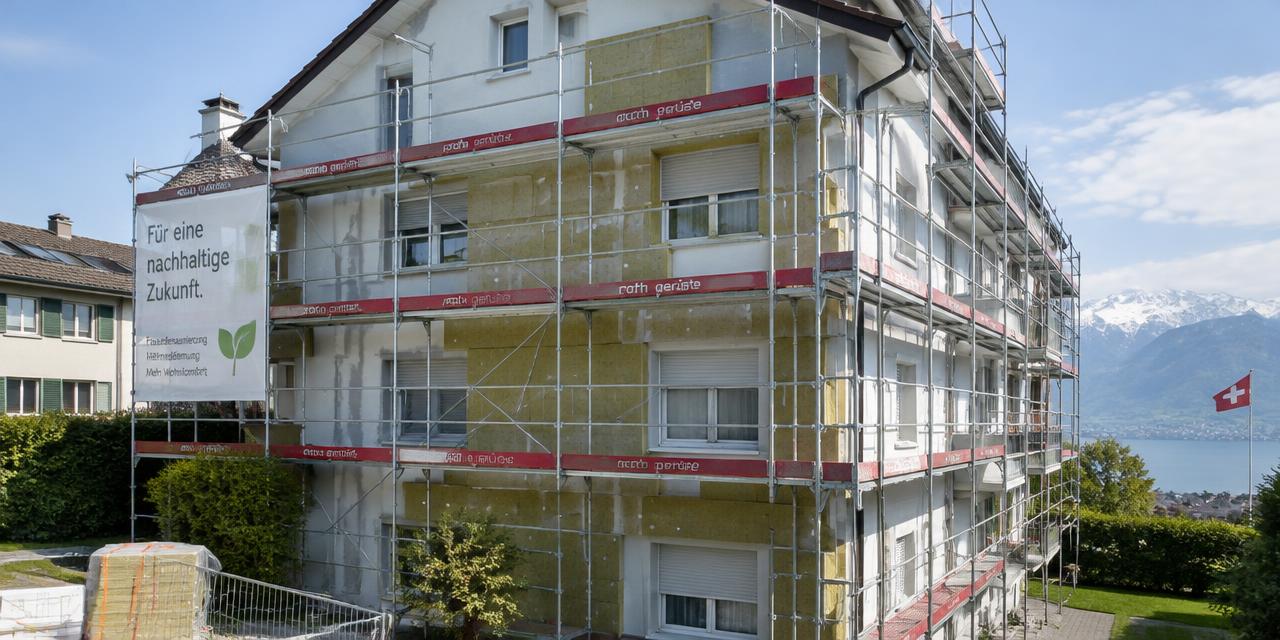
Typical progress begins with the installation of scaffolding, followed by preparation of the substrate (cleaning, treatment of cracks). Then, the insulation boards are fixed, then covered with the reinforcement layer and the protective finish.
The removal of scaffolding marks the end of the site. It is recommended to establish a realistic schedule with your contractor, taking into account potential weather hazards.
Anticipating the steps allows minimizing nuisances for occupants and guaranteeing execution in accordance with the rules of art, thus ensuring the longevity of your energy investment for decades to come.
Insufficient preparation is the main source of problems arising during facade insulation. The most common mistake is neglecting the state of the substrate, which can lead to poor adhesion of the insulation.
Also ensure that ventilation is reviewed in parallel to avoid internal condensation problems. Never neglect the administrative aspect, as starting work without authorization can lead to fines or restoration orders.
Before requesting quotes, check that your file is ready : have you carried out an energy audit? Have you identified the applicable grants? Are the architectural details documented?
Ensure that you have consulted several qualified companies to compare not only prices, but especially the quality of the technical solutions offered.
Require local references and ensure that the description of the work is complete, including waste management and finishes. The clarity of communication with your professional is the best guarantor of the success of your renovation project.
1. Estimate
Set a budget range with the estimator.
2. Grants
Apply before work starts.
3. Quotes
Compare at least 3 quotes.
4. Permit
Check with the municipality whether a permit is needed.
5. Works
Follow the site and do a written handover.
Per cantonal schedule.
Jura support for building envelope insulation.
www.leprogrammebatiments.chCheck amounts and conditions with the provider before signing: apply before work starts in most cases.
2800 Delémont · about 0 km
Based in Delémont, Thierry Chappuis Sàrl specializes in interior and exterior painting, plastering, and facade renovation.
chappuis-thierry.digitalone.site2800 Delémont · about 0 km
Construction and renovation company in Delémont, specializing in masonry, sanitary facilities, heating, and turnkey projects in the Jura region.
adsconstruction.ch2800 Delémont · about 0 km
Technical insulation specialist since 1973, ISSA SA provides solutions for thermal insulation, heating, ventilation, and acoustic protection.
issajura.ch2800 Delémont · about 0 km
Founded in 1990 in Delémont, this joinery company provides bespoke interior fittings and exterior joinery, including windows, doors, staircases, shutters, terraces and facades.
menuiserievallee.chSuggestions from the commercial register by distance and activity. Not an endorsement or partnership.
It is advisable to insulate if your heating bills increase or if there are signs of discomfort. It is optimal to couple this work with other renovations to reduce scaffolding costs.
Yes, because external insulation changes the appearance of your building. Always check with municipal authorities before starting.
You must submit an application to the Buildings Program before starting work. The website leprogrammebatiments.ch provides the necessary details.
Expenses for energy saving are deductible as effective expenses. This reduces your taxable income.
The ideal period is between spring and early autumn. Frost days must be avoided to ensure the quality of the plaster.
Yes, for buildings built before 1990. A professional inspection is recommended to identify hazardous materials.
ETICS always changes the appearance. If strict rules exist, one must choose materials and finishes close to the original.
Altitude
418 m
Heating degree days
2'931 Kj/an
20/12 °C
Frost days
62 jours/an
Solar irradiation
1'270 kWh/m²/an
horizontal
Winter design temperature
-7.9 °C
1er percentile des minimales
Mean temperature
11 °C
Source : swisstopo – service d'altitude (MNT) · Open-Meteo Historical Weather API (réanalyse ERA5, moyenne 2015-2024)
Source : Ville de Delémont
These rules apply across the whole canton, not only in this town.
Tax deductions
Source : S0