
Steinlin und Partner AG
3930 Visp · about 4.7 km
Steinlin und Partner AG is a Swiss company specializing in electrical installations, energy solutions such as photovoltaics, and IT services.
steinlin.chHome solar battery · Brigue-Glis
At a glance
Small project
CHF 4'000 – CHF 9'300
Typical project
CHF 7'400 – CHF 15'700
Large project
CHF 12'700 – CHF 25'900
| Project | Quantity | Low | High | Per unit |
|---|---|---|---|---|
| Small project | 5 kWh | CHF 4'000 | CHF 9'300 | CHF 1'200 |
| Typical project | 10 kWh | CHF 7'400 | CHF 15'700 | CHF 1'100 |
| Large project | 18 kWh | CHF 12'700 | CHF 25'900 | CHF 1'000 |
Computed with our estimator for Brigue-Glis (regional factor included), standard finish. Only the project size changes.
Included
Not included
In Brigue-Glis, the federal building register lists 1'980 residential buildings and 7'739 dwellings. These municipal benchmarks help put your home in context, but do not replace an individual assessment.
49 % built before 1980
Construction year does not reveal past renovations: check the current insulation condition.
71 % · Heating oil
This distribution describes recorded buildings, not your system's consumption or efficiency.
| Energy | Heating | Hot water |
|---|---|---|
| Gas | 3 % | 0.1 % |
| Heating oil | 71 % | 58.3 % |
| District heating | 1 % | 0.9 % |
| Heat pump | 11 % | 9.5 % |
| Electricity | 8 % | 26 % |
| Wood | 6 % | 2.5 % |
| Solar thermal | 0 % | 1.1 % |
Each line gives the share of buildings using that energy, separately for heating and for hot water. The two columns do not always reach 100%: some buildings combine two systems, or reported none.
A standard non-condensing boiler is usually older and less efficient.
8 % of buildings mix housing with shops or offices.
For your renovation projects in Brig-Glis, official RegBL figures provide vital planning metrics. While data on the renovation year is absent, the median building volume is 875 m3 per SIA 416 standards, a key metric for scaling heating or insulation upgrades. Heritage protection data remains partial, with 1605 buildings left unrecorded out of 1853. As no buildings are currently listed as protected, it is still advisable to contact the municipality early in your process. Discussing your plans proactively ensures that any potential structural modifications align with local expectations for properties located within this specific Swiss municipality.
Source : Registre fédéral des bâtiments et des logements (RegBL), OFS, 2026. Existing residential buildings; percentages of recorded values.
Brig-Glis benefits from an annual global irradiation of 1477 kWh/m²/year, offering significant solar potential for homeowners.
Installing a storage battery becomes relevant when your energy production exceeds your immediate consumption, especially during off-peak hours.
4 °C, storage allows for securing your essential household needs even when photovoltaic production declines in winter.
The local energy strategy, aiming for the Energy City Gold label, encourages energy efficiency, making this project a consistent choice with the municipality's development.
The ideal time to plan these works is during a comprehensive energy renovation or when replacing your solar inverter. By integrating the battery into the existing system, you maximize the efficiency of your panels.
Consider this investment as a long-term preparation, in line with cantonal and municipal decarbonization goals.
Energy storage allows for smoothing demand peaks, especially in a context where heating needs, influenced by 3019 heating degree days per year, remain predominant in the region.
Storage capacity is the primary determining factor for your project in Brig-Glis. A well-sized battery should be correlated to your actual nightly consumption rather than the peak power of your panels.
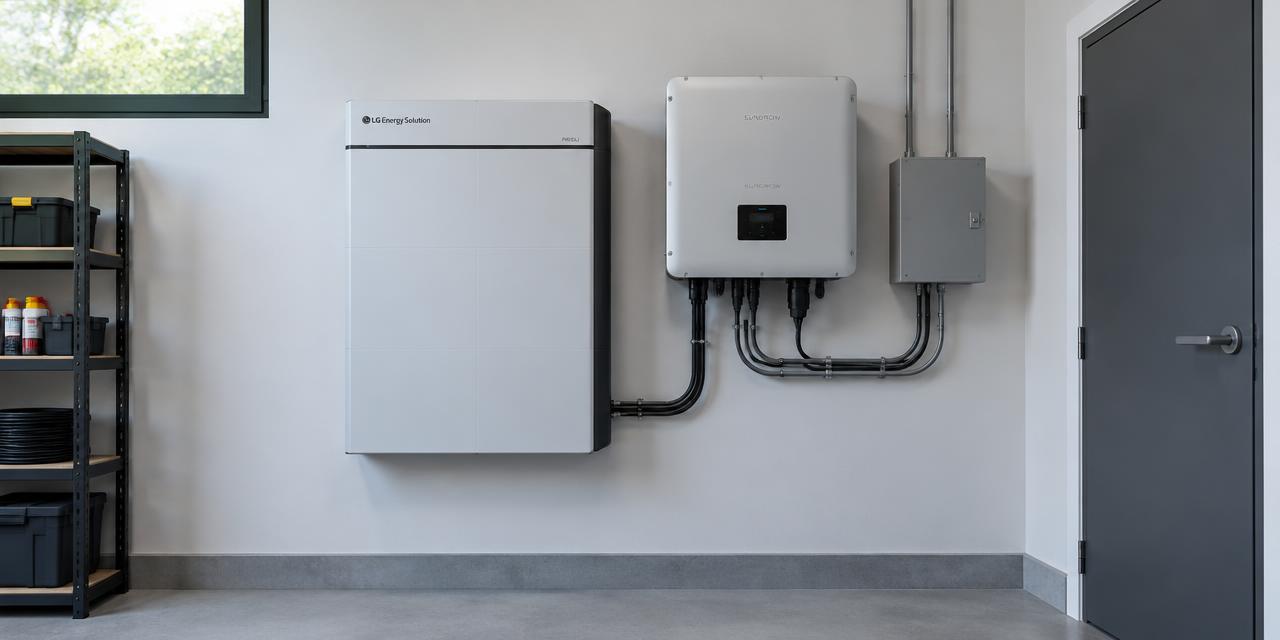
There are AC-coupled or DC-coupled systems, each offering advantages depending on whether you already own a solar installation or are creating a new one.
Lithium-iron-phosphate technologies are currently preferred for their durability and increased thermal safety in environments subject to climatic variations.
Furthermore, the choice of the hybrid inverter is crucial for system compatibility. Carefully check the compatibility between battery brands and your existing inverter to avoid efficiency losses during energy conversion.
Some advanced options include emergency power functions in case of grid failure, requiring a specific installation compliant with current standards.
Also, consider the location of the battery : it should ideally be installed in a temperate space, protected from frost and well-ventilated to maintain its performance throughout the year.
An analysis of your annual consumption profile is essential to avoid under-sizing, which would make the investment useless, or expensive over-sizing.
In Brig-Glis, the housing stock presents varied characteristics, from old village houses to more recent constructions. Buildings dating from before 1990 require special attention regarding electrical compliance before integrating a storage system.
Indeed, the age of electrical panels can complicate the connection and require prior standardization to ensure safety.
Thermal insulation of attics or basements, where batteries are often stored, must also be verified to avoid thermal shocks that harm the cells' lifespan.
For recent constructions, integration is facilitated by prepared infrastructures, but one must ensure that conduits for power and communication cables are accessible.
In any case, the weight of the battery is a structural element to consider if you plan wall mounting. Stone walls of old buildings present technical challenges for the secure anchoring of heavy equipment.
Before any intervention, have the capacity of your home electrical network audited.
An existing solar installation on an old roof could also hide sealing problems which, if not fixed, expose the electronics of your storage system to humidity, permanently compromising its integrity and your investment.
However, the chosen location must comply with fire safety rules, especially if the installation is in a confined technical room.
For any major modification of electrical installations, it is imperative to request a connection authorization from the local network operator to validate the impact on the meter and the distribution network.
If your building is listed or located in a protected area, check if aesthetic or structural restrictions apply, although batteries are mainly indoor equipment.
It is highly recommended to contact the town planning department of the municipality of Brig-Glis before launching your project. They can inform you about possible local restrictions or specific guidelines for your plot area.
Compliance with electrical safety standards is the absolute priority; any installation must be carried out by qualified professionals who will take care of the declaration of conformity.
Never skip this verification step with the town hall, as it protects your insurance coverage in the event of an electrical incident.
Rigorous planning with the competent authorities ensures the owner's peace of mind and the long-term compliance of the installation.
It is crucial to consult the official website of the Confederation and the energy portal of the Canton of Valais to check if local or municipal promotion programs have been activated recently.
The order of procedures is imperative : you must absolutely obtain confirmation of eligibility or a grant decision before incurring any costs or signing a quote. Failure to respect this anteriority systematically leads to the refusal of any aid.
On the tax front, investments in energy efficiency and renewable energy production are generally deductible from taxable income. These tax deductions help reduce the overall tax burden of the owner.
It is advisable to keep all detailed invoices and compliance proofs for your tax return. Consult your tax administration or a tax advisor to validate the specific deduction modalities applicable in the Canton of Valais.
Also consider that if the storage installation increases the market value of your property, this could influence your property tax base.
Remain vigilant towards commercial offers promising automatic aid without prior verification, as they do not replace the necessary official steps.
Planning a solar storage project in Brig-Glis requires a structured approach to avoid setbacks. The first phase consists of analyzing your consumption profile, followed by requesting quotes from qualified companies.
Once the quote is chosen, the administrative phase begins with the request for connection authorization from the network operator.
It is recommended to launch these procedures during frost-free months, ideally between spring and early autumn, to facilitate access to the site and ensure that interior electrical installations are not subject to extreme humidity conditions.
Once authorizations are obtained, equipment is ordered. The project itself, if well prepared, is relatively fast. Technicians first proceed to connect the energy management system, then install the batteries and conduct safety tests.
The time required depends on the complexity of your current installation and the possible need to upgrade your electrical panel. Once the work is finished, a compliance inspection is carried out to validate the system.
Commissioning is accompanied by training on using monitoring tools via your solar management application.
By following this chronological order, you ensure a smooth transition to self-consumption, minimizing the risk of administrative or technical blocking along the way.
The first common mistake is to size the battery only based on the power of the solar panels instead of the actual nightly consumption. It is essential to perform a complete energy audit before committing.
Another classic mistake is forgetting to verify technical compatibility between the battery and the existing inverter, which can lead to significant material replacement costs.
Furthermore, never ignore the need for an official connection request, as this could make your installation non-compliant and invalidate your home insurance.
Avoid choosing a company based solely on a low price without checking its qualifications or local reviews.
Checklist before requesting quotes : 1. Analyze your electricity bills to determine your precise nightly consumption. 2. Check the condition of your electrical panel to anticipate a standardization upgrade. 3.
Identify a temperate and dry location in your building for the future battery. 4. Check the brand and model of your current solar inverter. 5. Contact your municipality to learn about possible zone rules. 6.
Prepare a simple file describing your existing solar installation. 7. Always request at least three comparable quotes from certified companies. 8. Ensure that each quote includes commissioning fees and declaration of conformity costs.
By following these points, you reduce unforeseen events and optimize the success of your energy project.
1. Estimate
Set a budget range with the estimator.
2. Grants
Apply before work starts.
3. Quotes
Compare at least 3 quotes.
4. Permit
Check with the municipality whether a permit is needed.
5. Works
Follow the site and do a written handover.
No specific grant listed for this work. Maintenance tax deductions may still apply.
3930 Visp · about 4.7 km
Steinlin und Partner AG is a Swiss company specializing in electrical installations, energy solutions such as photovoltaics, and IT services.
steinlin.ch3930 Visp · about 4.7 km
TZ Stromag offers comprehensive electrical engineering services for residential buildings, including installations, telematics services, and security.
stromag.ch3942 Raron · about 10.8 km
TZ Stromag is a full-service provider of electrical engineering for buildings, covering installations, automation, security, and in-house switchgear construction.
stromag.ch3929 Täsch · about 28.9 km
Specialist for electrical installations, photovoltaics, and household appliances with branches in Täsch and Visp.
imboden-elektro.chSuggestions from the commercial register by distance and activity. Not an endorsement or partnership.
Not necessarily, but it depends on the compatibility of your current inverter. A hybrid inverter is often required to manage the bidirectional flow of a battery, otherwise a separate AC-coupled system will be needed.
Yes, as long as it is installed in a frost-protected space. Batteries lose efficiency below 0 °C, so it is crucial to keep them in a temperate environment.
Modern lithium-iron-phosphate batteries have a typical lifespan of 10 to 15 years. Their performance gradually decreases after several thousand charge cycles.
Rarely. A battery optimizes your self-consumption, but does not replace the grid during periods of prolonged low winter sunlight. It supplements your energy supply.
Yes, any modification of the electrical system impacting the grid must be notified. Your installer generally takes care of this mandatory technical declaration.
Ideally in a dry basement or an insulated technical room. Damp and uninsulated spaces must be avoided to prevent any risk related to electronic components.
There is no guaranteed direct aid for storage. Always consult the Canton of Valais website and your municipality before starting to check current programs.
Estimated solar yield
1'300 kWh/kWc/an
toit ~30° sud, PR 0.8, estimation
Source : Open-Meteo Historical Weather API (réanalyse ERA5, moyenne 2015-2024)
Source : Stadtgemeinde Brig-Glis