
Canton
Solar thermal — Fribourg
Per current schedule.
Fribourg support for solar thermal.
www.leprogrammebatiments.chSolar water heating · Villars-sur-Glâne
At a glance
Small project
CHF 10'100 – CHF 23'600
Typical project
CHF 13'000 – CHF 30'200
Large project
CHF 17'800 – CHF 41'000
| Project | Quantity | Low | High | Per unit |
|---|---|---|---|---|
| Small project | 3 m² | CHF 10'100 | CHF 23'600 | CHF 5'500 |
| Typical project | 6 m² | CHF 13'000 | CHF 30'200 | CHF 3'500 |
| Large project | 11 m² | CHF 17'800 | CHF 41'000 | CHF 2'600 |
Computed with our estimator for Villars-sur-Glâne (regional factor included), standard finish. Only the project size changes.
Included
Not included
In Villars-sur-Glâne, the federal building register lists 1'440 residential buildings and 5'779 dwellings. These municipal benchmarks help put your home in context, but do not replace an individual assessment.
41 % built before 1980
Construction year does not reveal past renovations: check the current insulation condition.
31 % · Gas
This distribution describes recorded buildings, not your system's consumption or efficiency.
| Energy | Heating | Hot water |
|---|---|---|
| Gas | 31 % | 34.3 % |
| Heating oil | 21 % | 18.3 % |
| District heating | 19 % | 9.2 % |
| Heat pump | 19 % | 20.4 % |
| Electricity | 8 % | 15.3 % |
| Wood | 2 % | 0.9 % |
| Solar thermal | 0 % | 1.8 % |
Each line gives the share of buildings using that energy, separately for heating and for hot water. The two columns do not always reach 100%: some buildings combine two systems, or reported none.
A standard non-condensing boiler is usually older and less efficient.
6.9 % of buildings mix housing with shops or offices.
For homeowners in Villars-sur-Glâne, RegBL figures provide critical planning context. Eight buildings are under heritage protection, requiring early contact with municipal authorities for permit feasibility. Regarding scale, the median house volume is 830 m3 based on SIA 416, which helps gauge the scope of necessary heating or insulation upgrades. Please be aware that data coverage is partial; volume measurements are available for only 43 out of 749 houses, and heritage status is known for just 75 out of 1388 total buildings. Always verify these figures with local documentation before finalizing your renovation budget.
Source : Registre fédéral des bâtiments et des logements (RegBL), OFS, 2026. Existing residential buildings; percentages of recorded values.
At an altitude of 664 meters, Villars-sur-Glâne presents climatic conditions where renewable energies make perfect sense.3 °C and significant heating needs, solar thermal energy offers an efficient solution to reduce your dependence on fossil fuels.
With 96 frost days per year and an interesting global irradiation of 1354 kWh/m²/year, your roof has real potential to contribute to your domestic hot water production. The Communal Climate Plan adopted in late 2024 actively encourages these initiatives.
It is wise to plan this work during a comprehensive renovation of your roof or when replacing your heating system. Anticipating these investments allows you to optimize costs by integrating collectors when roof access is facilitated.
By aligning your project with local climate goals, you concretely contribute to improving the energy efficiency of the local building stock while enhancing your real estate value in the long term.
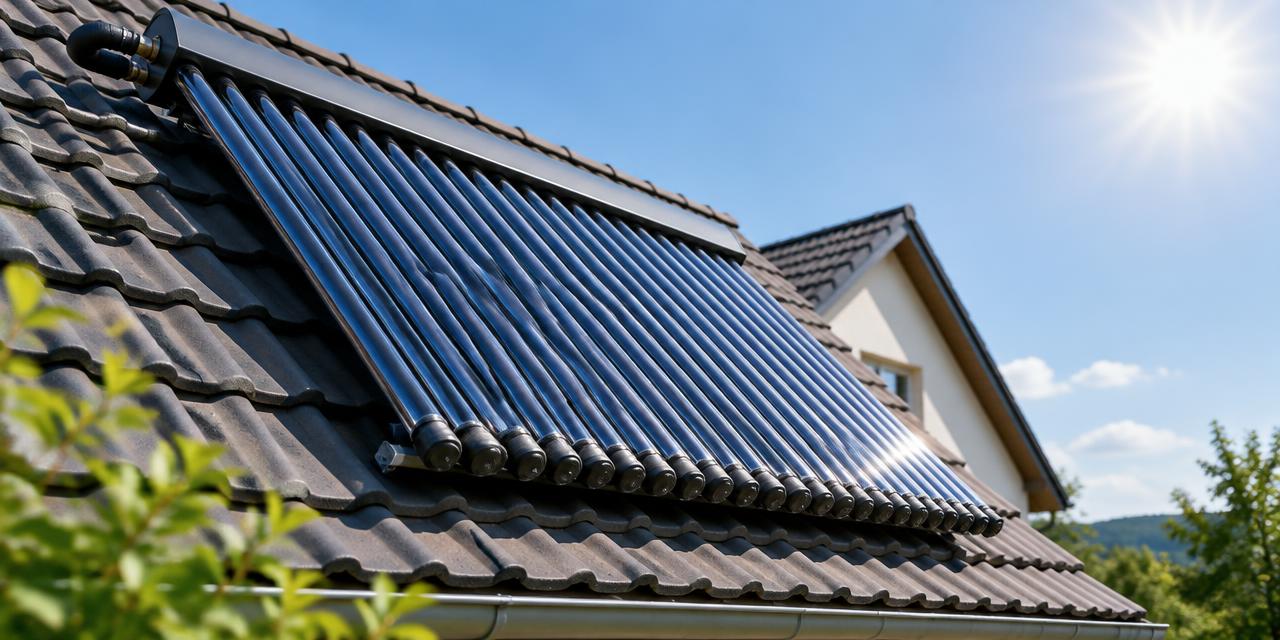
The choice between flat plate collectors and vacuum tube collectors is the first decisive step. Flat plate collectors are robust, often more affordable, and perfectly suited for intense summer and spring use.
Conversely, vacuum tube models offer better efficiency when outside temperatures are low, which can be advantageous during the cool periods experienced in Villars-sur-Glâne.
Sizing must be done by a professional to ensure optimal coverage of your needs without unnecessary overproduction during the summer months.
Integration into the building also influences cost and aesthetics. You can opt for an on-roof installation, which is simpler to implement, or full integration where collectors replace part of the tiles.
Furthermore, combination with a heat pump requires a rigorous sizing study. Solar thermal collectors generally cover a large part of summer hot water, but their interaction with your existing heating system must be harmonized.
Remember to check the compatibility of your current hot water tank, which might require an upgrade to accommodate solar gain.
Houses built before 1990 require special vigilance regarding the potential presence of pollutants, such as asbestos, during any roof intervention. It is imperative to carry out a diagnosis before starting work to ensure the safety of workers and occupants.
In addition, the state of roof insulation is a limiting factor: installing solar collectors on a poorly insulated roof means losing part of the energy benefit through structural heat loss.
For more recent homes, the challenge lies more in the compatibility of control systems. Existing distribution networks must be checked to ensure they support the temperatures carried by the solar circuit.
In any case, ensure that the roof structure can support the weight of the panels. If your building is over ten years old, you benefit from specific tax rules for energy renovation works, making the investment all the more attractive.
Always evaluate the overall health of your roof before adding heavy elements to avoid costly repairs in the years following the installation.
Although many installations are facilitated to encourage energy transition, specific rules may apply if your property is located in a protected area or if it has particular historical importance.
Never assume exemption from a permit application, even for what seems like a standard installation.
Explicitly ask if your project requires a building permit or just a notification of work. Also check guidelines regarding visual appearance, especially the integration of collectors on the roof.
Prior discussion with local authorities validates the compliance of your file before committing to equipment costs. Also be attentive to property line setbacks and local fire safety regulations.
Proactive verification with municipal services will protect you against any later requirements for dismantling due to administrative non-compliance.
Any installation started before the validation of your application cannot claim financial aid. Consult the official Buildings Program website to know the amounts according to current scales.
These subsidies are an important lever to reduce the initial cost of your project.
On the tax side, investments in renewable energy and energy efficiency are deductible. If you own a building over 10 years old, you can choose to deduct either the actual costs or a flat rate of 20% of the rental value.
For buildings less than 10 years old, the flat rate is 10%.
A very advantageous point is the carry-forward rule : if your deductible expenses exceed the income of your property for the current tax year, you can carry this excess over to the next two tax periods.
This allows you to smooth out the tax impact of your investment.
The execution of your solar project should be planned to avoid periods of extreme cold.
Although work can be carried out in any season, it is preferable to avoid days of intense frost to ensure worker comfort and the proper implementation of hydraulic components.
The first step is to obtain necessary authorizations and the validation of your financial aid application.
Once these documents are obtained, the schedule revolves around ordering equipment, whose delivery must be synchronized with the installer's availability.
Steps on site start with preparing the roof, including installing mounting systems. Next comes the installation of solar collectors, followed by hydraulic connection to the technical room.
The last phase includes filling the circuit with heat transfer fluid and commissioning. This step is crucial as it allows testing for tightness and control settings.
Plan a project handover phase to check, with the installer, that the system works according to projected hot water production for your household.
The most common error is starting work before receiving confirmation for financial aid. Ensure you have checked the condition of your roof, as installing panels on an aging structure is a source of future problems.
Never neglect aesthetic integration, as an installation that distorts a roof can cause problems with municipal authorities. It is also risky to under-size or over-size the system without a study of real needs.
Do not forget to request quotes detailing expected performance and component warranties.
Checklist before requesting quotes : check the age and condition of your roof with a professional. Ensure your hot water tank is compatible with a solar extension. Prepare a simple document listing your current annual hot water consumption.
Consult current municipal regulations in Villars-sur-Glâne regarding exterior appearance. Explicitly ask if the quote includes commissioning and user training. Confirm that the company is qualified for roofing and hydraulic work.
Finally, validate with your cantonal office the steps to obtain subsidies before any signature.
1. Estimate
Set a budget range with the estimator.
2. Grants
Apply before work starts.
3. Quotes
Compare at least 3 quotes.
4. Permit
Check with the municipality whether a permit is needed.
5. Works
Follow the site and do a written handover.
Per current schedule.
Fribourg support for solar thermal.
www.leprogrammebatiments.chCheck amounts and conditions with the provider before signing: apply before work starts in most cases.
1762 Givisiez · about 2 km
AC Energies SA specializes in the engineering, installation, and maintenance of HVAC systems, as well as heating solutions utilizing renewable energy.
ac-energies.ch1762 Givisiez · about 2 km
VCS Maintenance SA is a family-run business based in Givisiez specializing in the installation and maintenance of heating, ventilation, and plumbing systems in the canton of Fribourg.
vcs-maintenance.ch1753 Matran · about 2.7 km
Caltech Sàrl specializes in the installation, maintenance, and 24/7 emergency repair of heating, sanitary, and solar thermal systems.
caltech.ch1700 Fribourg · about 3.2 km
Fribourg-based company specializing in tinwork, roofing, plumbing, heating systems, and solar panel installations.
jr-sarl.chSuggestions from the commercial register by distance and activity. Not an endorsement or partnership.
You can benefit from Fribourg aid through the Buildings Program. It is essential to submit your application before starting work.
Yes, it is highly recommended to check with the urban planning department of Villars-sur-Glâne. Each project must be validated according to local rules.
Yes, the solar potential is real thanks to satisfactory annual irradiation. The system sustainably reduces your energy bills in summer.
Yes, investments in energy efficiency are deductible. The excess can be carried forward to the next two tax periods.
The duration depends on the scope of the site and the complexity of the integration. Consult your installer for a personalized estimate.
You benefit from advantageous tax conditions for renovation. You can deduct either the actual costs or a flat rate of 20%.
No, but a study is necessary to ensure compatibility. Often, a simple upgrade of the tank is sufficient.
Estimated solar yield
1'192 kWh/kWc/an
toit ~30° sud, PR 0.8, estimation
Altitude
664 m
Heating degree days
3'472 Kj/an
20/12 °C
Frost days
96 jours/an
Solar irradiation
1'354 kWh/m²/an
horizontal
Winter design temperature
-9.3 °C
1er percentile des minimales
Mean temperature
9.3 °C
Source : Open-Meteo Historical Weather API (réanalyse ERA5, moyenne 2015-2024) · swisstopo – service d'altitude (MNT)
Source : Commune de Villars-sur-Glâne
These rules apply across the whole canton, not only in this town.
Tax deductions
Source : Administration Cantonale des Impôts du Canton de Fribourg