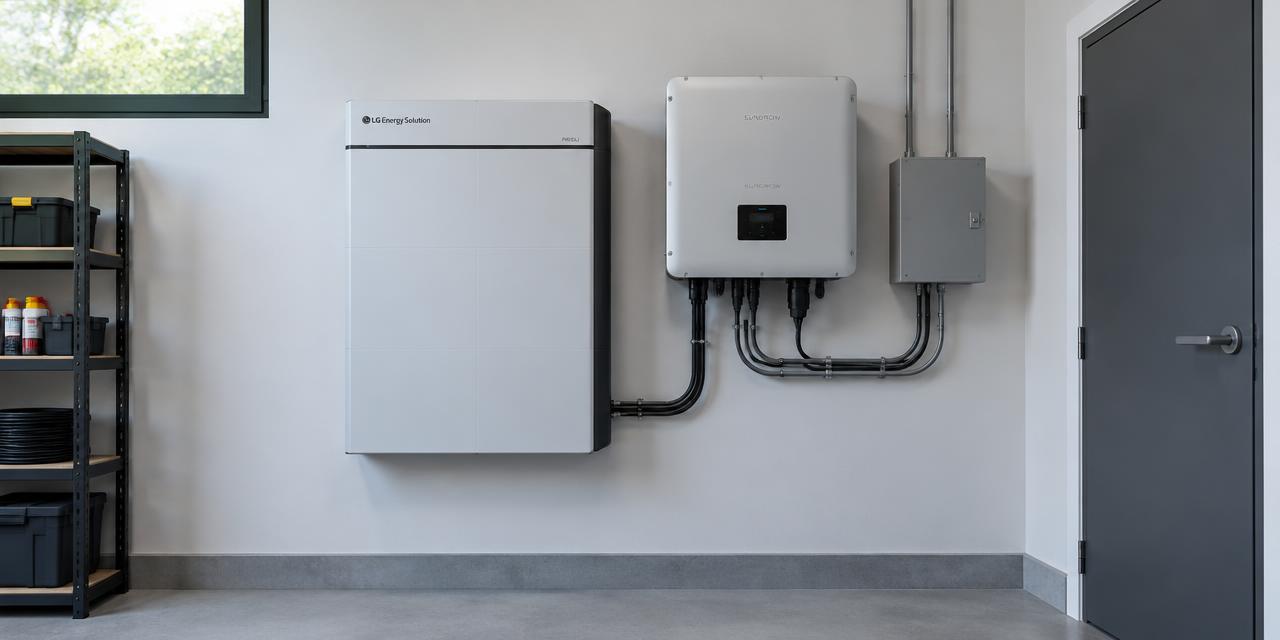
Installing a home solar battery in Saanen is an excellent initiative to optimize your energy self-consumption. By capturing excess electricity produced during the day, you reduce your reliance on the power grid during the evening. This project requires careful thought regarding your actual electricity needs. To get an accurate cost estimate tailored to your residential situation, use the free RenoIndex estimator. It will allow you to plan your budget with confidence while considering the specifics of your existing installation to maximize efficiency.
At a glance
Typical budget
CHF 7'400 – CHF 15'700
Midpoint
CHF 10'700
Grants found
0
Nearby companies
4
Worked examples in Saanen
Small project
CHF 4'000 – CHF 9'300
Typical project
CHF 7'400 – CHF 15'700
Large project
CHF 12'700 – CHF 25'900
Project
Quantity
Low
High
Per unit
Small project
5 kWh
CHF 4'000
CHF 9'300
CHF 1'200
Typical project
10 kWh
CHF 7'400
CHF 15'700
CHF 1'100
Large project
18 kWh
CHF 12'700
CHF 25'900
CHF 1'000
Computed with our estimator for Saanen (regional factor included), standard finish. Only the project size changes.
Cost split (typical project)
Labour :CHF 2'100(20 %)
Materials :CHF 7'500(70 %)
Other costs :CHF 1'100(10 %)
What the price covers
Included
Supply and installation
VAT
Battery, charge management and standard connection; options according to answers
Not included
Permits and architect fees
Unexpected structural issues
Possible subsidies
Solar panels and complete electrical refurbishment
Saanen's housing stock in figures
In Saanen, the federal building register lists 2'904 residential buildings and 6'905 dwellings. These municipal benchmarks help put your home in context, but do not replace an individual assessment.
71 %built before 1980
48 %heated by oil or gas
19.4 %electric hot water
3.5 %with declared solar thermal
Age of residential buildings
71 % built before 1980
Before 191930 %
1919–19455 %
1946–196011 %
1961–197014 %
1971–198011 %
1981–19908 %
1991–20006 %
2001–20106 %
Since 201110 %
Construction year does not reveal past renovations: check the current insulation condition.
Main heating energy
46 % · Heating oil
Heating oil46 %
Wood29 %
Heat pump11 %
District heating6 %
Electricity5 %
Gas2 %
This distribution describes recorded buildings, not your system's consumption or efficiency.
Heating and hot water: which energies?
Energy
Heating
Hot water
Gas
2 %
1.8 %
Heating oil
46 %
49.6 %
District heating
6 %
5.9 %
Heat pump
11 %
7.3 %
Electricity
5 %
19.4 %
Wood
29 %
14.7 %
Solar thermal
0 %
1.1 %
Each line gives the share of buildings using that energy, separately for heating and for hot water. The two columns do not always reach 100%: some buildings combine two systems, or reported none.
Type of heating system
Boiler (unspecified)48.1 %
Stove14.9 %
Heat pump11.2 %
Standard boiler10.7 %
Heat exchanger (district)6.2 %
Central electric heating4.8 %
Condensing boiler3.3 %
A standard non-condensing boiler is usually older and less efficient.
Houses or apartment buildings?
Single-family houses45 %
Two-dwelling houses24.5 %
Apartment buildings (3+)30.4 %
Other0 %
29.6 % of buildings mix housing with shops or offices.
The typical building
storeys (median)
3
median footprint
139 m²
median dwelling area
80 m²
Renovations, heritage and volumes
For your renovation plans in Saanen, the official building registry data provides essential context. Regarding heritage protection, 42 out of 374 known buildings are protected, meaning you must contact the municipality early to navigate permit requirements. The median building volume is 1496 m3; however, this figure covers only 31 of the 1308 houses measured under the SIA 416 standard, with the remainder using other metrics. Please be aware that data coverage for building volume is partial and information regarding the renovation year is not available in the current registry for this municipality.
42
buildings flagged as protected
status known for 374 of 2'904 buildings; check with the municipality
A storage battery is particularly useful when your solar output clearly exceeds your daytime use. Without storage, this surplus is fed into the grid. By storing this energy, you can power your household appliances when the sun has gone down.
This increases the self-consumption rate of your home in Saanen, thereby optimizing your return on investment.
Carefully analyze your daily consumption profile before getting started, as this balance between generation and usage will determine the actual profitability of your new storage system.
System sizing
It is crucial to size your battery capacity based on your evening consumption, rather than the total power of your photovoltaic panels. An oversized system unnecessarily increases investment costs without guaranteeing increased efficiency.
Identify the energy-hungry appliances used during your evenings to define the optimal size. Do not hesitate to consult a professional for a precise technical study.
RenoIndex helps you visualize price ranges for different capacities to facilitate your purchasing decision and avoid common planning mistakes.
Compatibility and installation
Before any purchase, you must check compatibility with your existing inverter. Some battery models require specific interfaces or a hybrid inverter to function properly.
Improper integration can reduce system performance or lead to additional labor costs during installation. Ensure the space chosen for the battery complies with current safety standards.
By using the RenoIndex estimator, you can obtain a budget estimate that includes these technical aspects, allowing you to compare installer quotes against reliable price databases.
Budget planning
Budget planning is the most important step for your renovation project in Saanen. Beyond equipment costs, include electrical installation fees, any necessary upgrades to your distribution board, and commissioning fees.
Research available grants, although no specific subsidies have been listed for this municipality. Transparency is key to a successful project.
Use RenoIndex to get a realistic price range for your installation, giving you a solid negotiation lever with local contractors.
Your project in 5 steps
1. Estimate
Set a budget range with the estimator.
2. Grants
Apply before work starts.
3. Quotes
Compare at least 3 quotes.
4. Permit
Check with the municipality whether a permit is needed.
5. Works
Follow the site and do a written handover.
Grants and subsidies
No specific grant listed for this work. Maintenance tax deductions may still apply.
Companies in the area
Contrôle EXpert Sàrl, succursale de Châtel-Saint-Denis
1618 Châtel-St-Denis · about 24.7 km
Contrôle EXpert Sàrl is an inspection body specializing in periodic and acceptance testing of electrical installations, including photovoltaic systems and charging stations.
NAO Energy SA is a company specializing in energy transition solutions, installing solar panels, heat pumps, and storage systems across French-speaking Switzerland.
Suggestions from the commercial register by distance and activity. Not an endorsement or partnership.
Frequently asked questions
Is a battery essential?
No, it is not essential, but it is very useful if you want to increase your solar self-consumption. Without one, you feed your surplus into the grid. A RenoIndex study will help you decide.
How to estimate costs?
Costs vary based on capacity. To get a reliable price range tailored to your project in Saanen, use the free RenoIndex estimator which aggregates Swiss market data.
What is the main compatibility factor?
Compatibility with your current solar inverter is essential. Ensure the chosen model can technically integrate with your existing setup to avoid unforeseen expenses or performance issues.
Should I size according to panel power?
No, it is advisable to size storage capacity primarily based on your actual consumption during the evening. This avoids investing in capacity that is excessive for your daily needs.