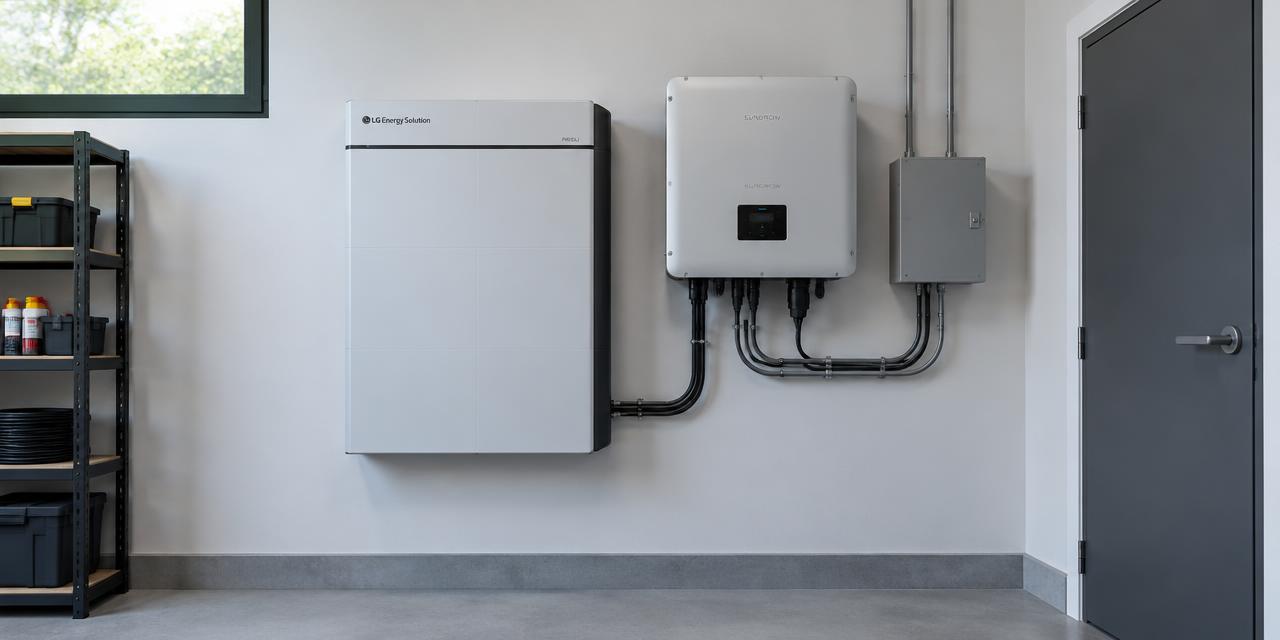
Installing a solar battery in Lyss: Guide and tips
Are you planning to optimize your photovoltaic system in Lyss by adding a storage unit? Integrating a home solar battery allows you to maximize self-consumption and reduce your reliance on the local power grid. This guide helps you understand the essential criteria for selecting your equipment. Before starting the work, remember to use the free RenoIndex estimator to get a precise price range in Swiss francs, ensuring you can plan your energy investment in the canton of Bern with complete peace of mind.
At a glance
Typical budget
CHF 7'400 – CHF 15'700
Midpoint
CHF 10'700
Grants found
0
Nearby companies
4
Worked examples in Lyss
Small project
CHF 4'000 – CHF 9'300
Typical project
CHF 7'400 – CHF 15'700
Large project
CHF 12'700 – CHF 25'900
Project
Quantity
Low
High
Per unit
Small project
5 kWh
CHF 4'000
CHF 9'300
CHF 1'200
Typical project
10 kWh
CHF 7'400
CHF 15'700
CHF 1'100
Large project
18 kWh
CHF 12'700
CHF 25'900
CHF 1'000
Computed with our estimator for Lyss (regional factor included), standard finish. Only the project size changes.
Cost split (typical project)
Labour :CHF 2'100(20 %)
Materials :CHF 7'500(70 %)
Other costs :CHF 1'100(10 %)
What the price covers
Included
Supply and installation
VAT
Battery, charge management and standard connection; options according to answers
Not included
Permits and architect fees
Unexpected structural issues
Possible subsidies
Solar panels and complete electrical refurbishment
Lyss's housing stock in figures
In Lyss, the federal building register lists 2'556 residential buildings and 7'998 dwellings. These municipal benchmarks help put your home in context, but do not replace an individual assessment.
47 %built before 1980
59 %heated by oil or gas
31.6 %electric hot water
1.8 %with declared solar thermal
Age of residential buildings
47 % built before 1980
Before 19195 %
1919–194511 %
1946–196010 %
1961–19709 %
1971–198012 %
1981–199012 %
1991–200015 %
2001–201014 %
Since 201113 %
Construction year does not reveal past renovations: check the current insulation condition.
Main heating energy
38 % · Heating oil
Heating oil38 %
Heat pump26 %
Gas21 %
Wood6 %
District heating5 %
Electricity4 %
This distribution describes recorded buildings, not your system's consumption or efficiency.
Heating and hot water: which energies?
Energy
Heating
Hot water
Gas
21 %
18.6 %
Heating oil
38 %
30.4 %
District heating
5 %
3.9 %
Heat pump
26 %
9.4 %
Electricity
4 %
31.6 %
Wood
6 %
4 %
Solar thermal
0 %
1.7 %
Each line gives the share of buildings using that energy, separately for heating and for hot water. The two columns do not always reach 100%: some buildings combine two systems, or reported none.
Type of heating system
Boiler (unspecified)39.4 %
Heat pump26.1 %
Standard boiler13.2 %
Condensing boiler11.3 %
Heat exchanger (district)4.8 %
Central electric heating3.5 %
Stove1.1 %
A standard non-condensing boiler is usually older and less efficient.
Houses or apartment buildings?
Single-family houses60.5 %
Two-dwelling houses7.6 %
Apartment buildings (3+)31.8 %
8.5 % of buildings mix housing with shops or offices.
The typical building
storeys (median)
3
median footprint
120 m²
median dwelling area
94 m²
Renovations, heritage and volumes
For your renovation planning in Lyss, the RegBL figures provide useful benchmarks, even though the data coverage remains partial. With a median building volume of 707 cubic meters based on the SIA 416 standard, you can better estimate the scale of necessary heating or insulation work, though this applies only to a measured subset of properties. Since there are no recorded data points regarding renovation years or heritage protection status for the municipality, you should contact local authorities early to verify specific permit requirements. Proactive coordination with your municipality ensures that any applicable building regulations are factored into your renovation budget.
0
buildings flagged as protected
status known for 211 of 2'556 buildings; check with the municipality
A solar battery is worthwhile when solar output clearly exceeds your daytime use. By storing the surplus produced during sunny hours, you can utilize this clean energy after sunset or during evening peak periods.
This significantly boosts your household's self-consumption rate in Lyss. If your production is low compared to your usage, the economic benefit of storage decreases.
Therefore, carefully evaluate your annual consumption profile before investing in this high-performance equipment to ensure it remains a viable addition for your home.
Ideal capacity sizing
A common mistake is choosing battery capacity based on panel power. Instead, it is crucial to size capacity by evening consumption and your actual electricity needs during non-sunny periods.
An oversized system represents an unnecessary extra cost, while a battery that is too small will not cover your needs.
Analyze your electricity bills and your household load profile to determine the optimal size, ensuring you can cover your nighttime energy needs efficiently and cost-effectively without overspending.
Technical pre-checks
Before purchasing your new battery, you must verify its compatibility with your existing inverter. Not all models communicate in the same way, and some systems require specific hybrid inverters to function correctly.
Contact a qualified installer who can assess whether your current setup allows for the easy addition of a storage unit or if replacing certain components is necessary.
This step is crucial to ensure the long-term reliability of your solar installation in Lyss and avoid technical complications during equipment commissioning.
Budgeting and tips
Setting up a storage solution is a significant investment. To properly prepare your project in Lyss, it is advisable to request several detailed quotes to compare services. Do not forget to include labor and software configuration costs in your total budget.
For a reliable estimate of installation costs, use our free RenoIndex tool. It will provide a realistic price range in Swiss francs, allowing you to compare offers with confidence and make an informed decision for your personal energy transition.
Your project in 5 steps
1. Estimate
Set a budget range with the estimator.
2. Grants
Apply before work starts.
3. Quotes
Compare at least 3 quotes.
4. Permit
Check with the municipality whether a permit is needed.
5. Works
Follow the site and do a written handover.
Grants and subsidies
No specific grant listed for this work. Maintenance tax deductions may still apply.
Companies in the area
Solar conseil Sàrl
2605 Sonceboz-Sombeval · about 16.1 km
Solar conseil Sàrl specializes in the installation of photovoltaic power plants, energy storage solutions, and energy efficiency consulting in the Jura and Bernese Jura regions.
Suggestions from the commercial register by distance and activity. Not an endorsement or partnership.
Frequently asked questions
Does a solar battery require specific maintenance?
Most modern lithium batteries require almost no maintenance. However, it is recommended to monitor software updates for your management system and have a professional periodically check connections to ensure optimal long-term performance.
Where should I install the battery in my home?
It is best to install the battery in a dry place, away from frost and excessive heat, such as a basement or a ventilated technical room. Avoid areas exposed to extreme temperature variations to extend the lifespan of your cells.
How long does a solar battery last?
The average lifespan of a residential solar battery is between 15 and 20 years. This longevity depends heavily on the number of charge cycles and daily usage conditions. Modern technologies retain good capacity after many years of heavy use.
Can I add a battery to an old installation?
Yes, this is possible using AC-coupling systems. However, it is imperative to verify technical compatibility with your current inverter. A professional installer can advise you on the best solution for upgrading your existing photovoltaic system in Lyss.