
Canton
Facade insulation — Fribourg
Contribution per insulated m².
Fribourg support for thermal insulation of facades and roofs.
www.leprogrammebatiments.chRoof renovation · Fribourg
At a glance
Small project
CHF 16'400 – CHF 37'600
Typical project
CHF 29'700 – CHF 65'400
Large project
CHF 49'600 – CHF 107'200
| Project | Quantity | Low | High | Per unit |
|---|---|---|---|---|
| Small project | 70 m² | CHF 16'400 | CHF 37'600 | CHF 400 |
| Typical project | 140 m² | CHF 29'700 | CHF 65'400 | CHF 300 |
| Large project | 245 m² | CHF 49'600 | CHF 107'200 | CHF 300 |
Computed with our estimator for Fribourg (regional factor included), standard finish. Only the project size changes.
Included
Not included
In Fribourg, the federal building register lists 3'307 residential buildings and 22'990 dwellings. These municipal benchmarks help put your home in context, but do not replace an individual assessment.
75 % built before 1980
Construction year does not reveal past renovations: check the current insulation condition.
48 % · Gas
This distribution describes recorded buildings, not your system's consumption or efficiency.
| Energy | Heating | Hot water |
|---|---|---|
| Gas | 48 % | 44.4 % |
| Heating oil | 23 % | 20.9 % |
| District heating | 13 % | 9.7 % |
| Heat pump | 11 % | 10.5 % |
| Electricity | 4 % | 11 % |
| Wood | 2 % | 1.1 % |
| Solar thermal | 0 % | 2 % |
Each line gives the share of buildings using that energy, separately for heating and for hot water. The two columns do not always reach 100%: some buildings combine two systems, or reported none.
A standard non-condensing boiler is usually older and less efficient.
19.1 % of buildings mix housing with shops or offices.
For your renovation projects in Fribourg, the official RegBL figures provide essential context for homeowners. Regarding heritage protection, one building is officially designated as protected out of 2916 structures, highlighting the need to contact the municipality early to secure permits if your property is affected. Please note that data coverage is partial, as the renovation year is unknown for all buildings. Furthermore, information regarding house volume according to the SIA 416 standard is currently unavailable, as all 876 houses fall under other categories. This makes it necessary to perform independent assessments when planning the scale of heating or insulation works.
Source : Registre fédéral des bâtiments et des logements (RegBL), OFS, 2026. Existing residential buildings; percentages of recorded values.
7 °C. With 3,233 Kj/year of heating needs, the state of your roof directly impacts your energy consumption. A faulty roof can lead to water infiltration or significant heat loss during extreme cold spells.
It is advisable to intervene before structural damage becomes irreversible. Planning should consider the lifespan of materials and signs of wear, such as porous tiles or insufficient insulation.
Anticipating these works allows you to benefit from the best weather conditions to avoid complications related to frost and precipitation, thereby ensuring optimal material installation.
The choice of materials is decisive, especially at altitude where snow loads and frost directly influence the durability of the roof covering.
Homeowners can choose between traditional clay tiles, metal roofs, or more modern solutions, depending on aesthetic and technical requirements. Each material has its own resistance characteristics against local weather conditions.
Furthermore, the decision to integrate solar panels must be made beforehand, as their removal and reinstallation must be budgeted for during roof replacement.
With global irradiation of 1,346 kWh/m²/year, Fribourg offers interesting potential for photovoltaics.
Also consider that roof insulation, carried out simultaneously with the covering, significantly improves energy efficiency and is often eligible for the Building Programme.
In Fribourg, building structures vary and require special attention depending on the age of the building. In older houses, it is common to encounter obsolete or missing insulation.
During renovations, vigilance is required regarding the possible presence of hazardous materials such as asbestos, often hidden in old building elements, especially before 1990. A preliminary diagnosis is necessary to secure the construction site.
Roof networks, including rainwater drainage and ventilation, must also be adapted to current standards. In more recent constructions, the focus is on airtightness and high thermal performance.
It is crucial to adapt your project to the technical specifics of your building to ensure a sustainable renovation that complies with current safety and energy efficiency requirements.
It is imperative to consult the municipal authorities of Fribourg to understand local planning regulations, especially if your building is located in a protected or historic area. Respecting local architectural heritage is an essential requirement.
Municipal regulations define aesthetic and technical criteria for facade and roof works. Never start work without having received the approval of the competent services.
A complete file must be submitted according to local procedures, including plans and precise descriptions. A proactive check with your municipality will allow you to avoid any delays or administrative sanctions during your project.
More information is available via the Building Programme to ensure your project's eligibility.
Regarding taxation, investments in renewable energy, improvement of energy efficiency, and environmental protection are deductible from your income.
If these costs exceed the property's income during the current fiscal year, the surplus can be carried forward to the two following fiscal periods.
In addition, properties older than 10 years can benefit from a flat-rate deduction of 20% on the rental value or choose to deduct actual maintenance costs.
Roof renovation always begins with a phase of technical evaluation and obtaining the necessary authorizations. Once the project is validated and the financial file submitted, choosing the artisans is a key step.
The implementation period should ideally avoid the months of intense winter to limit risks related to frost and bad weather, although professionals are accustomed to the climatic conditions of Fribourg.
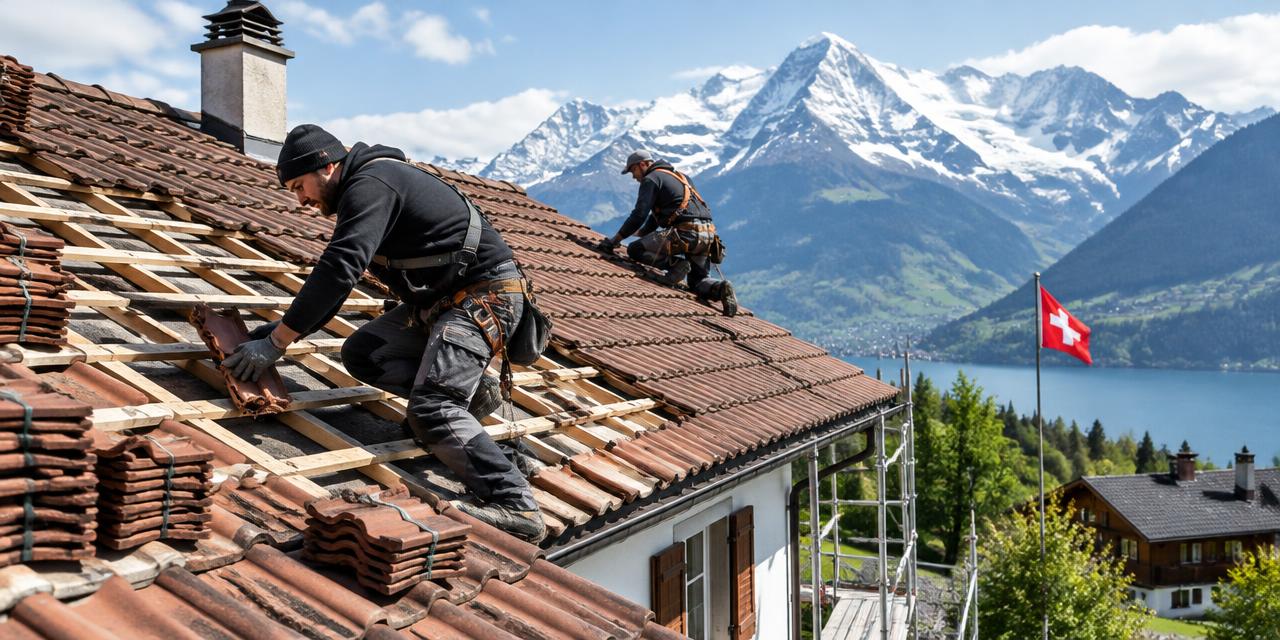
Construction generally begins with setting up safety measures and scaffolding. This is followed by the removal of the old covering, possible repair of the framework, installation of insulation, and finally, the installation of the new covering.
Each step requires precise coordination to ensure the building remains watertight throughout the work. Meticulous planning allows for a smooth sequence of tasks between the different trades working on your roof.
Never neglect applying for prior administrative authorizations before signing a contract. Do not forget to include the removal and reinstallation of existing solar panels in your budget if necessary.
Do not choose an artisan without checking their references for similar projects in the region. Ensure that insulation is addressed at the same time as the covering to optimize financial support.
Checklist before your quote requests : Check if your building is listed by the historic monuments service. Precisely identify the desired insulation works. Prepare a roof plan and photos of the damaged areas.
Systematically request several detailed quotes to compare services. Check the validity of the professional insurance of the chosen providers. Confirm that the quote includes the management of construction site waste.
1. Estimate
Set a budget range with the estimator.
2. Grants
Apply before work starts.
3. Quotes
Compare at least 3 quotes.
4. Permit
Check with the municipality whether a permit is needed.
5. Works
Follow the site and do a written handover.
Contribution per insulated m².
Fribourg support for thermal insulation of facades and roofs.
www.leprogrammebatiments.chCheck amounts and conditions with the provider before signing: apply before work starts in most cases.
1700 Fribourg · about 0 km
Roth Gerüste AG specializes in scaffolding assembly for all types of building construction and renovation work.
rothgerueste.ch1700 Fribourg · about 0 km
Specialist in waterproofing, tinsmithing, and flat roofs, including greening, industrial flooring, and building maintenance in Fribourg.
tecton.ch1700 Fribourg · about 0 km
Fribourg-based company specializing in tinwork, roofing, plumbing, heating systems, and solar panel installations.
jr-sarl.ch1700 Fribourg · about 0 km
VB Charpente Sàrl is a Fribourg-based company specializing in carpentry, roofing, tinsmithing, skylights, and solar installations.
vbcharpente.chSuggestions from the commercial register by distance and activity. Not an endorsement or partnership.
It is best to intervene outside of periods of heavy frost, generally between spring and early autumn. This facilitates the work of artisans and ensures better material application.
Yes, it is highly recommended as it allows you to benefit from support via the Building Programme. Insulating from the outside when replacing the covering is a technically efficient solution.
Any significant exterior modification often requires authorization. You must imperatively consult Fribourg's urban planning services before signing any quotes.
Yes, but it is advisable to check the condition of the framework and covering first. If the roof requires future renovation, the works must be coordinated.
The Building Programme offers support for insulation. The application must be submitted before work begins to be eligible.
The potential presence of hazardous materials such as asbestos is a major risk. A specialized diagnosis must be carried out before the construction site begins.
Investments in energy efficiency are deductible. If costs exceed property income, the surplus can be carried forward to the following two years.
Altitude
587 m
Heating degree days
3'233 Kj/an
20/12 °C
Frost days
79 jours/an
Solar irradiation
1'346 kWh/m²/an
horizontal
Winter design temperature
-7.7 °C
1er percentile des minimales
Mean temperature
10.1 °C
Estimated solar yield
1'184 kWh/kWc/an
toit ~30° sud, PR 0.8, estimation
Source : swisstopo – service d'altitude (MNT) · Open-Meteo Historical Weather API (réanalyse ERA5, moyenne 2015-2024)
Source : Ville de Fribourg
These rules apply across the whole canton, not only in this town.
Tax deductions
Source : Administration Cantonale des Impôts du Canton de Fribourg