
F. Imeri Sàrl
2829 Vermes · about 13 km
The website presented under the name Imeri Chauffage et Sanitaire Sàrl offers plumbing, heating and solar thermal work, while F. Imeri Sàrl’s registered purpose refers to a scrap metal business.
imeri-sarl.chHeat pump installation · Solothurn
At a glance
Small project
CHF 31'500 – CHF 57'500
Typical project
CHF 39'700 – CHF 74'000
Large project
CHF 52'100 – CHF 98'600
| Project | Quantity | Low | High | Per unit |
|---|---|---|---|---|
| Small project | 80 m² | CHF 31'500 | CHF 57'500 | CHF 500 |
| Typical project | 160 m² | CHF 39'700 | CHF 74'000 | CHF 300 |
| Large project | 280 m² | CHF 52'100 | CHF 98'600 | CHF 300 |
Computed with our estimator for Solothurn (regional factor included), standard finish. Only the project size changes.
Included
Not included
In Solothurn, the federal building register lists 2'863 residential buildings and 9'414 dwellings. These municipal benchmarks help put your home in context, but do not replace an individual assessment.
79 % built before 1980
Construction year does not reveal past renovations: check the current insulation condition.
56 % · Gas
This distribution describes recorded buildings, not your system's consumption or efficiency.
| Energy | Heating | Hot water |
|---|---|---|
| Gas | 56 % | 42.8 % |
| Heating oil | 22 % | 16.7 % |
| District heating | 6 % | 5.3 % |
| Heat pump | 13 % | 6.6 % |
| Electricity | 3 % | 26.1 % |
| Wood | 2 % | 0.8 % |
| Solar thermal | 0 % | 1.7 % |
Each line gives the share of buildings using that energy, separately for heating and for hot water. The two columns do not always reach 100%: some buildings combine two systems, or reported none.
A standard non-condensing boiler is usually older and less efficient.
For your renovation projects in Solothurn, the federal building register (RegBL) indicates that 3 buildings are listed under heritage protection, requiring early coordination with the municipality for permit applications. The building volume data covers 1517 houses with a median volume of 462 m3 according to the SIA 416 standard, which is essential for scaling your heating and insulation upgrades. Please note that data coverage is partial, as 1514 buildings are recorded under unknown or other standards. Since renovation year data is not available, you should conduct a thorough on-site assessment to accurately plan your specific property improvements.
Source : OFS — RegBL (export communal complet). Existing residential buildings; percentages of recorded values.
Before installing a heat pump, first check whether your area can connect to a priority district heating network. If such a network is available, connecting may be more advantageous. Next, consider the insulation state of your house.
A good thermal envelope reduces the appliance's power requirements.
The local design outdoor temperature also plays a crucial role in determining the heat pump's capacity needed to ensure optimal thermal comfort throughout the year, even during the coldest months in Solothurn.
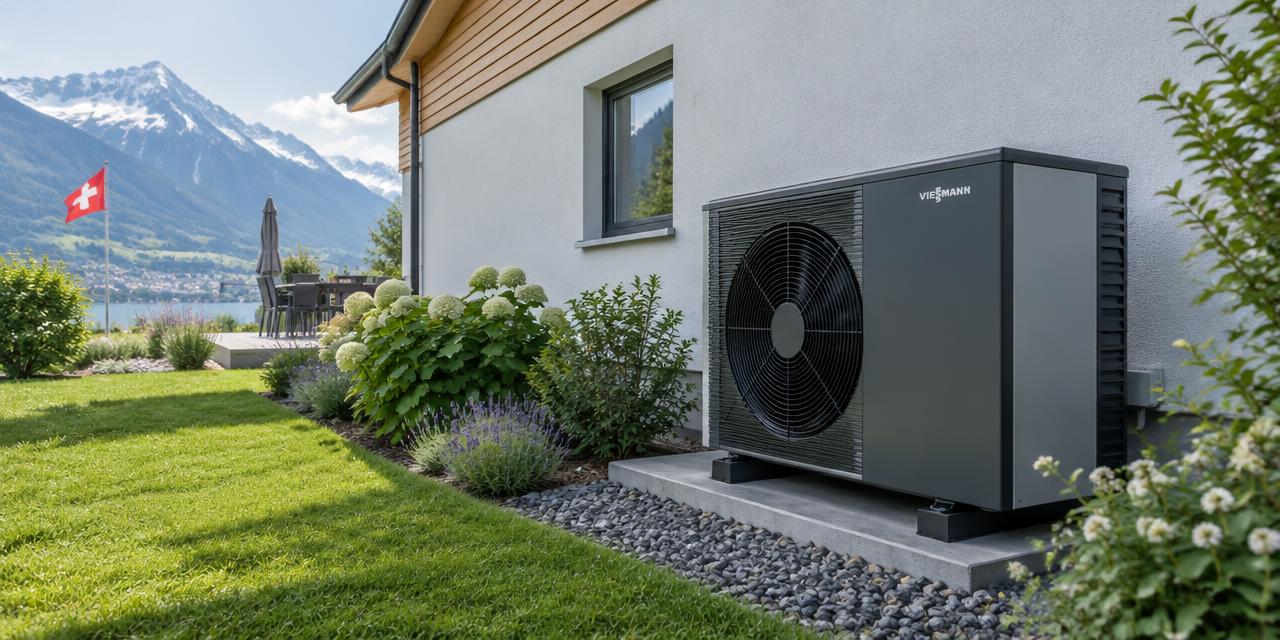
The placement of outdoor units is a sensitive issue for neighbors. Outdoor air-water heat pumps must meet noise limits towards neighbors. It is recommended to choose a location away from bedrooms or patio areas.
Solutions exist, such as soundproofing enclosures or thoughtful orientation of the unit, to limit noise pollution. A preliminary acoustic study can save you from future conflicts.
Ensure that the installation respects not only good neighborly relations but also the technical requirements to guarantee the durability and silent performance of your new heating installation.
Correct sizing is the key to your heat pump's profitability. A unit that is too powerful will wear out prematurely due to short cycles, while an undersized unit will not heat enough during winter cold peaks. Use local data to refine this choice.
Switching to a heat pump is also the ideal opportunity to optimize your existing heat distribution system, such as replacing classic radiators with low-temperature emitters.
This significantly improves the overall performance coefficient of your system, allowing you to achieve significant energy savings in the long term while enjoying gentler and more even heat.
Replacing a boiler with a heat pump follows a rigorous process. After the initial analysis and verification of local conditions, request several quotes from specialized installers to compare technologies and costs.
Once the company is chosen, ensure that all necessary permits are obtained from the relevant authorities. The work includes removing the old equipment, installing the heat pump, connecting it to the heating circuit, and commissioning.
Finally, a tuning phase is essential to adjust the machine's heating curve according to your actual needs and your home's specifics, thus ensuring optimal operation from the very first days.
1. Estimate
Set a budget range with the estimator.
2. Grants
Apply before work starts.
3. Quotes
Compare at least 3 quotes.
4. Permit
Check with the municipality whether a permit is needed.
5. Works
Follow the site and do a written handover.
No specific grant listed for this work. Maintenance tax deductions may still apply.
2829 Vermes · about 13 km
The website presented under the name Imeri Chauffage et Sanitaire Sàrl offers plumbing, heating and solar thermal work, while F. Imeri Sàrl’s registered purpose refers to a scrap metal business.
imeri-sarl.ch2740 Moutier · about 15.1 km
Lack Cheminées SA specializes in the design and installation of fireplaces, stoves, wood ovens, and grills in Moutier.
lackcheminees.ch2740 Moutier · about 15.1 km
Company in Moutier specializing in plumbing, heating (oil, wood, heat pumps), and solar thermal and photovoltaic solutions.
bmonnerat.ch2740 Moutier · about 15.1 km
Specialized company for the installation, operation, and maintenance of sanitary equipment and heating systems in Moutier.
sergepeteut.chSuggestions from the commercial register by distance and activity. Not an endorsement or partnership.
In general, a properly maintained heat pump has an average lifespan of between 15 and 20 years. Annual maintenance performed by a certified professional is essential to preserve energy performance, extend longevity, and prevent costly breakdowns. This regular monitoring also ensures compliance with current environmental and safety standards.
No, it is not mandatory. While underfloor heating is ideal because it operates at low temperatures, high-performance radiators or low-temperature models are perfectly compatible. They allow the heat pump to operate efficiently without requiring major renovation work on your floors. The essential factor is the correct sizing of the emitters.
Modern models are designed to be quiet. However, noise depends on location and technology. It is recommended to carefully choose the fan's orientation relative to neighbors' windows and install the unit on anti-vibration supports. A professional can advise you on the optimal positioning to minimize any sound impact.
The cost varies depending on the power, type of heat pump, and necessary associated work. To get a personalized estimate based on your actual situation, use the free RenoIndex calculator. This will provide an indicative price range for your project, facilitating your discussions with installers when requesting quotes.