
Canton
Solar thermal — Neuchâtel
Per current schedule.
Neuchâtel support for solar thermal.
www.leprogrammebatiments.chSolar water heating · Neuchâtel
At a glance
Small project
CHF 9'200 – CHF 21'500
Typical project
CHF 11'800 – CHF 27'400
Large project
CHF 16'200 – CHF 37'300
| Project | Quantity | Low | High | Per unit |
|---|---|---|---|---|
| Small project | 3 m² | CHF 9'200 | CHF 21'500 | CHF 5'000 |
| Typical project | 6 m² | CHF 11'800 | CHF 27'400 | CHF 3'200 |
| Large project | 11 m² | CHF 16'200 | CHF 37'300 | CHF 2'300 |
Computed with our estimator for Neuchâtel (regional factor included), standard finish. Only the project size changes.
Included
Not included
In Neuchâtel, the federal building register lists 5'655 residential buildings and 26'308 dwellings. These municipal benchmarks help put your home in context, but do not replace an individual assessment.
80 % built before 1980
Construction year does not reveal past renovations: check the current insulation condition.
45 % · Gas
This distribution describes recorded buildings, not your system's consumption or efficiency.
| Energy | Heating | Hot water |
|---|---|---|
| Gas | 45 % | 35.8 % |
| Heating oil | 41 % | 34.9 % |
| District heating | 3 % | 2.3 % |
| Heat pump | 8 % | 6.2 % |
| Electricity | 1 % | 8.7 % |
| Wood | 3 % | 1.2 % |
| Solar thermal | 0 % | 10.7 % |
Each line gives the share of buildings using that energy, separately for heating and for hot water. The two columns do not always reach 100%: some buildings combine two systems, or reported none.
A standard non-condensing boiler is usually older and less efficient.
15.6 % of buildings mix housing with shops or offices.
For your renovation projects in Neuchâtel, RegBL data provides essential guidance. With 20 buildings officially classified under heritage protection out of 5323 structures, it is crucial to contact the municipality early to understand permit requirements. Regarding heating or insulation upgrades, the median house volume is 641 m3, though data coverage is partial as only 4 out of 2034 houses have been measured according to the SIA 416 standard. These official figures serve as a necessary starting point to help you scale your renovation works effectively and ensure compliance with local regulations from the very beginning of your planning process.
Source : Registre fédéral des bâtiments et des logements (RegBL), OFS, 2026. Existing residential buildings; percentages of recorded values.
With an altitude of 434 meters and a global irradiation of 1320 kWh/m²/year, Neuchâtel offers favorable conditions for utilizing solar energy.
The 51 frost days per year highlight the importance of having a high-performance hot water system that effectively complements your main heating installation.
Undertaking these works is particularly relevant when you are planning a comprehensive renovation of your heat generation system or when replacing an aging water heater.
The local situation, marked by 2866 heating degree days per year, underscores the necessity of reducing dependence on fossil fuels. By investing in solar thermal, you stabilize your energy costs while benefiting from the city's 'Cité de l'énergie Gold' status.
The best time to act remains when your boiler reaches the end of its life or during roof refurbishment, which allows for limiting labor costs by consolidating technical interventions.
Sizing is the crucial step. Solar thermal collectors generally cover a large part of the summer hot water needs, thus drastically reducing the strain on your boiler during the mild months.
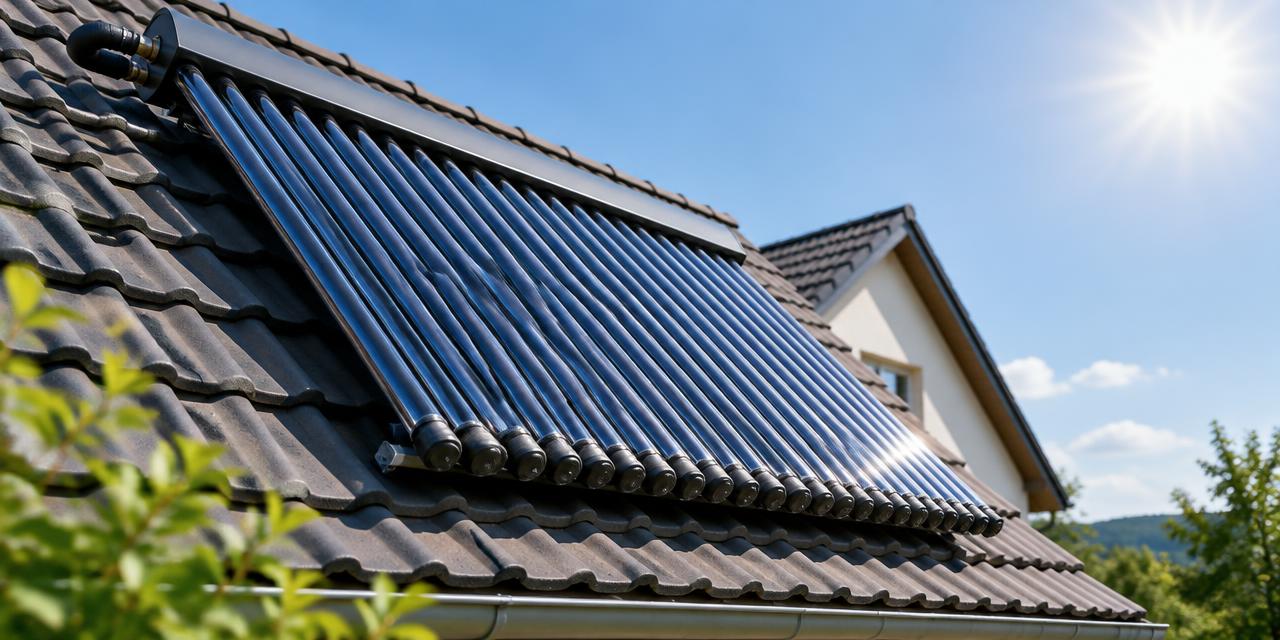
It is essential to choose between flat plate collectors, which are robust and economical, or vacuum tube collectors, which are more efficient in cold weather or low sunlight, although more expensive.
These options must be adapted to your actual household consumption.
Another technical dimension involves combining your solar collectors with a heat pump. This requires a rigorous sizing study carried out by a qualified professional to ensure optimal synergy between the technologies.
The integration into your building's management system must be designed to maximize the self-consumption of the produced energy.
Finally, the choice of the storage tank must take into account the space available in your basement and your peak consumption needs to avoid any shortage of hot water.
In Neuchâtel, the real estate stock is varied, ranging from historic buildings to more recent constructions.
If your building dates from before 1990, particular attention must be paid to the potential presence of asbestos in old insulation or coatings, especially when fixing structures on the roof.
A preliminary analysis by an expert is recommended before any drilling, especially if heavy roofing work is required to support the weight of the panels.
The quality of your home's insulation also influences the overall efficiency of the system. A well-insulated building better retains the solar energy captured in its distribution network.
For older houses, it is common for piping networks to require upgrading to limit heat loss between the collectors and the storage.
Also, check the condition of your roof structure : solar thermal installations add a structural load that an engineer or roofer must validate to ensure the durability of your roof against local weather conditions.
You must submit a notification to the competent communal or cantonal authority about twenty days before the scheduled start of works. This step is essential to validate the compliance of your project.
Be careful, however : if your building is located outside the building zone or if it is a protected object (historic monument or protected site), the simple notification procedure is not always sufficient.
It is imperative to contact your municipality's urban planning department beforehand to obtain written confirmation. This preventive check avoids costly administrative blockages and ensures that your project respects local heritage requirements.
Do not start any work before receiving formal approval or passing the required notification period.
These aids aim to encourage the replacement of energy-intensive systems and support your initial investment.
Tax-wise, investments intended to save energy are deductible from your taxable income. If your costs exceed your net income, you can carry forward this deduction to the next two tax years.
Note that if you opt for a flat-rate deduction for the maintenance of your property, you will not be able to deduct these actual costs separately.
It is therefore recommended to calculate each year, for each building, the most advantageous option between the flat rate and actual costs. The tax authority can provide you with details on the carry-forward amounts after full declaration of your invoices.
The project takes place in several key phases. Everything begins with planning and submitting the subsidy application. Once approval is received, work generally begins with securing the roof, then installing the mounting system.
The actual installation of the collectors follows, then comes the phase of hydraulic connection to the storage tank and the installation of the control system. Commissioning and pressure tests finalize the intervention.
It is wise to schedule work outside periods of heavy frost, as 51 days per year present risks for workers at height and can complicate the laying of heat transfer fluids.
Intermediate seasons such as spring or early autumn often offer milder weather conditions, facilitating precision work on the roof.
A good craftsman will know how to coordinate the steps to minimize the duration during which your heating or hot water system must be interrupted, thus ensuring your comfort.
The most common error is to underestimate the sizing of the system, which limits performance over the year. Never neglect the technical feasibility study.
Before requesting quotes, ensure you have the following : check the age and condition of your roof to support the panels, check the compatibility with your existing heating system, and request written confirmation from urban planning regarding authorization.
Ensure the quote details the type of collectors and the warranties offered.
Do not sign any commitment before receiving feedback on your cantonal subsidy application. Also avoid choosing a provider solely on price without comparing the quality of the components.
Finally, verify that the chosen company has proven local experience, particularly to respect installation rules on old or protected buildings in Neuchâtel.
A simple checklist : is the subsidy application submitted, is the urban planning department notified, and has the roof been inspected?
1. Estimate
Set a budget range with the estimator.
2. Grants
Apply before work starts.
3. Quotes
Compare at least 3 quotes.
4. Permit
Check with the municipality whether a permit is needed.
5. Works
Follow the site and do a written handover.
Per current schedule.
Neuchâtel support for solar thermal.
www.leprogrammebatiments.chCheck amounts and conditions with the provider before signing: apply before work starts in most cases.
2000 Neuchâtel · about 0 km
Riedo Clima AG provides comprehensive building services including heating, ventilation, and renewable energy systems.
riedoclima.ch2000 Neuchâtel · about 0 km
Tecaro SA, based in Neuchâtel, specializes in the installation and renovation of sanitary facilities and sustainable heating systems, while also providing 24/7 emergency services.
tecaro.ch2074 Marin-Epagnier · about 5.9 km
Since 1992, F. Borgeat Chauffage in Marin-Epagnier has designed, installed and maintained renewable and fossil-fuel heating systems, including heat pumps and solar thermal systems.
borgeat-chauffage.ch2207 Coffrane · about 6.1 km
CHRISTEN CHAUFFAGE SANITAIRE Sàrl provides specialized services in the installation, maintenance, and design of heating systems, heat pumps, sanitary facilities, and solar thermal systems.
christen-sarl.chSuggestions from the commercial register by distance and activity. Not an endorsement or partnership.
A well-maintained installation generally works for 20 to 25 years. Components like collectors are very durable, while the circulation pump may need replacement after a decade.
Yes, it is perfectly possible. You just need to use adjustable supports to tilt the collectors towards the south to maximize solar capture.
No, solar thermal is a supplementary system. In winter, low light requires a backup heating system to ensure thermal comfort.
In general, rain cleans the panels sufficiently. A periodic visual inspection is enough to verify the absence of significant deposits or debris.
This depends on the number of inhabitants. On average, count about 1.5 to 2 m² of collectors per person to cover domestic hot water needs.
This is an indicative delay. It is better to wait for the explicit confirmation from the municipality to avoid any risk of administrative non-compliance.
Solar thermal aids depend on the current scale. Check the official platform to know the possible combinations according to your precise situation.
Estimated solar yield
1'162 kWh/kWc/an
toit ~30° sud, PR 0.8, estimation
Altitude
434 m
Heating degree days
2'866 Kj/an
20/12 °C
Frost days
51 jours/an
Solar irradiation
1'320 kWh/m²/an
horizontal
Winter design temperature
-4.5 °C
1er percentile des minimales
Mean temperature
11.3 °C
Source : Open-Meteo Historical Weather API (réanalyse ERA5, moyenne 2015-2024) · swisstopo – service d'altitude (MNT)
Source : Ville de Neuchâtel
These rules apply across the whole canton, not only in this town.
Permits
Source : azprojet.ch
Tax deductions
Source : SCCO_I772_Notice4_PP.pdf