
Canton
Solar thermal — Neuchâtel
Per current schedule.
Neuchâtel support for solar thermal.
www.leprogrammebatiments.chSolar water heating · La Chaux-de-Fonds
At a glance
Small project
CHF 9'200 – CHF 21'500
Typical project
CHF 11'800 – CHF 27'400
Large project
CHF 16'200 – CHF 37'300
| Project | Quantity | Low | High | Per unit |
|---|---|---|---|---|
| Small project | 3 m² | CHF 9'200 | CHF 21'500 | CHF 5'000 |
| Typical project | 6 m² | CHF 11'800 | CHF 27'400 | CHF 3'200 |
| Large project | 11 m² | CHF 16'200 | CHF 37'300 | CHF 2'300 |
Computed with our estimator for La Chaux-de-Fonds (regional factor included), standard finish. Only the project size changes.
Included
Not included
In La Chaux-de-Fonds, the federal building register lists 4'535 residential buildings and 22'323 dwellings. These municipal benchmarks help put your home in context, but do not replace an individual assessment.
78 % built before 1980
Construction year does not reveal past renovations: check the current insulation condition.
39 % · Heating oil
This distribution describes recorded buildings, not your system's consumption or efficiency.
| Energy | Heating | Hot water |
|---|---|---|
| Gas | 24 % | 19.3 % |
| Heating oil | 39 % | 30.1 % |
| District heating | 17 % | 15.7 % |
| Heat pump | 9 % | 7.5 % |
| Electricity | 4 % | 16.1 % |
| Wood | 6 % | 2.6 % |
| Solar thermal | 1 % | 7.7 % |
Each line gives the share of buildings using that energy, separately for heating and for hot water. The two columns do not always reach 100%: some buildings combine two systems, or reported none.
A standard non-condensing boiler is usually older and less efficient.
23 % of buildings mix housing with shops or offices.
When planning renovations in La Chaux-de-Fonds, referencing official RegBL data is vital for accurate budgeting. The median house volume is 835 m3, though this figure covers only 29 of 1731 houses, indicating partial data coverage. Regarding heritage protection, 20 out of 138 known buildings are officially protected. If your property is classified, you must contact municipal authorities early to secure necessary permits before starting construction. Carefully evaluating these specific figures allows you to better understand the scope of your project, helping you anticipate costs and streamline the renovation process for your home in this municipality.
Source : Registre fédéral des bâtiments et des logements (RegBL), OFS, 2026. Existing residential buildings; percentages of recorded values.
3 °C. In this context, the demand for heating and domestic hot water is particularly high, reaching 3824 Kj/year.3 °C.
The ideal time to install thermal collectors is ideally during the renovation of your hot water production system or during roof repairs.
Thanks to global irradiation of 1304 kWh/m²/year, even at altitude, solar harvesting remains an effective solution for preheating your water, especially during months when sunshine is sufficient to relieve your main boiler.
Anticipating this work helps to amortize energy costs over the long term while adding value to your local real estate assets.
The sizing of a solar thermal installation depends closely on your household's hot water needs. Solar thermal collectors generally cover a large part of summer hot water, but their winter performance requires a precise study.
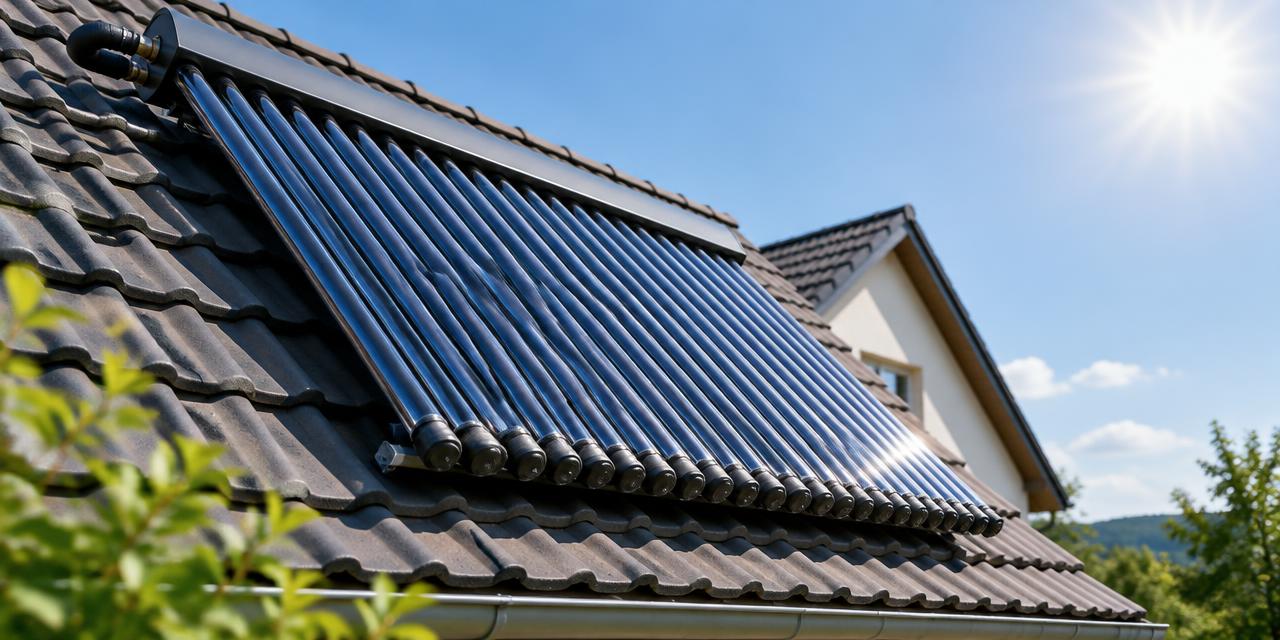
The choice between flat plate collectors, which are robust and versatile, and vacuum tube collectors, which are more efficient in cold weather, is a first technical lever. The latter are often preferred at high altitudes to limit thermal losses.
Complexity increases when you consider coupling these collectors with other systems, such as a heat pump. This configuration requires a rigorous sizing study to ensure optimal synergy between the technologies.
Storage materials, such as solar hot water tanks, must also be adapted to your building size and consumption volume.
Finally, the quality level of temperature regulators influences your system's ability to optimize solar inputs based on the region's variable sunshine.
La Chaux-de-Fonds has a dense architectural heritage, notably linked to its industrial history. For older buildings, thermal insulation is often the critical point before considering a solar installation.
It is imperative to check the condition of the roof structure to support the weight of the collectors.
If your construction dates from before 1990, prior diagnoses concerning the presence of asbestos in roofing elements or insulation are essential to avoid any health risk during the installation of fixing systems.
Existing distribution networks must also be inspected. Old piping may not withstand the temperature rise of the heat transfer fluid or may leak during connection.
Furthermore, the configuration of local roofs, which are sometimes complex, requires reflection on visual integration. An analysis of the overall thermal envelope is advised before concluding that solar thermal is the unique solution.
Consistency between your roof insulation and new installations ensures the sustainability of your investment in the face of the region's harsh winters.
This rule applies to building zones, provided that they are not located on protected objects or in perimeters defined by cantonal law as sensitive in terms of heritage.
A simple notification to the competent municipal authority is sufficient, usually about twenty days before the start of the work.
However, it is crucial to check the classification of your property before ordering the material.
If your building is a protected cultural property or located in an ISOS perimeter with a preservation objective of level A, strict constraints may apply, making the project subject to a standard building permit.
Contact the municipal authority to confirm if your address is affected by specific restrictions. This preliminary step guarantees the compliance of your installation and avoids administrative appeals that could unduly delay your energy transition project.
In addition, the municipal energy fund can also grant support under conditions, with a minimum annual allocation dedicated to the renovation of energy-intensive buildings.
Systematically check the eligibility of your project with the relevant authorities, as conditions evolve according to available budgets.
Tax-wise, investments intended to save energy are deductible from your income. If these maintenance or improvement costs generate a negative net income, the surplus can be carried forward to the following two tax years.
Note that it is possible to choose between the deduction of effective costs and a flat-rate deduction for each tax period.
In the case of energy-saving investments, the effective cost option is often more advantageous, as it allows for capitalizing on these heavy expenses over a total period of three years.
The planning of a solar project in La Chaux-de-Fonds must integrate constraints related to winter conditions. The best season for carrying out roofing and installation work is undoubtedly the frost-free period, from spring to early autumn.
During months when frost is frequent, safe access to roofs becomes perilous and external plumbing work is strongly discouraged.
Therefore, anticipate the submission of your prior notice at the end of winter to obtain the necessary authorizations before the good season.
The site generally begins with the installation of anchors on the roof structure, followed by the assembly of the collectors and the installation of the hydraulic circuit.
Then, the connection to the storage tank and the configuration of the electronic control are carried out inside the building. A pressure test phase is essential to check the tightness of the circuit before commissioning.
Finally, a final fine-tuning is carried out to ensure that the system articulates correctly with your existing boiler and guarantees optimal hot water production.
A common mistake is neglecting the general condition of the roof before installing collectors. Never underestimate the importance of an asbestos diagnostic on old buildings to prevent any work site blockage.
It is not recommended to order components without having received confirmation from the competent authority following your notification. Remember that requesting a grant after the work has begun systematically leads to its refusal.
Before soliciting quotes, check if your current insulation is sufficient to reduce your energy needs. Ensure that the orientation and inclination of your roof allow for efficient solar harvesting.
Compile all documents related to the heritage protection of your municipality to avoid surprises. Compare proposals by insisting on the hydraulic integration with your existing systems.
Check that the companies consulted possess real expertise in solar thermal installation and not just general plumbing. Finally, always provide a margin for the electrical connections required for the regulation of the solar system.
1. Estimate
Set a budget range with the estimator.
2. Grants
Apply before work starts.
3. Quotes
Compare at least 3 quotes.
4. Permit
Check with the municipality whether a permit is needed.
5. Works
Follow the site and do a written handover.
Per current schedule.
Neuchâtel support for solar thermal.
www.leprogrammebatiments.chCheck amounts and conditions with the provider before signing: apply before work starts in most cases.
2300 La Chaux-de-Fonds · about 0 km
Eau Design & Energie Sàrl, based in La Chaux-de-Fonds, specializes in custom bathroom design as well as the installation and maintenance of heating and plumbing systems.
eaudesign.ch2300 La Chaux-de-Fonds · about 0 km
Voegtli SA specializes in sanitary installations, heating, air conditioning, and ventilation services based in La Chaux-de-Fonds.
voegtlisa.ch2301 La Chaux-de-Fonds · about 2.9 km
Georges Metzger SA is a family business in La Chaux-de-Fonds that has installed, renovated and maintained plumbing and heating systems, including heat pumps and solar thermal systems, since 1923.
metzgersa.ch2314 La Sagne NE · about 8.7 km
Founded in 1960 in La Sagne, family-owned Jaquet SA carries out plumbing, heating, roofing and sheet metal work and installs heat pumps, solar thermal and photovoltaic systems throughout the canton of Neuchâtel and surrounding areas.
jaquet-sa.chSuggestions from the commercial register by distance and activity. Not an endorsement or partnership.
Yes, but its efficiency decreases significantly during frequent frost days. It then mainly serves as preheating for your domestic water.
You must file a standard building permit application, as the simplified notification procedure is generally not applicable.
Yes, it is an excellent combination to optimize your energy efficiency. A rigorous sizing study is, however, essential.
A due south orientation is ideal, but a southeast or southwest orientation also allows for excellent yields. The project study will validate viability.
No, it is imperative to submit your grant application before starting the work. Any request made after the fact will be refused.
Yes, you can carry forward the energy-saving costs to the next two fiscal years. The tax authority will determine the carryable amounts.
The notification procedure generally takes about twenty days. This period allows the authorities to verify the compliance of your project.
Estimated solar yield
1'148 kWh/kWc/an
toit ~30° sud, PR 0.8, estimation
Altitude
990 m
Heating degree days
3'824 Kj/an
20/12 °C
Frost days
100 jours/an
Solar irradiation
1'304 kWh/m²/an
horizontal
Winter design temperature
-10.3 °C
1er percentile des minimales
Mean temperature
8.3 °C
Source : Open-Meteo Historical Weather API (réanalyse ERA5, moyenne 2015-2024) · swisstopo – service d'altitude (MNT)
Source : Ville de La Chaux-de-Fonds
These rules apply across the whole canton, not only in this town.
Permits
Source : azprojet.ch
Tax deductions
Source : SCCO_I772_Notice4_PP.pdf