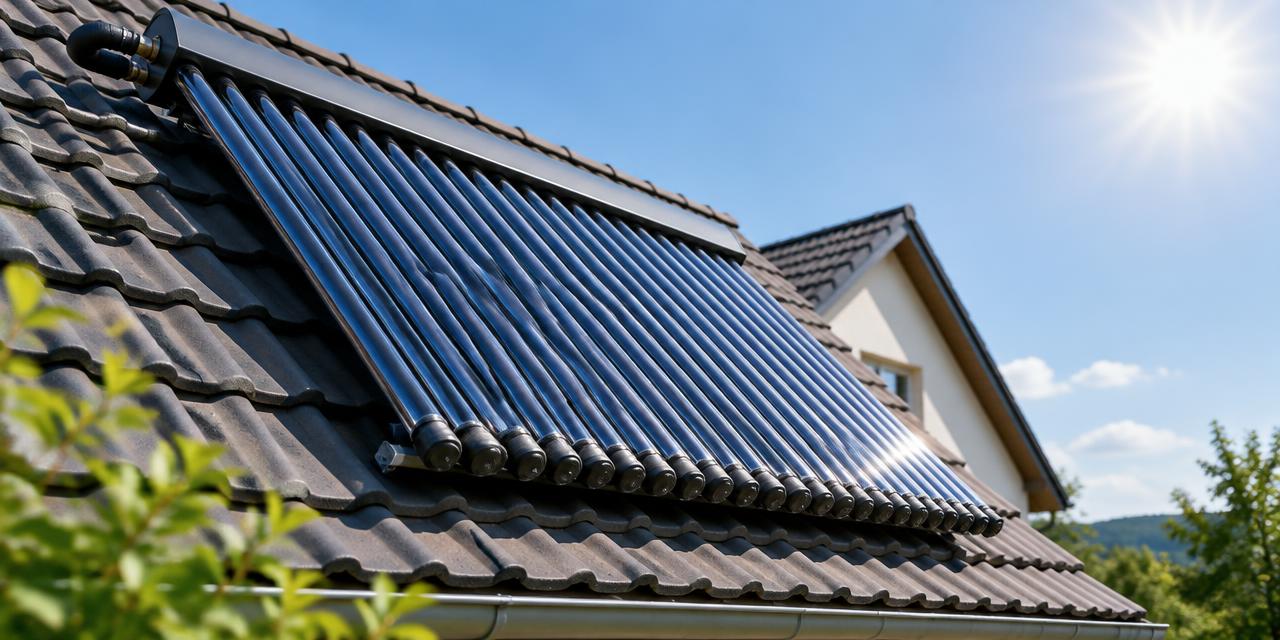
Are you considering installing solar water heating in Windisch to reduce your energy consumption? This ecological solution allows you to heat your sanitary water using the sun's rays. Before starting your work, it is essential to plan your installation carefully. Discover our tips for successfully carrying out your energy transition project. To get an accurate cost estimate adapted to your situation, do not hesitate to use our free RenoIndex tool, which will provide you with a price range in CHF to help budget your project.
At a glance
Typical budget
CHF 11'800 – CHF 27'400
Midpoint
CHF 19'000
Grants found
0
Nearby companies
4
Worked examples in Windisch
Small project
CHF 9'200 – CHF 21'500
Typical project
CHF 11'800 – CHF 27'400
Large project
CHF 16'200 – CHF 37'300
Project
Quantity
Low
High
Per unit
Small project
3 m²
CHF 9'200
CHF 21'500
CHF 5'000
Typical project
6 m²
CHF 11'800
CHF 27'400
CHF 3'200
Large project
11 m²
CHF 16'200
CHF 37'300
CHF 2'300
Computed with our estimator for Windisch (regional factor included), standard finish. Only the project size changes.
Cost split (typical project)
Labour :CHF 7'600(40 %)
Materials :CHF 9'500(50 %)
Other costs :CHF 1'900(10 %)
What the price covers
Included
Supply and installation
VAT
Collectors, controls, standard connection and tank according to answers
Not included
Permits and architect fees
Unexpected structural issues
Possible subsidies
Roof refurbishment and replacement of main heating
Windisch's housing stock in figures
In Windisch, the federal building register lists 1'270 residential buildings and 3'800 dwellings. These municipal benchmarks help put your home in context, but do not replace an individual assessment.
75 %built before 1980
74 %heated by oil or gas
27.7 %electric hot water
4.2 %with declared solar thermal
Age of residential buildings
75 % built before 1980
Before 191915 %
1919–194518 %
1946–196020 %
1961–197012 %
1971–198010 %
1981–19905 %
1991–20009 %
2001–20106 %
Since 20116 %
Construction year does not reveal past renovations: check the current insulation condition.
Main heating energy
40 % · Heating oil
Heating oil40 %
Gas34 %
Heat pump18 %
Electricity4 %
Wood3 %
District heating1 %
This distribution describes recorded buildings, not your system's consumption or efficiency.
Heating and hot water: which energies?
Energy
Heating
Hot water
Gas
34 %
29.7 %
Heating oil
40 %
29 %
District heating
1 %
0.3 %
Heat pump
18 %
9.7 %
Electricity
4 %
27.7 %
Wood
3 %
1.7 %
Each line gives the share of buildings using that energy, separately for heating and for hot water. The two columns do not always reach 100%: some buildings combine two systems, or reported none.
Type of heating system
Boiler (unspecified)74.7 %
Heat pump17.6 %
Central electric heating3.6 %
Condensing boiler1.3 %
Heat exchanger (district)1.3 %
Direct electric heaters0.7 %
Stove0.6 %
A standard non-condensing boiler is usually older and less efficient.
Houses or apartment buildings?
Single-family houses65.9 %
Two-dwelling houses9.1 %
Apartment buildings (3+)24.9 %
Other0.2 %
7.8 % of buildings mix housing with shops or offices.
The typical building
storeys (median)
2
median footprint
113 m²
median dwelling area
85 m²
Renovations, heritage and volumes
For renovation projects in Windisch, the federal building register (RegBL) identifies 260 out of 1270 buildings as protected heritage sites. If your property is classified, you must consult the municipality early regarding permits. Regarding building volume, data is partial as no values following the SIA 416 standard are available for the 837 residential buildings recorded. Furthermore, no data exists regarding the year of renovation for the 1270 buildings in this municipality. Due to these gaps in the register, homeowners should obtain specific building assessments independently to ensure accurate planning for their energy or structural upgrades.
260
buildings flagged as protected
status known for 1'270 of 1'270 buildings; check with the municipality
Installing solar thermal collectors is a sustainable investment for your home in Windisch.Solar thermal collectors usually cover much of summer hot water, thus significantly reducing your dependence on fossil fuels or electricity.
By using a free and renewable resource, you improve the energy performance of your building while saving on your monthly bills.
It is a concrete step for the environment that also increases the long-term value of your property while actively participating in the Swiss energy transition. Proper planning is the key to efficient year-round usage.
Planning and sizing
A high-performance installation requires a rigorous study of your roof and your needs. Combining collectors with a heat pump needs a sizing study to ensure optimal compatibility between the systems.
It is important to evaluate the slope and orientation of your roof to maximize solar yield. Working with certified professionals guarantees an installation that complies with current technical standards.
This design step helps avoid costly over-sizing while ensuring constant hot water production throughout the year, even during seasonal transition periods. A thorough analysis beforehand is crucial for the long-term profitability of your investment.
Financing and available support
Although the initial cost may seem high, several financial mechanisms exist. Several cantons subsidise collectors per m² or per installation, which allows you to amortise your work faster.
We advise you to check with the energy department of the canton of Aargau to find out about the current support programmes. Investing in renewables is often encouraged to promote energy renovation of the existing building stock.
For a clear view of your overall budget, our RenoIndex simulator supports you by calculating an indicative price range for your specific project, allowing you to plan your investment with confidence.
Installation and maintenance
The actual installation must be carried out by qualified companies to guarantee the safety and longevity of the system.
Once in place, solar thermal requires little maintenance, but regular checking of fluids and components is recommended to maintain optimal efficiency.
Maintenance every few years helps prevent premature wear of equipment and ensures the system continues to deliver maximum output.
By entrusting the installation and monitoring to local experts, you benefit from responsive service and technical expertise adapted to the climatic particularities of your region, protecting your investment over the long term.
Your project in 5 steps
1. Estimate
Set a budget range with the estimator.
2. Grants
Apply before work starts.
3. Quotes
Compare at least 3 quotes.
4. Permit
Check with the municipality whether a permit is needed.
5. Works
Follow the site and do a written handover.
Grants and subsidies
No specific grant listed for this work. Maintenance tax deductions may still apply.
Companies in the area
F. Imeri Sàrl
2829 Vermes · about 58.2 km
The website presented under the name Imeri Chauffage et Sanitaire Sàrl offers plumbing, heating and solar thermal work, while F. Imeri Sàrl’s registered purpose refers to a scrap metal business.
Suggestions from the commercial register by distance and activity. Not an endorsement or partnership.
Frequently asked questions
Is it cost-effective in Windisch?
Profitability depends on your hot water consumption and sunlight. By drastically reducing your reliance on paid energy during the summer months, you save over the long term. Use RenoIndex to estimate costs and compare with your current bills.
What permits are required?
Most solar thermal installations on roofs are subject to a notification procedure. Always check with the municipal services of Windisch if a specific building permit is required for your building, especially if it is listed or located in a protected area.
Does the system work in winter?
Yes, but efficiency is lower in winter due to reduced sunlight. The system then acts as support for the main heating, which takes over to ensure a constant temperature. A combination with a boiler or a heat pump is ideal.
How many m² of collectors to install?
The surface area required depends on the number of residents and your hot water needs. On average, count about 1 to 1.5 m² of collectors per person in the household. An accredited installer will precisely size the installation during the preliminary study.