
Canton
Heat pump grant — Valais
Flat contributions per kW or per installation depending on technology.
Valais supports renewable heating via the Buildings Programme and additional cantonal grants.
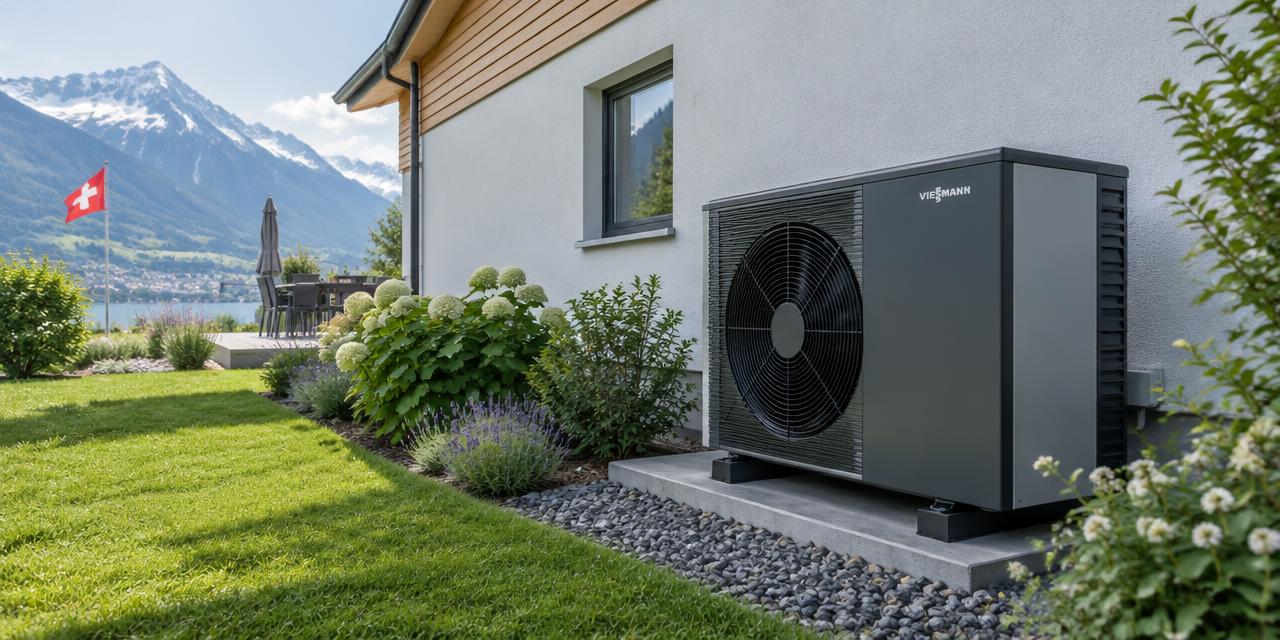
www.leprogrammebatiments.chHeat pump installation · Sierre
At a glance
Small project
CHF 30'600 – CHF 55'900
Typical project
CHF 38'600 – CHF 71'900
Large project
CHF 50'600 – CHF 95'800
| Project | Quantity | Low | High | Per unit |
|---|---|---|---|---|
| Small project | 80 m² | CHF 30'600 | CHF 55'900 | CHF 500 |
| Typical project | 160 m² | CHF 38'600 | CHF 71'900 | CHF 300 |
| Large project | 280 m² | CHF 50'600 | CHF 95'800 | CHF 300 |
Computed with our estimator for Sierre (regional factor included), standard finish. Only the project size changes.
Included
Not included
In Sierre, the federal building register lists 2'768 residential buildings and 9'985 dwellings. These municipal benchmarks help put your home in context, but do not replace an individual assessment.
59 % built before 1980
Construction year does not reveal past renovations: check the current insulation condition.
64 % · Gas
This distribution describes recorded buildings, not your system's consumption or efficiency.
| Energy | Heating | Hot water |
|---|---|---|
| Gas | 64 % | 44.6 % |
| Heating oil | 20 % | 18.5 % |
| Heat pump | 5 % | 3.9 % |
| Electricity | 10 % | 31 % |
| Wood | 2 % | 0.7 % |
| Solar thermal | 0 % | 1.1 % |
Each line gives the share of buildings using that energy, separately for heating and for hot water. The two columns do not always reach 100%: some buildings combine two systems, or reported none.
A standard non-condensing boiler is usually older and less efficient.
For your renovation plans in Sierre, RegBL data provides essential guidance, despite partial data coverage. With a median building volume of 502 m3 based on 27 units measured under SIA 416 standards, you can effectively scale heating or insulation upgrades. Regarding heritage protection, 4 out of the 77 recorded buildings are officially protected. It is vital to contact the municipality early in your planning phase to determine your property's status. This proactive step helps you navigate potential permit requirements and ensures your renovation project complies with local regulations concerning protected sites or historical preservation.
Source : Registre fédéral des bâtiments et des logements (RegBL), OFS, 2026. Existing residential buildings; percentages of recorded values.
The city of Sierre, situated at an altitude of 524 meters, experiences 72 days of frost annually and a winter design temperature of -10 °C. These conditions require careful sizing of your future heat pump to ensure optimal comfort during the coldest periods.
With 2988 heating degree-days per year, replacing fossil fuel systems is a priority for reducing your carbon footprint while adapting your building to the Valais climate.
The ideal time to plan is before your current boiler reaches the end of its life or during a comprehensive thermal renovation.
It is essential to check the schedule for the CAD Sierre network, managed by OIKEN, which utilizes industrial waste heat and sewage heat.
Before making a decision, verify if your neighborhood is eligible for connection, as this could be a more relevant alternative than an individual heat pump.
The technological choice for your heat pump depends primarily on your property and the power required to offset the local design temperature of -10 °C.
Air-to-water heat pumps remain the most common, but their performance is directly correlated with your building's thermal insulation.
Proper sizing ensures the pump doesn't frequently rely on electric backup, which helps manage your annual electricity consumption.
Furthermore, integrating photovoltaic panels, favored by a global irradiation of 1451 kWh/m²/an in Sierre, can optimize your heat pump's operation. The estimated yield of 1277 kWh/kWc/an allows you to consume your own energy for heating.
Note that outdoor air-to-water heat pumps must strictly respect noise limits towards neighbors, a crucial point when placing the outdoor unit in dense residential areas of the Sierre region.
In Sierre, the building stock is heterogeneous, ranging from old stone Valais houses to buildings from the 1970s and 1980s. For houses built before 1990, an asbestos assessment is mandatory before starting any dismantling of old pipes or boilers.
Vested heating networks may also need to be upgraded to support the lower operating temperatures of a heat pump compared to gas or oil boilers.
Buildings from the real estate boom era often require reinforced insulation before installing a heat pump to ensure optimal efficiency.
Without adequate insulation, the required pump power could be excessive, unnecessarily increasing investment and operating costs.
Always check the state of your internal heating circuit, as high-temperature radiators may need to be replaced with low-temperature emitters or underfloor heating to improve the seasonal performance factor (SPF) of your installation.
Before beginning your procedures, contact the municipal urban planning department to learn about specific regulations for your area, particularly regarding the visual aspect of the outdoor unit if your building is listed or located in a heritage protection zone.
Local rules may impose minimum distances from property boundaries, especially for air-to-water heat pumps due to potential noise issues. It is recommended to consult municipal services to check if a permit process is required.
Compliance with the 2024–2027 energy planning is a priority in Sierre; therefore, any installation must align with the decarbonization goals of the municipal action plan to avoid administrative blocks.
These grants are essential for reducing the total cost of your project. The golden rule is to submit your subsidy application mandatorily before the start of the work. Any application submitted after the work has begun will be systematically rejected.
Consult the Building Program website for specific details on eligible technologies. In addition to this direct aid, remember that investments aimed at saving energy can be deducted from your tax return, according to the current cantonal provisions.
It is advisable to keep all payment vouchers and detailed invoices.
Also, remember to check with the municipality of Sierre for any additional local incentives, within the framework of the 2024–2027 energy policy program, to strengthen the financial support for your thermal transition.
The flow of a heat pump project follows several structured stages. It all starts with a thorough technical assessment of your home, including an energy needs study. Once validated, you proceed to apply for municipal permits and then for subsidies.
It is imperative to wait for the written confirmation of subsidies before signing the final quotes. Electrical and hydraulic connection works are then planned.
The actual construction phase involves dismantling the old system, installing the outdoor unit, connecting to the existing distribution network, and commissioning.
Although there is no mandatory season, it is often wise to avoid winter cold peaks in Sierre, where the 72 annual frost days could complicate the switch between the old and new systems if the home is occupied.
Early planning allows for adjusting the pump during moderate temperatures, ensuring optimal thermal comfort as soon as winter conditions harden.
Avoid the classic mistake of not checking for connection to the district heating network before choosing an individual solution. Also, ensure you do not underestimate your house's insulation, as a heat pump does not replace an efficient thermal renovation.
Never sign a contract before receiving official approval for your financial aid. Finally, do not overlook the acoustic study for the location of the outdoor unit, to avoid unnecessary neighborhood conflicts.
Checklist before requesting quotes : check if the neighborhood is eligible for the CAD Sierre district heating connection; have a complete thermal calculation carried out by a specialist; examine the state of the internal heating distribution network; verify that the winter design temperature of -10 °C has been taken into account; ensure the location of the outdoor unit complies with distance and noise standards; list accessible cantonal and federal aid; request several detailed comparative quotes including commissioning and maintenance.
1. Estimate
Set a budget range with the estimator.
2. Grants
Apply before work starts.
3. Quotes
Compare at least 3 quotes.
4. Permit
Check with the municipality whether a permit is needed.
5. Works
Follow the site and do a written handover.
Flat contributions per kW or per installation depending on technology.
Valais supports renewable heating via the Buildings Programme and additional cantonal grants.
www.leprogrammebatiments.chCheck amounts and conditions with the provider before signing: apply before work starts in most cases.
3960 Sierre · about 0 km
Valais-based company specializing in sanitary installations, heating systems, roofing, and tinsmith work for residential and commercial buildings.
lehnersa.ch3960 Sierre · about 0 km
Since 1982, GD Climat SA has specialized in heating, ventilation, air conditioning, automation and industrial piping installations in Valais and the Chablais region.
gdclimat.ch3960 Corin-de-la-Crête · about 0 km
Domelec Sàrl is a Valais-based company specializing in photovoltaic installations, battery storage, and optimized energy home automation.
domelec.ch3960 Corin-de-la-Crête · about 0 km
B-Groupe is a network of Valais-based companies active in the construction, engineering, and maintenance sectors.
b-groupe.chSuggestions from the commercial register by distance and activity. Not an endorsement or partnership.
CAD Sierre is a district heating network managed by OIKEN using industrial waste heat. You must check with the municipality if your address is covered by this priority project.
Valais offers contributions via the Building Program. Amounts are flat-rate and vary according to technology, provided you submit your application before the start of the work.
This may be necessary if your current radiators require high temperatures. A heat pump is more efficient with low-temperature emitters like underfloor heating.
This is the local winter design temperature. It is used to calculate the necessary power so that your heat pump can heat your house properly without excessive backup usage.
Yes, air-to-water heat pumps must respect strict noise limits towards neighbors. An acoustic study is recommended before installation.
Absolutely, it is recommended in Sierre. With high irradiation, your panels can cover a significant part of the pump's electricity consumption.
Contact them at the start of the project. They will inform you if your area requires special permits, especially for heritage protection.
Altitude
524 m
Heating degree days
2'988 Kj/an
20/12 °C
Frost days
72 jours/an
Solar irradiation
1'451 kWh/m²/an
horizontal
Winter design temperature
-10 °C
1er percentile des minimales
Mean temperature
11.3 °C
Estimated solar yield
1'277 kWh/kWc/an
toit ~30° sud, PR 0.8, estimation
Source : swisstopo – service d'altitude (MNT) · Open-Meteo Historical Weather API (réanalyse ERA5, moyenne 2015-2024)
Source : Ville de Sierre
Source : Ville de Sierre