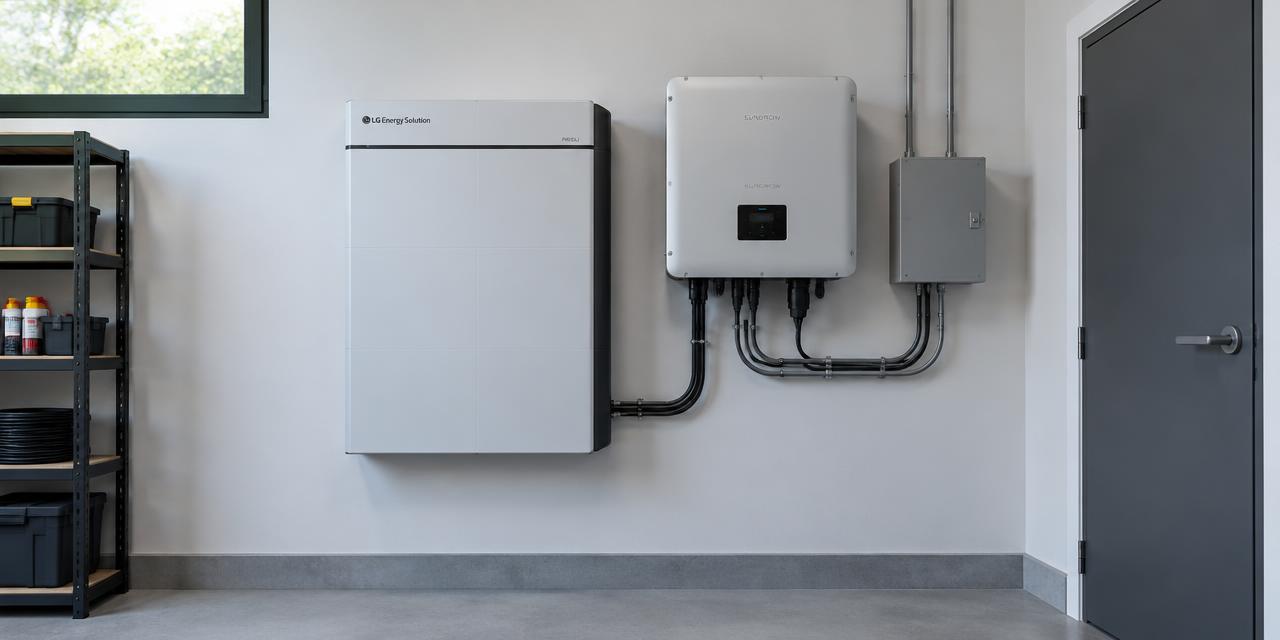
Expert Guide: Installing a Solar Battery Storage System in Le Locle
Installing a solar battery storage system in Le Locle is a key step to optimizing your energy autonomy. This guide details the technical, tax, and administrative aspects specific to your municipality.
At a glance
Typical budget
CHF 7'200 – CHF 15'400
Midpoint
CHF 10'500
Grants found
0
Nearby companies
4
Worked examples in Le Locle
Small project
CHF 4'000 – CHF 9'100
Typical project
CHF 7'200 – CHF 15'400
Large project
CHF 12'400 – CHF 25'400
Project
Quantity
Low
High
Per unit
Small project
5 kWh
CHF 4'000
CHF 9'100
CHF 1'200
Typical project
10 kWh
CHF 7'200
CHF 15'400
CHF 1'100
Large project
18 kWh
CHF 12'400
CHF 25'400
CHF 1'000
Computed with our estimator for Le Locle (regional factor included), standard finish. Only the project size changes.
Cost split (typical project)
Labour :CHF 2'100(20 %)
Materials :CHF 7'300(70 %)
Other costs :CHF 1'100(10 %)
What the price covers
Included
Supply and installation
VAT
Battery, charge management and standard connection; options according to answers
Not included
Permits and architect fees
Unexpected structural issues
Possible subsidies
Solar panels and complete electrical refurbishment
Le Locle's housing stock in figures
In Le Locle, the federal building register lists 2'039 residential buildings and 6'784 dwellings. These municipal benchmarks help put your home in context, but do not replace an individual assessment.
80 %built before 1980
76 %heated by oil or gas
16 %electric hot water
10.5 %with declared solar thermal
Age of residential buildings
80 % built before 1980
Before 191941 %
1919–19459 %
1946–196013 %
1961–197010 %
1971–19807 %
1981–19906 %
1991–20006 %
2001–20104 %
Since 20115 %
Construction year does not reveal past renovations: check the current insulation condition.
Main heating energy
40 % · Heating oil
Heating oil40 %
Gas36 %
Wood11 %
Heat pump5 %
District heating4 %
Electricity4 %
Solar thermal2 %
This distribution describes recorded buildings, not your system's consumption or efficiency.
Heating and hot water: which energies?
Energy
Heating
Hot water
Gas
36 %
30.4 %
Heating oil
40 %
31.7 %
District heating
4 %
3.3 %
Heat pump
5 %
4.1 %
Electricity
4 %
16 %
Wood
11 %
5.5 %
Solar thermal
2 %
8.1 %
Each line gives the share of buildings using that energy, separately for heating and for hot water. The two columns do not always reach 100%: some buildings combine two systems, or reported none.
Type of heating system
Boiler (unspecified)71.6 %
Heat pump8.2 %
Condensing boiler6.9 %
Stove4.3 %
Heat exchanger (district)3.3 %
Central electric heating3 %
Direct electric heaters0.5 %
A standard non-condensing boiler is usually older and less efficient.
Houses or apartment buildings?
Single-family houses48.6 %
Two-dwelling houses11.3 %
Apartment buildings (3+)33.4 %
Other6.7 %
14.4 % of buildings mix housing with shops or offices.
The typical building
storeys (median)
3
median footprint
156 m²
median dwelling area
80 m²
Renovations, heritage and volumes
For homeowners planning renovations in Le Locle, the RegBL figures provide vital planning context. With 22 buildings identified as protected heritage, early consultation with municipal authorities regarding permits is essential. The median house volume of 677.5 m3, based on the SIA 416 standard, helps determine the scale of necessary heating and insulation upgrades. Please be aware that data coverage is partial; while 990 houses are registered, volume measurements are available for only 74 properties. Reviewing these official figures helps you better prepare for the specific regulatory and structural requirements of your renovation project.
22
buildings flagged as protected
status known for 178 of 1'902 buildings; check with the municipality
8 °C and nearly 107 frost days per year. With significant heating needs, illustrated by 4,007 heating degree days, effective energy management is a priority for homeowners.
The local solar irradiation, estimated at 1,302 kWh/m²/year, offers real potential for photovoltaic production, but production is lower in winter, the period when needs are highest.
A battery is useful if your solar production significantly exceeds your daytime consumption, which is often the case in Le Locle during the summer months.
By installing a storage system, you compensate for the gap between daytime production and nighttime needs, especially during months with more generous sunshine.
This project is particularly opportune if you are planning a global renovation of your heating system or during the initial installation of solar panels, in order to maximize self-consumption and reduce your dependence on the grid during periods of high demand.
Technical choices that affect the project
The selection of your battery system must be based on your actual consumption profile rather than just the peak power of your panels. Size the capacity according to evening consumption to ensure optimal coverage between sunset and the following morning.
It is crucial to verify compatibility with your existing inverter before purchasing, as there are AC-coupled or DC-coupled solutions, each with its own technical specifications and installation requirements.
Options also include smart energy management systems (EMS) that allow you to prioritize battery charging or powering other household appliances. Durability and the number of charge cycles are key quality criteria to ensure the longevity of the investment.
Finally, consider modularity : some systems allow for adding extra storage units if your needs evolve in the future, thus offering valuable flexibility for a durable installation adapted to the local climatic context.
Specificities of local buildings
The real estate stock in Le Locle is marked by great diversity, ranging from old constructions to more recent buildings. For any battery installation, it is crucial to assess the state of your home's internal electrical network.
In buildings constructed before 1990, specific checks on insulation and the compliance of electrical wiring must be carried out by a professional to ensure a safe integration of the new components.
The cellar or garage where the battery will be installed must also feature stable conditions, despite the region's harsh winters. Temperatures that are too low can affect the performance and lifespan of lithium-ion cells.
Ensure that the chosen space is dry, well-ventilated, and that the walls do not show traces of dampness.
A prior technical diagnosis is highly recommended to ensure that the structures supporting the battery weight are adequate, particularly in older buildings whose floors may have specific constraints.
Authorizations and rules in Le Locle
It replaces the classic building permit for installations mounted on a roof, located in the building zone, and that are not in zones or on objects protected by cantonal or municipal law.
This notification must be submitted to the competent municipal or cantonal authority, about twenty days before the start of works.
Regarding heritage, it is imperative to consult the municipal urban planning department of Le Locle before taking any action. Each building may be subject to specific requirements depending on its geographical location or historical importance.
Do not assume a single rule for the whole city : the urban planning department will provide you with documents and procedures specific to your address, ensuring that your project complies with current local regulations without the risk of future challenges.
Financial aid and taxation
If these expenses cannot be fully deducted in the year of invoicing, they can be carried forward to the two following tax years, provided they were fully declared in year N. This carry-forward rule is crucial for optimizing the tax management of your work.
Note that the choice between deducting actual expenses and the flat-rate deduction (10% or 20% of gross yield depending on the age of the building) must be made carefully for each tax period.
If you opt for actual expenses, you must necessarily justify the expenses related to energy improvement. The tax authorities will automatically determine the carry-forward expenses.
We advise you to prepare your file in advance by organizing all invoices related to the work, and to consult a tax advisor if necessary before declaring your income, in order to maximize the benefits linked to your solar investment.
Schedule: Typical workflow of the project
The realization of a solar storage project follows logical steps that guarantee the compliance and efficiency of the installation. First, request quotes from qualified professionals after having performed your own energy audit.
Once the professional is chosen, validate the quote and submit the notification to the competent authority about twenty days before the start of works. This administrative phase is short but essential for complying with local legislation.
Scheduling the installation should ideally avoid periods of intense cold, even though the installation is mostly indoors. Access to your home and the extreme climatic conditions of Le Locle can influence the fluidity of the work.
Once the components are delivered and inspected, the actual installation typically lasts a few days, followed by a testing and commissioning phase.
Ensure you are present for the handover of the site and the training on how to use your management system, to fully understand how to monitor your energy performance from the first day of operation.
Common errors and checklist before requesting quotes
Never neglect to check the compatibility between your solar inverter and the chosen battery system, or you risk significant additional costs during commissioning.
A common mistake is overestimating the necessary storage capacity: size according to your actual night-time needs and not according to the total power of your photovoltaic panels.
Also ensure that the installer includes an emergency shut-off solution that is easily accessible in case of a technical problem.
Before requesting quotes, verify that your file is ready : determine precisely the current power of your panels and your actual annual electricity consumption. Check that the space provided for the battery is dry, temperate, and accessible.
Check with your municipality for any specificities related to your building. Finally, require a detailed quote including labor costs, equipment, and commissioning.
Ensure that the selected company has the necessary certifications to work on grid-connected electrical installations.
Your project in 5 steps
1. Estimate
Set a budget range with the estimator.
2. Grants
Apply before work starts.
3. Quotes
Compare at least 3 quotes.
4. Permit
Check with the municipality whether a permit is needed.
5. Works
Follow the site and do a written handover.
Grants and subsidies
No specific grant listed for this work. Maintenance tax deductions may still apply.
Companies in the area
Fahrni Toitures Sàrl
2303 La Chaux-de-Fonds · about 8.8 km
Established in La Chaux-de-Fonds in 1878, family-owned Fahrni Toitures carries out roofing and sheet metal work, replaces roof windows, and offers photovoltaic systems with battery storage alongside roof maintenance and snow removal.
swisspro is a company specializing in electrical installations, charging infrastructure for electric vehicles, and intelligent building automation solutions.
These rules apply across the whole canton, not only in this town.
Tax deductions
Carry-forward : Seule la part des frais d'investissement destinés à économiser l'énergie et à ménager l'environnement ainsi que les frais de démolition en vue d'une construction de remplacement, qui n'a pas pu être déduite l'année de facturation (année N) car elle aurait engendré un revenu net négatif, peut être reportée sur les deux années fiscales suivantes (N+1 et N+2). Ces frais doivent avoir été intégralement déclarés l'année de leur facturation. Si des frais sont reportés, la déduction forfaitaire n'est pas possible pour l'immeuble concerné pour la période fiscale correspondante. Le droit de reporter est réservé au propriétaire ayant supporté les frais. L'Intendance des impôts détermine d'office les frais reportables.
Flat rate deduction : 10% du rendement brut des loyers ou de la valeur locative (max. 7 200 CHF) si l'âge du bâtiment est inférieur ou égal à dix ans; 20% du rendement brut des loyers ou de la valeur locative (max. 12 000 CHF) si l'âge du bâtiment est supérieur à dix ans. Aucune autre déduction supplémentaire n'est possible avec le forfait. Les propriétaires d'immeubles commerciaux affectés à leur activité indépendante ne peuvent pas opter pour la déduction forfaitaire pour ces immeubles, mais c'est possible pour d'autres immeubles de leur fortune privée.
Maintenance costs : Le/la contribuable peut choisir, lors de chaque période fiscale et pour chaque immeuble, entre la déduction des frais effectifs et la déduction forfaitaire. Les frais effectifs déductibles sont ceux visant à maintenir la valeur de l'immeuble, facturés durant l'année de calcul. Si les dépenses comportent des dépenses d’entretien, d’amélioration et/ou d’économies d’énergie, une répartition par nature est nécessaire selon un catalogue de répartition.
Energy investments : Les investissements destinés à économiser l’énergie et à ménager l’environnement (remplacement d'éléments vétustes ou adjonction d'éléments/installations dans les bâtiments existants) sont déductibles. Ces frais peuvent être reportés sur les deux années fiscales suivantes s'ils n'ont pas pu être déduits intégralement l'année de facturation (N, N+1, N+2).