
Enosis Sàrl
3213 Liebistorf · about 44.8 km
Enosis develops biomethanation technologies to convert CO2 and surplus electricity into storable and sustainable green gas.
enosis-energies.comHome solar battery · Langnau im Emmental
At a glance
Small project
CHF 4'000 – CHF 9'300
Typical project
CHF 7'400 – CHF 15'700
Large project
CHF 12'700 – CHF 25'900
| Project | Quantity | Low | High | Per unit |
|---|---|---|---|---|
| Small project | 5 kWh | CHF 4'000 | CHF 9'300 | CHF 1'200 |
| Typical project | 10 kWh | CHF 7'400 | CHF 15'700 | CHF 1'100 |
| Large project | 18 kWh | CHF 12'700 | CHF 25'900 | CHF 1'000 |
Computed with our estimator for Langnau im Emmental (regional factor included), standard finish. Only the project size changes.
Included
Not included
In Langnau im Emmental, the federal building register lists 2'021 residential buildings and 4'890 dwellings. These municipal benchmarks help put your home in context, but do not replace an individual assessment.
69 % built before 1980
Construction year does not reveal past renovations: check the current insulation condition.
37 % · Heating oil
This distribution describes recorded buildings, not your system's consumption or efficiency.
| Energy | Heating | Hot water |
|---|---|---|
| Gas | 1 % | 0.6 % |
| Heating oil | 37 % | 20.8 % |
| District heating | 2 % | 0.9 % |
| Heat pump | 22 % | 6 % |
| Electricity | 4 % | 46.7 % |
| Wood | 35 % | 21.6 % |
| Solar thermal | 0 % | 3.1 % |
Each line gives the share of buildings using that energy, separately for heating and for hot water. The two columns do not always reach 100%: some buildings combine two systems, or reported none.
A standard non-condensing boiler is usually older and less efficient.
23.9 % of buildings mix housing with shops or offices.
For your renovation plans in Langnau im Emmental, please be aware that the official federal building register data provides only partial coverage. Among the 2021 recorded buildings, heritage status is known for 188 properties, with zero buildings currently marked as protected. Regarding house volume, data is available for 971 houses, yet no precise measurements according to the SIA 416 standard are provided. Due to these limitations in the available records, it is essential to contact the local municipality early in your project. Direct consultation ensures you have accurate information before proceeding with structural or energy-related renovations in this municipality.
Source : OFS — RegBL (export communal complet). Existing residential buildings; percentages of recorded values.
A battery is worthwhile when solar output clearly exceeds your daytime use. Most households produce the most energy while family members are away. By storing this surplus, you can use your own free electricity in the evening and at night.
This significantly increases your self-consumption rate, which is particularly advantageous given current electricity prices.
Before you start, carefully analyze your annual consumption profile to assess whether the investment will be repaid by savings on your electricity bill in the long term. Proper planning is the first step toward energy independence.
Size capacity by evening consumption, not panel power. An oversized system represents an unnecessary cost, while a system that is too small will not cover your needs.
It is crucial to study your evening consumption habits, including the use of heating, water heaters, or heavy appliances after sunset. A qualified installer can help you calculate the ideal size in kilowatt-hours.
Keep in mind that storage efficiency decreases slightly during charge and discharge cycles, which must be factored into your energy forecasts. Plan ahead for maximum efficiency.
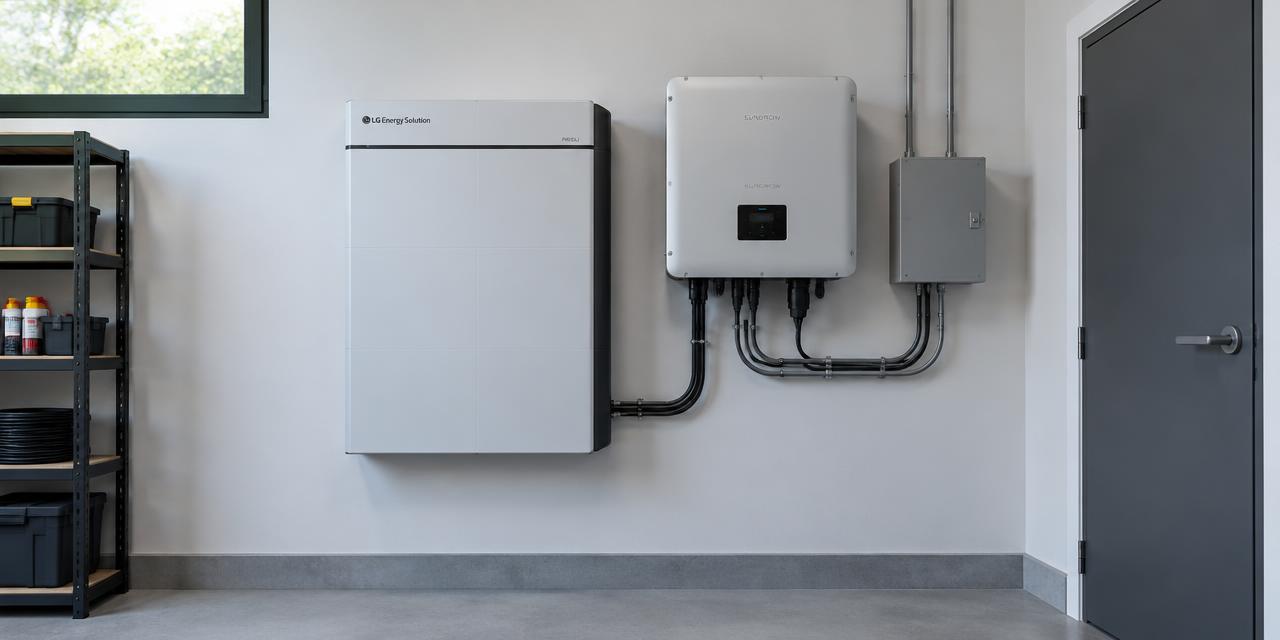
Check compatibility with your existing inverter before buying. If you already own solar panels, you may need to add an inverter-charger or opt for an AC coupling solution.
Some modern batteries are 'all-in-one' systems and include their own inverter, which can simplify installation but requires close compatibility with your home energy management system.
Ensure that the chosen hardware complies with Swiss electrical safety standards. Consult an expert to verify that existing wiring can support the additional load and that the software integration is conflict-free.
The cost of a solar battery depends on its technology, capacity, and the electrical work required for the installation. It is important to compare quotes from several local installers to obtain the best value for money.
Use the RenoIndex calculator to get a clear price range based on current market realities.
In addition to the price of the storage unit, do not forget to include labor costs for installation and any necessary updates to your electrical panel to ensure a compliant and durable installation for the decades to come.
1. Estimate
Set a budget range with the estimator.
2. Grants
Apply before work starts.
3. Quotes
Compare at least 3 quotes.
4. Permit
Check with the municipality whether a permit is needed.
5. Works
Follow the site and do a written handover.
No specific grant listed for this work. Maintenance tax deductions may still apply.
3213 Liebistorf · about 44.8 km
Enosis develops biomethanation technologies to convert CO2 and surplus electricity into storable and sustainable green gas.
enosis-energies.com1700 Fribourg · about 49.3 km
Solesa SA specializes in electrical installations and renewable energy systems, including consulting and maintenance in Fribourg.
solesa.com.ar1700 Fribourg · about 49.3 km
Electrical engineering office in Fribourg specializing in inspection, compliance, electrical panels, and energy consulting.
lexel.ch1700 Fribourg · about 49.3 km
Fri Solar Sàrl, based in Fribourg, specializes in the installation of photovoltaic systems and battery storage for both residential and commercial clients.
frisolar.chSuggestions from the commercial register by distance and activity. Not an endorsement or partnership.
Most modern lithium batteries have a lifespan of 10 to 20 years. Performance decreases gradually with the number of full charge cycles. Moderate use and installation in a temperature-controlled room help to extend this duration.
It depends on your model and the installation. Some systems include an automatic backup function that switches to stored energy during a power outage. Carefully verify this technical option with your installer if maintaining power is a priority for you.
Modern solar batteries require very little maintenance. They are generally equipped with intelligent management systems that optimize charging and discharging autonomously. However, it is recommended to have the connections and general condition checked annually by a professional during the maintenance of your photovoltaic system.
Yes, it is entirely possible to add a battery to an existing installation. You may need to opt for an AC-coupled system if your solar inverter cannot be replaced. Discuss this with a professional to evaluate the best technical solution for your current system.