
Hallenbarter & Russi Gebäudetechnik AG
3988 Obergoms · about 64.5 km
Obergoms-based company specializing in sanitary installations, heating systems, roofing, and tinsmith work for new builds and renovations.
hallenbarter-russi.chHeat pump installation · Küssnacht (SZ)
At a glance
Small project
CHF 29'100 – CHF 53'200
Typical project
CHF 36'700 – CHF 68'300
Large project
CHF 48'100 – CHF 91'100
| Project | Quantity | Low | High | Per unit |
|---|---|---|---|---|
| Small project | 80 m² | CHF 29'100 | CHF 53'200 | CHF 500 |
| Typical project | 160 m² | CHF 36'700 | CHF 68'300 | CHF 300 |
| Large project | 280 m² | CHF 48'100 | CHF 91'100 | CHF 200 |
Computed with our estimator for Küssnacht (SZ) (regional factor included), standard finish. Only the project size changes.
Included
Not included
In Küssnacht (SZ), the federal building register lists 2'217 residential buildings and 6'592 dwellings. These municipal benchmarks help put your home in context, but do not replace an individual assessment.
47 % built before 1980
Construction year does not reveal past renovations: check the current insulation condition.
42 % · Heat pump
This distribution describes recorded buildings, not your system's consumption or efficiency.
| Energy | Heating | Hot water |
|---|---|---|
| Gas | 3 % | 3 % |
| Heating oil | 32 % | 31.6 % |
| District heating | 7 % | 6.3 % |
| Heat pump | 42 % | 14 % |
| Electricity | 7 % | 34 % |
| Wood | 9 % | 6.4 % |
| Solar thermal | 0 % | 4.2 % |
Each line gives the share of buildings using that energy, separately for heating and for hot water. The two columns do not always reach 100%: some buildings combine two systems, or reported none.
A standard non-condensing boiler is usually older and less efficient.
For your renovation plans in Küssnacht, RegBL data provides helpful benchmarks, although coverage remains partial. Regarding building scale, there is a median volume of 1395.5 m3 for the 10 houses measured according to the SIA 416 standard, which is essential for estimating the scope of heating and insulation upgrades. Data concerning specific renovation years or heritage protection status is not recorded. Given these gaps in coverage, we strongly advise homeowners to contact the local municipal authorities early in the planning process to verify any specific building requirements or historical conservation constraints that might apply to your individual property.
Source : OFS — RegBL (export communal complet). Existing residential buildings; percentages of recorded values.
Before starting your heat pump project, it is essential to check whether your area can connect to a priority district heating network. In many areas, the development of thermal networks can be a more relevant alternative to an individual system.
Check with local authorities regarding existing energy master plans. If no network solution is planned, an individual heat pump becomes the preferred choice to ensure your energy independence while increasing the value of your property assets.
Sizing your system is a crucial step to ensure the thermal comfort of your home in Küssnacht. The local design outdoor temperature sets the heat pump's capacity needed to efficiently heat your home, even during harsh winters.
Incorrectly calculated power can lead to excessive electricity consumption or thermal discomfort.
A certified professional will perform an accurate calculation based on your building's actual heating requirements, ensuring optimal efficiency for your future installation.
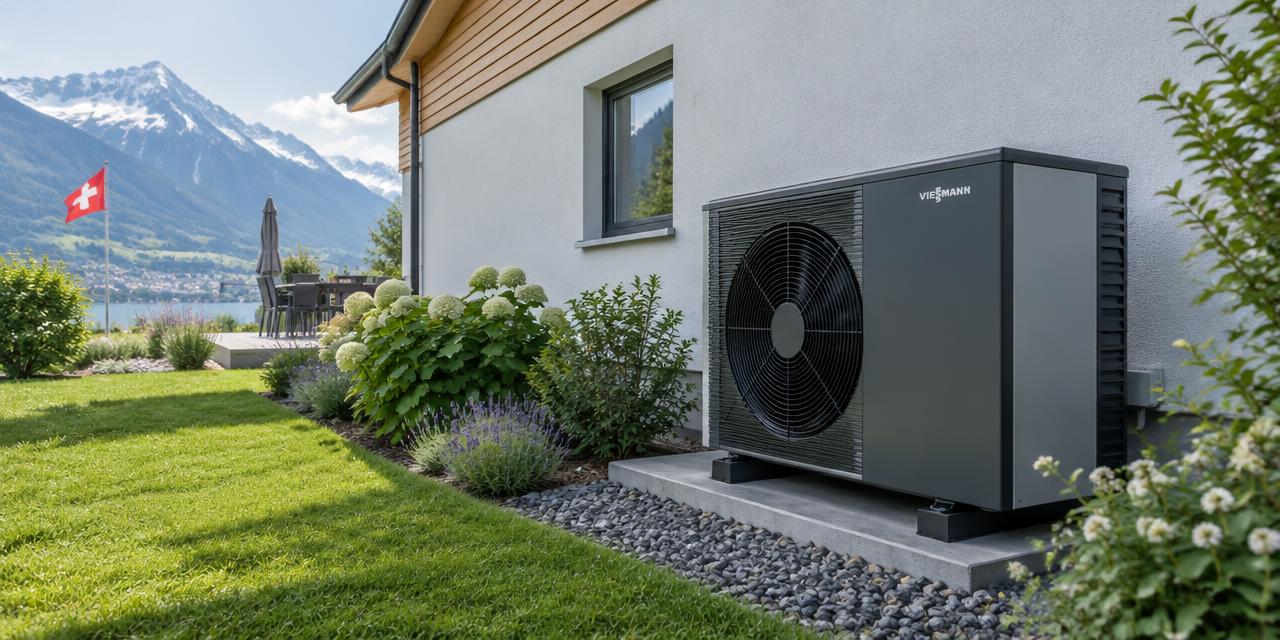
The installation of an air-water heat pump often involves an outdoor unit. These devices must meet noise limits towards neighbours to avoid any disputes. The unit's positioning is strategic: avoid pointing it directly towards bedroom windows or rest areas.
Soundproofing devices or acoustic screens can be installed if space is limited. It is advisable to discuss the location with your installer in order to comply with the current acoustic best practices.
A successful heat pump installation requires careful planning and the choice of competent partners. Beyond the technical aspect, it is important to consider the overall insulation of your building, as efficient heating relies on good sealing.
Don't forget to consult available grants in the canton of Schwyz that could support your project. For a clear view of costs, use RenoIndex to get a price range adapted to your situation.
Rigorous preparation is the key to a sustainable and economical installation.
1. Estimate
Set a budget range with the estimator.
2. Grants
Apply before work starts.
3. Quotes
Compare at least 3 quotes.
4. Permit
Check with the municipality whether a permit is needed.
5. Works
Follow the site and do a written handover.
No specific grant listed for this work. Maintenance tax deductions may still apply.
3988 Obergoms · about 64.5 km
Obergoms-based company specializing in sanitary installations, heating systems, roofing, and tinsmith work for new builds and renovations.
hallenbarter-russi.ch2829 Vermes · about 77.4 km
The website presented under the name Imeri Chauffage et Sanitaire Sàrl offers plumbing, heating and solar thermal work, while F. Imeri Sàrl’s registered purpose refers to a scrap metal business.
imeri-sarl.ch2832 Rebeuvelier · about 82.1 km
Eco6therm specializes in the installation of heating systems, particularly heat pumps, and solar photovoltaic energy solutions.
eco6therm.ch2824 Vicques · about 82.7 km
Specialist since 1968 in sanitary installations, heating (gas, oil, wood, renewable energy), and tinsmithing with 24/7 emergency repair service.
sanit.chSuggestions from the commercial register by distance and activity. Not an endorsement or partnership.
To get a realistic price range adapted to your specific needs, use our free RenoIndex estimator. This tool allows you to have a clear view of the costs in just a few clicks.
Air-water heat pumps must meet noise limits towards neighbours. Careful positioning and the use of acoustic screens help comply with standard neighbourhood requirements.
Yes, always check whether your area can connect to a priority district heating network. It is often a more efficient alternative to installing an individual heat pump.
Yes, the local design outdoor temperature defines the required capacity. Incorrect calculation can reduce energy efficiency and increase your electricity bills unnecessarily.