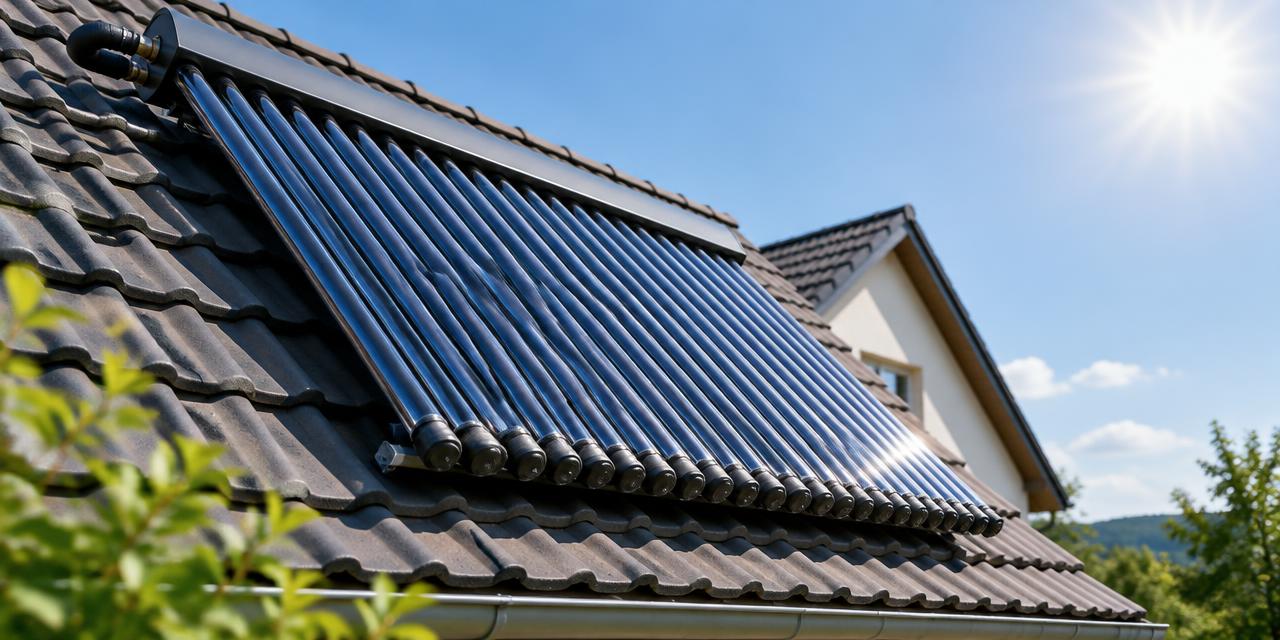
Solar Water Heating in Hünenberg: Guide and Cost Estimations
Are you considering installing solar thermal collectors in Hünenberg to improve your building's energy efficiency? This is an excellent way to reduce your energy bills while increasing your property value. In the canton of Zug, the energy transition is a high priority. Proper project planning is crucial to ensure long-term profitability. Use our free RenoIndex estimator to get a precise price range tailored to your specific needs in the municipality of Hünenberg and plan your investment effectively.
At a glance
Typical budget
CHF 11'500 – CHF 26'600
Midpoint
CHF 18'400
Grants found
0
Nearby companies
4
Worked examples in Hünenberg
Small project
CHF 8'900 – CHF 20'800
Typical project
CHF 11'500 – CHF 26'600
Large project
CHF 15'700 – CHF 36'200
Project
Quantity
Low
High
Per unit
Small project
3 m²
CHF 8'900
CHF 20'800
CHF 4'800
Typical project
6 m²
CHF 11'500
CHF 26'600
CHF 3'100
Large project
11 m²
CHF 15'700
CHF 36'200
CHF 2'300
Computed with our estimator for Hünenberg (regional factor included), standard finish. Only the project size changes.
Cost split (typical project)
Labour :CHF 7'400(40 %)
Materials :CHF 9'200(50 %)
Other costs :CHF 1'800(10 %)
What the price covers
Included
Supply and installation
VAT
Collectors, controls, standard connection and tank according to answers
Not included
Permits and architect fees
Unexpected structural issues
Possible subsidies
Roof refurbishment and replacement of main heating
Hünenberg's housing stock in figures
In Hünenberg, the federal building register lists 1'405 residential buildings and 3'656 dwellings. These municipal benchmarks help put your home in context, but do not replace an individual assessment.
40 %built before 1980
38 %heated by oil or gas
13.7 %electric hot water
4.3 %with declared solar thermal
Age of residential buildings
40 % built before 1980
Before 19197 %
1919–19452 %
1946–19602 %
1961–19705 %
1971–198024 %
1981–199020 %
1991–200015 %
2001–201018 %
Since 20118 %
Construction year does not reveal past renovations: check the current insulation condition.
Main heating energy
41 % · Heat pump
Heat pump41 %
Heating oil23 %
Gas15 %
District heating15 %
Wood5 %
Electricity1 %
This distribution describes recorded buildings, not your system's consumption or efficiency.
Heating and hot water: which energies?
Energy
Heating
Hot water
Gas
15 %
13 %
Heating oil
23 %
18 %
District heating
15 %
15.3 %
Heat pump
41 %
35 %
Electricity
1 %
13.7 %
Wood
5 %
3.1 %
Solar thermal
0 %
1.8 %
Each line gives the share of buildings using that energy, separately for heating and for hot water. The two columns do not always reach 100%: some buildings combine two systems, or reported none.
Type of heating system
Heat pump40.6 %
Boiler (unspecified)40.4 %
Heat exchanger (district)15.5 %
Condensing boiler1.6 %
Stove1 %
Central electric heating0.9 %
A standard non-condensing boiler is usually older and less efficient.
Houses or apartment buildings?
Single-family houses63.8 %
Two-dwelling houses11.1 %
Apartment buildings (3+)25.1 %
8.1 % of buildings mix housing with shops or offices.
The typical building
storeys (median)
3
median footprint
135 m²
median dwelling area
121 m²
Renovations, heritage and volumes
For renovation planning in Hünenberg, official data shows that out of 1405 buildings, 375 are under heritage protection, necessitating early municipal consultation and specific permits. The median house volume is 690 m3, which is critical for scaling heating and insulation works based on the SIA 416 standard. Please be aware that data coverage is partial regarding volume, as only 32 buildings are measured according to this standard. Information regarding the year of renovation is not available in the current registry. These figures serve as a foundational guide for estimating the scope of your upcoming property renovation projects.
375
buildings flagged as protected
status known for 442 of 1'405 buildings; check with the municipality
Solar thermal collectors usually cover much of summer hot water. To maximize this performance in Hünenberg, your roof orientation and collector tilt are determining factors. A south-facing orientation is ideal for capturing maximum solar radiation.
It is advisable to conduct a technical audit beforehand to check the condition of your roof and the compatibility of your current water heater with the new solar system. This ensures that your investment will be fully utilized during the sunny months.
Integration and sizing
Combining collectors with a heat pump needs a sizing study. This hybrid approach allows you to cover your heating and domestic hot water needs more efficiently.
Correct sizing avoids unnecessary oversizing or, conversely, insufficient capacity for your actual needs. Working with qualified professionals in Hünenberg will help you define the optimal configuration for your home.
Sizing takes into account your usual consumption, the number of occupants, and the building's technical constraints to ensure harmonious operation.
Available financial support
Several cantons subsidise collectors per m² or per installation. It is essential to inquire before starting the work. Although programmes may vary, the objective is to promote energy renovation.
Check the specific eligibility criteria in the canton of Zug before submitting your grant applications. Early planning ensures you benefit from all available financial support to reduce your project's initial cost.
RenoIndex supports you by providing realistic estimates to budget your project before starting the grant process.
Key steps of your renovation
Energy renovation always starts with an accurate analysis of existing conditions. In Hünenberg, as everywhere in Switzerland, the success of a solar project relies on the quality of installation and regular maintenance.
After consulting the RenoIndex estimator, contact local installers to get detailed quotes. Compare proposals while considering the quality of materials and offered warranties.
Once the installation is complete, make sure to schedule annual maintenance to maintain the performance of your collectors. Regular monitoring ensures the durability of your system and optimal return on investment.
Your project in 5 steps
1. Estimate
Set a budget range with the estimator.
2. Grants
Apply before work starts.
3. Quotes
Compare at least 3 quotes.
4. Permit
Check with the municipality whether a permit is needed.
5. Works
Follow the site and do a written handover.
Grants and subsidies
No specific grant listed for this work. Maintenance tax deductions may still apply.
Companies in the area
F. Imeri Sàrl
2829 Vermes · about 74.5 km
The website presented under the name Imeri Chauffage et Sanitaire Sàrl offers plumbing, heating and solar thermal work, while F. Imeri Sàrl’s registered purpose refers to a scrap metal business.
Suggestions from the commercial register by distance and activity. Not an endorsement or partnership.
Frequently asked questions
Do I need a permit for solar thermal?
Generally, solar installations on roofs are subject to a simple notification procedure. It is advisable to check with the municipality of Hünenberg if your building is listed or located in a specific protection zone.
What is the average lifespan of an installation?
A well-maintained solar thermal installation has an average lifespan of 20 to 25 years. Regular maintenance helps to extend this duration and ensure maximum efficiency.
How long does it take to recoup the investment?
Profitability depends on hot water consumption and grants obtained. On average, the return on investment is often between 10 and 15 years, depending on avoided energy costs.
Can I install solar on any type of roof?
Most roofs are suitable, but the structure must support the weight of the collectors. A professional must verify the integrity of the roof structure and the orientation before any installation.