
Canton
Heat pump grant — Fribourg
Flat amounts depending on heat pump type (air-water, ground-source).
Support from the canton of Fribourg and the Buildings Programme for heat pumps replacing fossil fuels.
www.leprogrammebatiments.chHeat pump installation · Bulle
At a glance
Small project
CHF 32'900 – CHF 60'300
Typical project
CHF 41'600 – CHF 77'500
Large project
CHF 54'600 – CHF 103'300
| Project | Quantity | Low | High | Per unit |
|---|---|---|---|---|
| Small project | 80 m² | CHF 32'900 | CHF 60'300 | CHF 600 |
| Typical project | 160 m² | CHF 41'600 | CHF 77'500 | CHF 400 |
| Large project | 280 m² | CHF 54'600 | CHF 103'300 | CHF 300 |
Computed with our estimator for Bulle (regional factor included), standard finish. Only the project size changes.
Included
Not included
In Bulle, the federal building register lists 3'036 residential buildings and 13'192 dwellings. These municipal benchmarks help put your home in context, but do not replace an individual assessment.
37 % built before 1980
Construction year does not reveal past renovations: check the current insulation condition.
48 % · District heating
This distribution describes recorded buildings, not your system's consumption or efficiency.
| Energy | Heating | Hot water |
|---|---|---|
| Heating oil | 30 % | 27.7 % |
| District heating | 48 % | 27.5 % |
| Heat pump | 14 % | 13.2 % |
| Electricity | 4 % | 17.6 % |
| Wood | 4 % | 12.8 % |
Each line gives the share of buildings using that energy, separately for heating and for hot water. The two columns do not always reach 100%: some buildings combine two systems, or reported none.
A standard non-condensing boiler is usually older and less efficient.
For homeowners in Bulle, official building register figures provide essential guidance for renovation planning. With 19 buildings designated as heritage-protected, it is vital to contact the municipality early regarding necessary permits. Regarding scale, the median house volume is 708 m3, based on a sample of 15 properties measured via the SIA 416 standard. Please note that data coverage is partial, meaning these figures represent specific subsets of the housing stock. These metrics are fundamental for correctly sizing heating systems and insulation upgrades, ensuring your renovation project aligns with the architectural reality and regulatory framework of the municipality.
Source : Registre fédéral des bâtiments et des logements (RegBL), OFS, 2026. Existing residential buildings; percentages of recorded values.
6 °C. With approximately 108 frost days per year, the heating demand is significant, totaling 3,544 heating degree days.
Replacing a fossil fuel boiler becomes a priority to optimize thermal comfort while aligning with the municipality's environmental policy, which has been labeled Cité de l’énergie Gold since 2020.
The ideal time for these works is at the end of the technical lifespan of your current system. Waiting for a total failure can force you into hasty decisions.
By planning ahead, you can precisely size your future heat pump according to the building's actual needs, thus ensuring optimal efficiency despite the harsh winters in the Gruyère region.
It is also recommended to verify beforehand if your neighborhood is connectable to the district heating network of Gruyère Energie SA, a solution often favored locally.
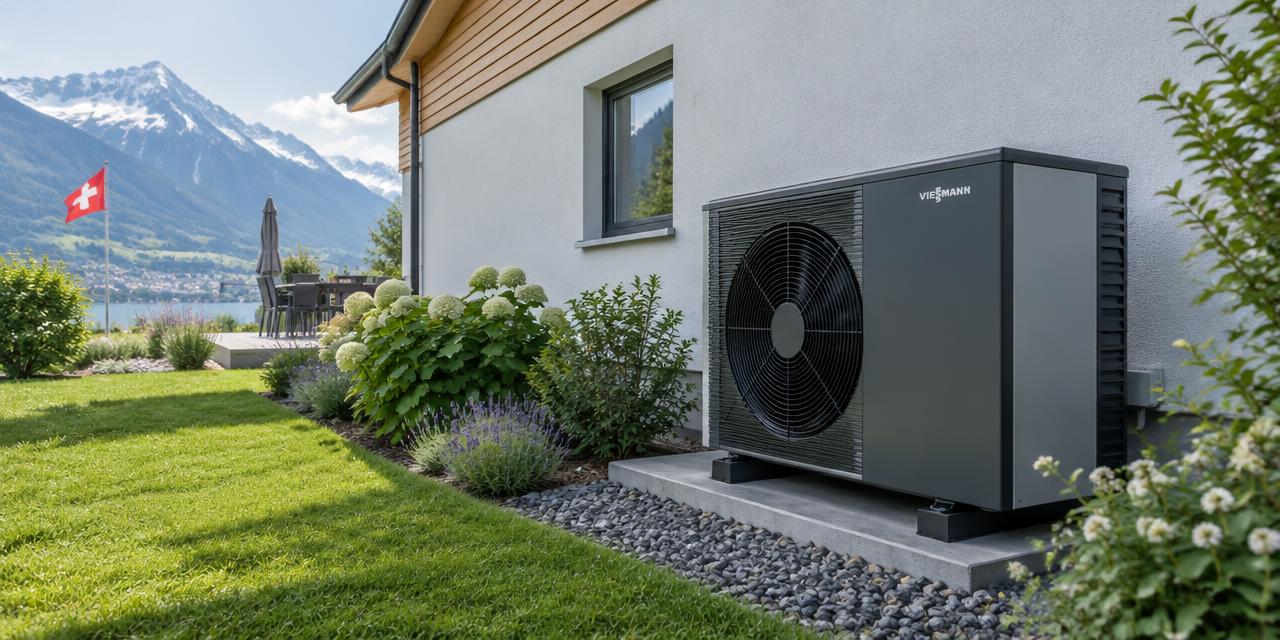
The choice of heat pump system mainly depends on the type of heat emitters already installed. An air-to-water heat pump is the most common solution, capturing calories from the outside air.
However, it is imperative to ensure that the outdoor unit complies with noise limits imposed on neighbors, a crucial point in dense residential areas in Bulle.
Global optimization can include coupling with photovoltaic panels, taking advantage of local sunshine of 1,362 kWh/m²/year, to power your installation. Sizing must imperatively be based on the local outdoor design temperature to ensure constant efficiency.
Finally, consider the flow temperature required for your radiators or floor heating; a prior energy renovation of the building envelope often allows for reducing this temperature, thus significantly increasing the seasonal performance of the heat pump.
In Bulle, the building stock is varied, ranging from historic village houses to recent constructions. For older buildings, installing a heat pump requires a preliminary analysis of the distribution system.
Old piping networks are sometimes unsuitable for the hydraulic needs of modern heat pumps.
Checking insulation is essential because a heat pump operating in a poorly insulated home will consume enormous amounts of energy in cold weather, exceeding the 108 annual local frost days.
It is also recommended to conduct a complete diagnosis including the status of asbestos for buildings constructed before 1990.
During the boiler room renovation, it is highly likely that technical adjustments will be required regarding ventilation and electrical connections. You should hire a professional capable of evaluating the compatibility of your current emitters.
In case of doubt, a comprehensive energy analysis remains the best approach to avoid unnecessary investments and ensure optimal longevity for your future equipment.
According to the Regulation for the execution of the cantonal energy law (RLE) in force since January 1, 2024, it is required that at least 10% of the necessary heat be covered by renewable energy or district heating.
Although a heat pump is an answer to this requirement, the application file must be rigorously prepared.
The municipality of Bulle, via its urban planning department, may require specific authorizations, particularly for the outdoor unit of an air-water heat pump to preserve urban aesthetics or comply with heritage protection perimeters.
It is imperative to check with the municipal office to understand local procedures before validating any contract.
Do not neglect to verify if your plot is included in a priority district heating area of the city, as this could influence the decision to grant your installation permit.
This aid, in the form of flat rates, varies according to the type of technology adopted, such as air-water or ground-water heat pumps.
Tax-wise, investments in energy efficiency are deductible from your taxable income. For buildings over 10 years old, the canton applies specific rules: you can deduct either the effective costs or a flat rate of 20% of the rental value.
The major advantage lies in the possibility of carrying forward the excess of investment costs to the two following tax periods if the cost of the work exceeds the income generated by the property.
This provision is particularly attractive for owners carrying out major works, as it allows for smoothing the tax burden over several years while sustainably increasing the value of the real estate.
Planning a heating system change in Bulle must follow a rigorous logic to avoid unforeseen events. The preliminary phase consists of consulting professionals for sizing, then submitting authorization requests.
Once permits are obtained and subsidies confirmed, the actual construction can begin. It is preferable to schedule work outside of extreme cold periods, knowing the city has many frost days per year.
The site generally begins with the removal of the old fossil fuel boiler, a step requiring proper disposal of old equipment. Next, the heat pump installation and hydraulic connections are carried out.
Commissioning includes fine-tuning of the controls, essential to maximize the COP (coefficient of performance).
Finally, the final functional test is performed to ensure the home's heating needs are perfectly met, regardless of the outdoor temperature observed during winter.
The success of your project depends on meticulous preparation. Absolutely avoid signing a quote before verifying that cantonal financial aid has been formally approved.
Do not neglect to ask for several comparative offers to understand the different ranges of heat pumps offered.6 °C outdoor temperature specific to Bulle.
Checklist before any request : Check if your neighborhood is connectable to the district heating of Gruyère Energie SA. Ensure your electrical installation is sufficient to support the new load.
Ask for a noise study for the outdoor unit to respect the tranquility of your neighbors. Check the condition of your current radiators to see if they are compatible with low-temperature operation.
Finally, ensure that the demolition and removal costs for the old equipment are included in the renovation contract to avoid surprises during final billing.
1. Estimate
Set a budget range with the estimator.
2. Grants
Apply before work starts.
3. Quotes
Compare at least 3 quotes.
4. Permit
Check with the municipality whether a permit is needed.
5. Works
Follow the site and do a written handover.
Flat amounts depending on heat pump type (air-water, ground-source).
Support from the canton of Fribourg and the Buildings Programme for heat pumps replacing fossil fuels.
www.leprogrammebatiments.chCheck amounts and conditions with the provider before signing: apply before work starts in most cases.
1630 Bulle · about 0 km
Fribourg-based specialist in maintenance, repair, and installation of heating, ventilation, air conditioning, and plumbing systems since 1989.
mdt-maintenance.ch1630 Bulle · about 0 km
Hyda concept SA specializes in heating, ventilation, and sanitary installations for residential and professional projects in Bulle.
hydro-concept.ch1630 Bulle · about 0 km
LEATECH SA specializes in facility management, technical HVAC maintenance, and janitorial services for residential and commercial buildings.
leatech.ch1630 Bulle · about 0 km
Specialized company in heating, ventilation, plumbing, and tinsmithing for modern building technology solutions.
raboud-energie.chSuggestions from the commercial register by distance and activity. Not an endorsement or partnership.
You must base calculations on an outdoor temperature of -12.6 °C. This figure corresponds to the 1st percentile of local minimums.
Yes, the network managed by Gruyère Energie SA is a solution recognized by the municipality. Check the availability at your specific address.
Yes, it is imperative. The subsidy application must be submitted via the Building Program before any work begins.
Absolutely, outdoor units must respect noise limits towards neighbors. A noise study is strongly recommended.
Yes, energy investments are deductible. The surplus can be carried forward to the two following tax periods.
It requires covering 10% of the necessary heat via renewable energy when replacing fossil heating. The heat pump usually meets this criterion.
With over 100 frost days, rigorous sizing according to the local temperature is essential to ensure energy efficiency.
Altitude
767 m
Heating degree days
3'544 Kj/an
20/12 °C
Frost days
108 jours/an
Solar irradiation
1'362 kWh/m²/an
horizontal
Winter design temperature
-12.6 °C
1er percentile des minimales
Mean temperature
9.1 °C
Estimated solar yield
1'199 kWh/kWc/an
toit ~30° sud, PR 0.8, estimation
Source : swisstopo – service d'altitude (MNT) · Open-Meteo Historical Weather API (réanalyse ERA5, moyenne 2015-2024)
Source : Ville de Bulle
Source : Ville de Bulle
These rules apply across the whole canton, not only in this town.
Fossil heating rules
Source : fr.ch
Tax deductions
Source : Administration Cantonale des Impôts du Canton de Fribourg