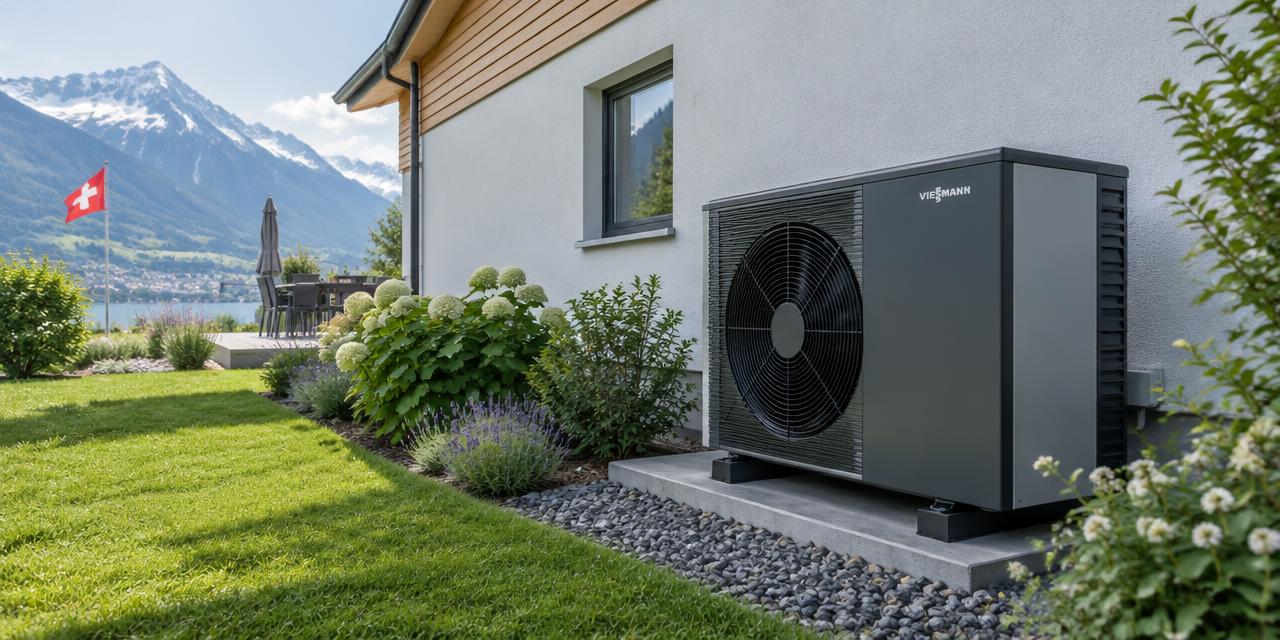
Indicative price, tips, grants and companies for your project in Bernex (Geneva).
At a glance
Typical budget
CHF 41'600 – CHF 77'500
Midpoint
CHF 58'200
Grants found
1
Nearby companies
4
Worked examples in Bernex
Small project
CHF 32'900 – CHF 60'300
Typical project
CHF 41'600 – CHF 77'500
Large project
CHF 54'600 – CHF 103'300
Project
Quantity
Low
High
Per unit
Small project
80 m²
CHF 32'900
CHF 60'300
CHF 600
Typical project
160 m²
CHF 41'600
CHF 77'500
CHF 400
Large project
280 m²
CHF 54'600
CHF 103'300
CHF 300
Computed with our estimator for Bernex (regional factor included), standard finish. Only the project size changes.
Cost split (typical project)
Labour :CHF 23'300(40 %)
Materials :CHF 29'100(50 %)
Other costs :CHF 5'800(10 %)
What the price covers
Included
Supply and installation
VAT
Heat pump and standard connections; removal and equipment only according to answers
Not included
Permits and architect fees
Unexpected structural issues
Possible subsidies
Drilling beyond 150 m, buried or contaminated tank, asbestos, insulation and new finishes
With air-to-air: hot water and ducts only if selected; adaptations beyond the options excluded
Bernex's housing stock in figures
In Bernex, the federal building register lists 1'611 residential buildings and 4'686 dwellings. These municipal benchmarks help put your home in context, but do not replace an individual assessment.
55 %built before 1980
63 %heated by oil or gas
7.6 %electric hot water
12.2 %with declared solar thermal
Age of residential buildings
55 % built before 1980
Before 191910 %
1919–19454 %
1946–19605 %
1961–197013 %
1971–198023 %
1981–199015 %
1991–200010 %
2001–20109 %
Since 201112 %
Construction year does not reveal past renovations: check the current insulation condition.
Main heating energy
39 % · Heating oil
Heating oil39 %
Gas24 %
Heat pump22 %
District heating7 %
Electricity4 %
Wood4 %
This distribution describes recorded buildings, not your system's consumption or efficiency.
Heating and hot water: which energies?
Energy
Heating
Hot water
Gas
24 %
22.6 %
Heating oil
39 %
36.6 %
District heating
7 %
6 %
Heat pump
22 %
3.1 %
Electricity
4 %
7.6 %
Wood
4 %
2.1 %
Solar thermal
0 %
11.6 %
Each line gives the share of buildings using that energy, separately for heating and for hot water. The two columns do not always reach 100%: some buildings combine two systems, or reported none.
Type of heating system
Boiler (unspecified)55 %
Heat pump22 %
Heat exchanger (district)6.6 %
Standard boiler5.5 %
Condensing boiler5.4 %
Central electric heating3.2 %
Direct electric heaters1.3 %
Stove0.6 %
A standard non-condensing boiler is usually older and less efficient.
Renovations, heritage and volumes
For your renovation projects in Bernex, the federal building registry data shows partial coverage. Although the register lists 1611 buildings, specific details regarding renovation years, heritage protection status, and building volumes based on the SIA 416 standard are not currently recorded or available in our system. Due to this lack of specific RegBL figures, property owners should communicate directly with the local municipal authorities to obtain precise information about their property before starting any major work. Early coordination with the municipality ensures that you address all relevant planning requirements and local building regulations for your renovation project.
0
buildings flagged as protected
status known for 35 of 1'611 buildings; check with the municipality
Suggestions from the commercial register by distance and activity. Not an endorsement or partnership.
Useful local data
Rules of the canton of Geneva
These rules apply across the whole canton, not only in this town.
Fossil heating rules
Note : Les exigences s'appliquent également aux nouvelles constructions, qui doivent être entièrement alimentées en chaleur renouvelable.
Legal basis : Loi sur l'énergie (Le)
In force since : 1er juin 2020
Heating replacement : En cas de remplacement d'une installation de production de chaleur (chauffage et/ou eau chaude sanitaire), 100% de la chaleur doit être d'origine renouvelable, à l'exception des cas où des contraintes techniques ou financières empêchent l'atteinte de cet objectif. Dans ces cas, un minimum de 20% d'énergie renouvelable est exigé, complété par des mesures compensatoires (consommation d'énergie, émissions de CO2 ou performances énergétiques globales).
Renewable share required : 100% (ou 20% avec mesures compensatoires si contraintes techniques/financières)
Solar panels : Soumise à autorisation de construire, mais avec une procédure simplifiée si certaines conditions sont remplies (conformité au droit des zones, intégration paysagère et patrimoniale satisfaisante, puissance totale inférieure à 100 kVA). Procédure simplifiée possible par le biais d'une déclaration préalable, si les installations sont sur des toits en pente conformes ou sur des toits plats non visibles, ou dans certains périmètres d'aménagement (zone 4B, 5, 5A, 5B, 6).
Heat pump : Les pompes à chaleur air-eau ou air-air nécessitent une autorisation de construire si leur puissance dépasse 10 kW. Si elles sont installées à l'intérieur, elles sont soumises à la LCI (Loi sur les constructions et les installations) et non à la LALPT (Loi sur l'aménagement du territoire et les constructions). Pour les pompes à chaleur de puissance inférieure ou égale à 10 kW, une déclaration préalable est nécessaire, accompagnée d'une attestation de conformité acoustique. Des exigences en matière de bruit sont mentionnées pour les installations extérieures, avec des valeurs limites d'immissions fixées par l'Ordonnance sur la protection contre le bruit (OPB) et des règles spécifiques du règlement d'application de la LCI (rLCI). Un bureau spécialisé en acoustique est souvent requis pour les projets complexes.