
Buchwalder Sàrl
2824 Vicques · about 23.1 km
Buchwalder Sàrl in Vicques has specialized in the installation, repair, and renovation of heating and sanitary systems since 1966.
buchwalder-sarl.chHeat pump installation · Allschwil
At a glance
Small project
CHF 31'500 – CHF 57'500
Typical project
CHF 39'700 – CHF 74'000
Large project
CHF 52'100 – CHF 98'600
| Project | Quantity | Low | High | Per unit |
|---|---|---|---|---|
| Small project | 80 m² | CHF 31'500 | CHF 57'500 | CHF 500 |
| Typical project | 160 m² | CHF 39'700 | CHF 74'000 | CHF 300 |
| Large project | 280 m² | CHF 52'100 | CHF 98'600 | CHF 300 |
Computed with our estimator for Allschwil (regional factor included), standard finish. Only the project size changes.
Included
Not included
In Allschwil, the federal building register lists 3'468 residential buildings and 11'497 dwellings. These municipal benchmarks help put your home in context, but do not replace an individual assessment.
67 % built before 1980
Construction year does not reveal past renovations: check the current insulation condition.
62 % · Gas
This distribution describes recorded buildings, not your system's consumption or efficiency.
| Energy | Heating | Hot water |
|---|---|---|
| Gas | 62 % | 56 % |
| Heating oil | 18 % | 11.2 % |
| District heating | 7 % | 7.1 % |
| Heat pump | 11 % | 10.1 % |
| Electricity | 1 % | 10.2 % |
| Wood | 1 % | 0.7 % |
| Solar thermal | 0 % | 4.5 % |
Each line gives the share of buildings using that energy, separately for heating and for hot water. The two columns do not always reach 100%: some buildings combine two systems, or reported none.
A standard non-condensing boiler is usually older and less efficient.
For renovation projects in Allschwil, official RegBL figures provide essential guidance. With 961 out of 3468 buildings under heritage protection, it is vital to contact the municipality early regarding necessary permits. The median house volume is 755 m3, which serves as a benchmark for planning the scale of heating or insulation works. Please note that for house volume, only 32 buildings were measured according to the SIA 416 standard, meaning data coverage is only partial. These indicators offer a foundation for homeowners to effectively assess the scope of future property renovations within the municipality.
Source : OFS — RegBL (export communal complet). Existing residential buildings; percentages of recorded values.
Before starting your energy renovation, it is essential to check your municipality's energy planning. First check whether your area can connect to a priority district heating network.
Connecting to the network can be a simpler and more efficient alternative to installing an individual heat pump.
This preliminary check allows you to align your project with regional energy goals while optimizing your long-term investment costs for heating your home in Allschwil.
The success of your installation depends on a rigorous thermal study. The local design outdoor temperature sets the heat pump's capacity required for your building.
An oversized or undersized unit will lead to unnecessary energy consumption or thermal discomfort. It is essential to hire a qualified heating engineer who can calculate the actual requirements based on your home's insulation.
Use the RenoIndex calculator to visualize the impact of these parameters on the overall budget of your renovation project.
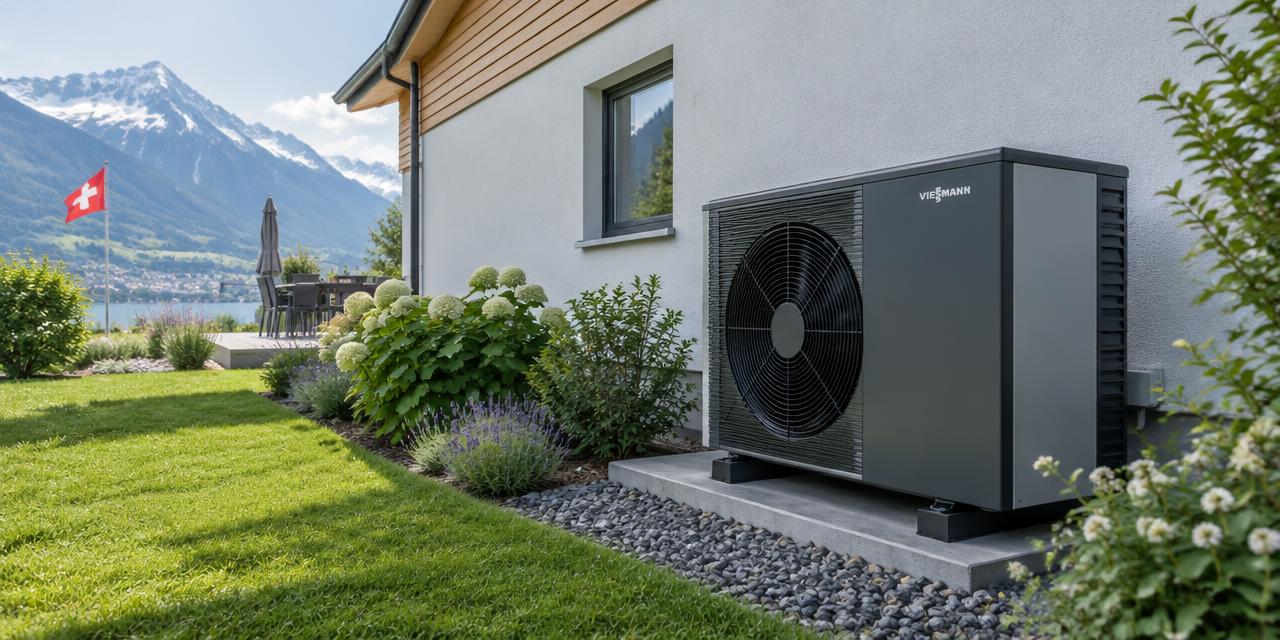
Modern air-water heat pumps are very quiet, but their outdoor installation requires careful planning. Outdoor air-water heat pumps must meet noise limits towards neighbours to avoid any noise disturbance.
When installing in Allschwil, make sure to choose a location away from your neighbours' windows and use soundproofing elements if necessary.
A proper orientation of the outdoor unit guarantees not only acoustic comfort but also compliance with the regulations in force in the canton of Basel-Landschaft regarding residential noise emissions.
The cost of a heat pump varies according to the chosen model, the complexity of the installation, and the necessary connection work. Anticipating costs is a crucial step for a successful energy transition.
To get a realistic price range adapted to the Swiss market, the free RenoIndex calculator is a valuable tool. It helps you precisely estimate your investment while taking into account the technical specificities of your home.
By planning your budget well from the start, you optimize the return on your future heating system.
1. Estimate
Set a budget range with the estimator.
2. Grants
Apply before work starts.
3. Quotes
Compare at least 3 quotes.
4. Permit
Check with the municipality whether a permit is needed.
5. Works
Follow the site and do a written handover.
No specific grant listed for this work. Maintenance tax deductions may still apply.
2824 Vicques · about 23.1 km
Buchwalder Sàrl in Vicques has specialized in the installation, repair, and renovation of heating and sanitary systems since 1966.
buchwalder-sarl.ch2824 Vicques · about 23.1 km
Gyger Haustechnik specializes in sanitary installations, heating systems, bathroom renovations, and tiling work.
gyger-co.ch2824 Vicques · about 23.1 km
Specialist since 1968 in sanitary installations, heating (gas, oil, wood, renewable energy), and tinsmithing with 24/7 emergency repair service.
sanit.ch2822 Courroux · about 23.1 km
Based in Courroux, Denis Paratte Sàrl carries out sheet metal work, roofing, plumbing and heating installations, as well as repairs and renovations.
denisparatte.chSuggestions from the commercial register by distance and activity. Not an endorsement or partnership.
The canton of Basel-Landschaft offers incentive programs for replacing fossil fuel heating systems with renewable ones. We advise you to check the canton's official portal to verify the eligibility of your current project.
As a general rule, a permit is required for heat pump installations, particularly regarding noise. Contact the municipal planning department to confirm the necessary administrative steps before starting your work.
The duration depends on the complexity of the system and any modifications to your existing heating circuit. On average, allow between three and five days for a complete installation carried out by qualified professionals.
Yes, it is possible, especially with high-temperature systems or if your house has good thermal insulation. It is recommended to have an expert check whether your current radiators are compatible with a heat pump.