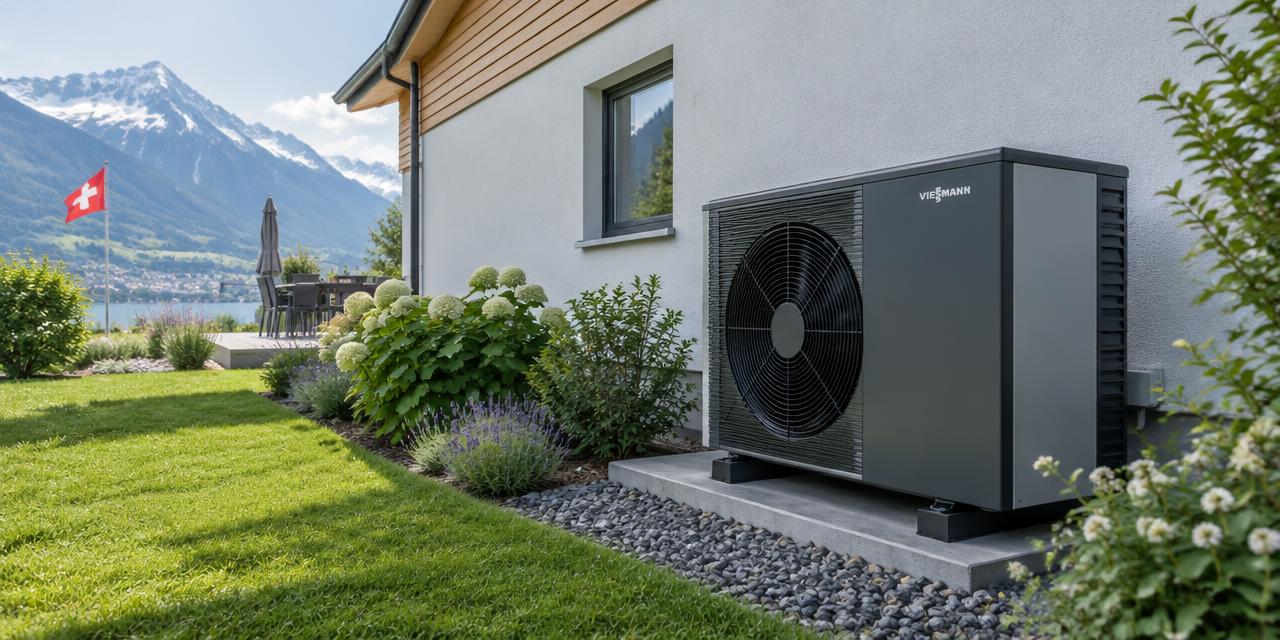
Heat pump installation in Zofingen: Complete guide
Are you planning a heat pump installation in Zofingen to replace your current heating system? This energy transition is an ideal way to improve your home's efficiency while reducing your carbon footprint. Before starting your project, it is essential to plan every step, from choosing the right technology to complying with local regulations. To help you budget for your project with peace of mind, use the free RenoIndex estimator now to get a cost range in Swiss francs tailored to your specific needs.
At a glance
Typical budget
CHF 39'700 – CHF 74'000
Midpoint
CHF 55'600
Grants found
0
Nearby companies
4
Worked examples in Zofingen
Small project
CHF 31'500 – CHF 57'500
Typical project
CHF 39'700 – CHF 74'000
Large project
CHF 52'100 – CHF 98'600
Project
Quantity
Low
High
Per unit
Small project
80 m²
CHF 31'500
CHF 57'500
CHF 500
Typical project
160 m²
CHF 39'700
CHF 74'000
CHF 300
Large project
280 m²
CHF 52'100
CHF 98'600
CHF 300
Computed with our estimator for Zofingen (regional factor included), standard finish. Only the project size changes.
Cost split (typical project)
Labour :CHF 22'200(40 %)
Materials :CHF 27'800(50 %)
Other costs :CHF 5'600(10 %)
What the price covers
Included
Supply and installation
VAT
Heat pump and standard connections; removal and equipment only according to answers
Not included
Permits and architect fees
Unexpected structural issues
Possible subsidies
Drilling beyond 150 m, buried or contaminated tank, asbestos, insulation and new finishes
With air-to-air: hot water and ducts only if selected; adaptations beyond the options excluded
Zofingen's housing stock in figures
In Zofingen, the federal building register lists 2'293 residential buildings and 6'469 dwellings. These municipal benchmarks help put your home in context, but do not replace an individual assessment.
69 %built before 1980
63 %heated by oil or gas
29.6 %electric hot water
1.8 %with declared solar thermal
Age of residential buildings
69 % built before 1980
Before 191918 %
1919–194519 %
1946–196013 %
1961–19708 %
1971–198011 %
1981–199010 %
1991–20006 %
2001–20108 %
Since 20118 %
Construction year does not reveal past renovations: check the current insulation condition.
Main heating energy
33 % · Heating oil
Heating oil33 %
Gas30 %
Heat pump25 %
Electricity5 %
District heating4 %
Wood3 %
This distribution describes recorded buildings, not your system's consumption or efficiency.
Heating and hot water: which energies?
Energy
Heating
Hot water
Gas
30 %
23.1 %
Heating oil
33 %
26.9 %
District heating
4 %
3.9 %
Heat pump
25 %
12.8 %
Electricity
5 %
29.6 %
Wood
3 %
1.7 %
Solar thermal
0 %
1.3 %
Each line gives the share of buildings using that energy, separately for heating and for hot water. The two columns do not always reach 100%: some buildings combine two systems, or reported none.
Type of heating system
Boiler (unspecified)64.5 %
Heat pump25.5 %
Central electric heating4.1 %
Heat exchanger (district)3.4 %
Condensing boiler1.3 %
Direct electric heaters0.6 %
Stove0.5 %
A standard non-condensing boiler is usually older and less efficient.
Renovations, heritage and volumes
For renovation planning in Zofingen, official register figures provide essential insights. With 361 out of 2293 buildings listed under heritage protection, homeowners must contact municipal authorities early to navigate permit requirements. The median building volume is 1464,5 m3, serving as a critical metric for scaling heating system upgrades or insulation works. Please note that data coverage is partial, as only two buildings are measured according to the SIA 416 standard. Additionally, as no renovation year data is available, homeowners should rely on independent surveys to assess the current technical state of their properties before initiating any project.
361
buildings flagged as protected
status known for 2'064 of 2'293 buildings; check with the municipality
The first step is to analyze your home's heating needs in Zofingen. First check whether your area can connect to a priority district heating network, as this may be a more straightforward solution.
Next, consider the local design outdoor temperature, which determines the required capacity of your heat pump. A properly sized unit ensures optimal long-term performance.
Do not overlook your building's insulation, as a well-insulated home reduces the power required for the new heating system. Use the RenoIndex estimator to get a reliable cost range in Swiss francs to plan your budget.
Compliance with noise regulations
It is advisable to position the unit at a sufficient distance from living areas and to choose low-noise models. Using sound barriers or strategic placement helps minimize disturbances. Ensure your setup meets current cantonal requirements.
You can use the RenoIndex estimator to assess the costs associated with your project, including all necessary measures for a compliant and neighbor-friendly installation.
Choosing the right technology
There are several types of heat pumps, including air-to-water, ground-to-water, or water-to-water models. Your choice will depend on your land configuration and available resources.
In Zofingen, air-to-water systems are very common due to their ease of installation. However, if geological conditions permit, a geothermal probe might offer better energy efficiency in the long run. Each technology involves different installation costs.
To compare these options financially, the RenoIndex estimator is a valuable tool that allows you to quickly get a price range in Swiss francs for each solution you are considering.
Installation and commissioning
Once you have chosen your model and obtained the necessary permits, installation by a certified professional is a decisive step. Proper mounting ensures the longevity of your equipment and prevents unnecessary energy consumption.
The technician will connect the unit to your existing distribution system, whether radiators or underfloor heating. Commissioning also includes fine-tuning the heating curve. Remember to schedule regular maintenance to ensure the system operates correctly.
RenoIndex supports you in this process by providing a total cost estimate, allowing you to budget for your renovation project with confidence.
Your project in 5 steps
1. Estimate
Set a budget range with the estimator.
2. Grants
Apply before work starts.
3. Quotes
Compare at least 3 quotes.
4. Permit
Check with the municipality whether a permit is needed.
5. Works
Follow the site and do a written handover.
Grants and subsidies
No specific grant listed for this work. Maintenance tax deductions may still apply.
Companies in the area
F. Imeri Sàrl
2829 Vermes · about 35.8 km
The website presented under the name Imeri Chauffage et Sanitaire Sàrl offers plumbing, heating and solar thermal work, while F. Imeri Sàrl’s registered purpose refers to a scrap metal business.
Suggestions from the commercial register by distance and activity. Not an endorsement or partnership.
Frequently asked questions
What are the steps to obtain financial grants?
Grants often depend on cantonal programs. It is advisable to check the official websites of the canton of AG before starting the work. Ensure that you submit your grant application before the installation begins. RenoIndex can help you estimate your remaining costs after accounting for potential grants.
Is a permit required in Zofingen?
Most heat pump installations require a notification or permit from the competent local authorities. Requirements may vary depending on the pump type (especially for geothermal probes). Contact your municipality to learn about the specific administrative steps for your plot and your energy renovation project.
How long does the installation take?
In general, the installation of a heat pump takes between three and five days for a standard air-to-water system. This duration may vary depending on the complexity of the connection work and the need to adapt your current heating system. Rigorous planning with your installer helps minimize heating downtime.
Is a heat pump suitable for all building types?
Although heat pumps are very efficient, they perform best in well-insulated buildings with low-temperature heat distribution systems, such as underfloor heating. In older buildings, prior thermal renovation may be necessary to ensure optimal efficiency and limit electricity consumption.