
F. Imeri Sàrl
2829 Vermes · about 119 km
The website presented under the name Imeri Chauffage et Sanitaire Sàrl offers plumbing, heating and solar thermal work, while F. Imeri Sàrl’s registered purpose refers to a scrap metal business.
imeri-sarl.chHeat pump installation · Wil (SG)
At a glance
Small project
CHF 29'400 – CHF 53'700
Typical project
CHF 37'100 – CHF 69'100
Large project
CHF 48'600 – CHF 92'100
| Project | Quantity | Low | High | Per unit |
|---|---|---|---|---|
| Small project | 80 m² | CHF 29'400 | CHF 53'700 | CHF 500 |
| Typical project | 160 m² | CHF 37'100 | CHF 69'100 | CHF 300 |
| Large project | 280 m² | CHF 48'600 | CHF 92'100 | CHF 200 |
Computed with our estimator for Wil (SG) (regional factor included), standard finish. Only the project size changes.
Included
Not included
In Wil (SG), the federal building register lists 3'589 residential buildings and 11'915 dwellings. These municipal benchmarks help put your home in context, but do not replace an individual assessment.
60 % built before 1980
Construction year does not reveal past renovations: check the current insulation condition.
48 % · Gas
This distribution describes recorded buildings, not your system's consumption or efficiency.
| Energy | Heating | Hot water |
|---|---|---|
| Gas | 48 % | 36.1 % |
| Heating oil | 20 % | 15.1 % |
| Heat pump | 28 % | 24.3 % |
| Electricity | 1 % | 17 % |
| Wood | 2 % | 1 % |
| Solar thermal | 0 % | 6.1 % |
Each line gives the share of buildings using that energy, separately for heating and for hot water. The two columns do not always reach 100%: some buildings combine two systems, or reported none.
A standard non-condensing boiler is usually older and less efficient.
For homeowners planning renovations in Wil, official register figures show that 467 out of 523 known buildings are under heritage protection. Engaging with the municipality early is essential to navigate permit requirements. Data coverage is partial as no information is available regarding the renovation year. Furthermore, the volume data for 2083 houses reflects standards other than SIA 416, and no median volume is recorded. Consequently, when calculating the scale of heating or insulation works, you should rely on professional site assessments rather than these register figures to ensure accurate planning for your specific property project.
Source : OFS — RegBL (export communal complet). Existing residential buildings; percentages of recorded values.
Before installing a heat pump, first check whether your area can connect to a priority district heating network. In some zones, connection to the municipal district heating system is preferred over an individual installation.
This preliminary step helps confirm whether a heat pump is the most relevant solution for your building.
A detailed analysis of your current energy needs will also help you correctly size the unit, ensuring maximum efficiency and a significant reduction in your energy consumption over the long term.
The capacity of your future heat pump is set by the local design outdoor temperature. This technical parameter is crucial to ensure consistent performance, even during the coldest winter days in Wil.
An incorrectly sized heat pump could lead to unnecessary extra costs or thermal discomfort.
It is therefore essential to consult a professional heating engineer who will accurately calculate these data specific to your geographical location, in order to optimize the operation of your heating system throughout the entire year.
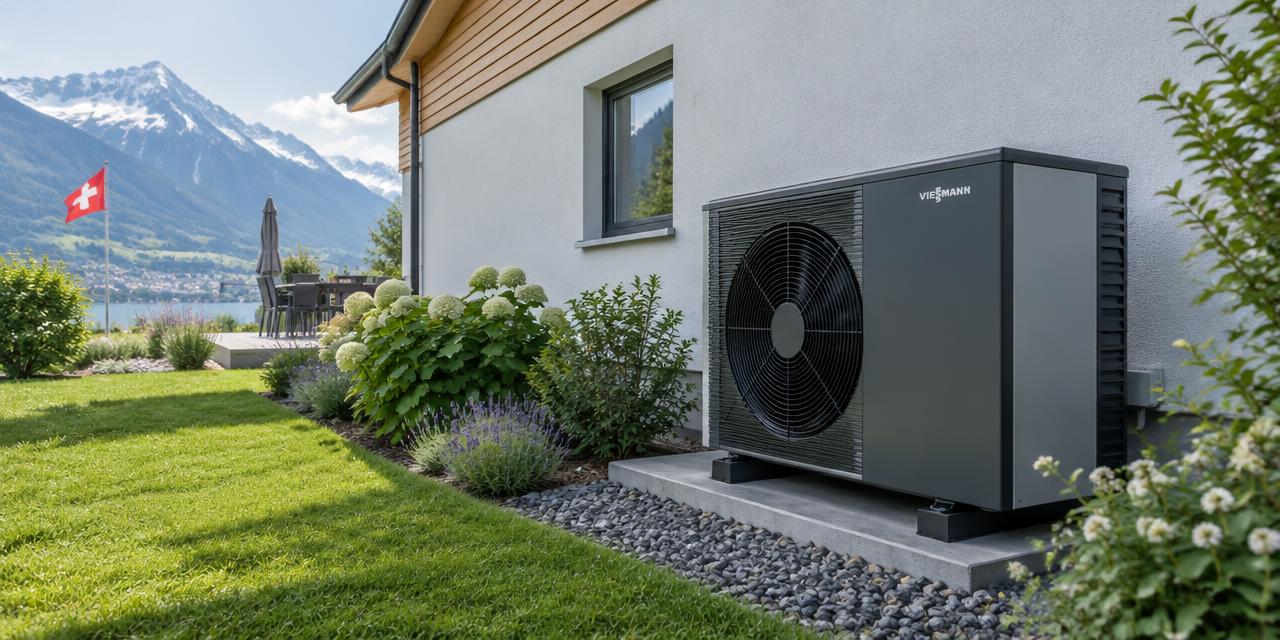
If you choose an outdoor air-water heat pump, you must meet noise limits towards your neighbours. The location of the outdoor unit plays a major role in sound propagation. Make sure that the airflow is not directed towards bedroom windows or adjacent terraces.
A well-thought-out installation helps avoid neighbourhood disputes and ensures compliance with current cantonal and federal regulations concerning noise emissions from household technical equipment.
The cost of a heat pump varies according to the chosen technology and the complexity of the installation work in your home.
Beyond the price of the appliance, you must anticipate costs for connection, commissioning, and possibly modifying your current heat distribution system. To obtain a precise estimate tailored to your project, do not hesitate to use our RenoIndex tool.
It will provide you with a realistic price range, helping you better prepare your financing application and manage your investments with peace of mind.
1. Estimate
Set a budget range with the estimator.
2. Grants
Apply before work starts.
3. Quotes
Compare at least 3 quotes.
4. Permit
Check with the municipality whether a permit is needed.
5. Works
Follow the site and do a written handover.
No specific grant listed for this work. Maintenance tax deductions may still apply.
2829 Vermes · about 119 km
The website presented under the name Imeri Chauffage et Sanitaire Sàrl offers plumbing, heating and solar thermal work, while F. Imeri Sàrl’s registered purpose refers to a scrap metal business.
imeri-sarl.ch3988 Obergoms · about 119.8 km
Obergoms-based company specializing in sanitary installations, heating systems, roofing, and tinsmith work for new builds and renovations.
hallenbarter-russi.ch2824 Vicques · about 122.9 km
Specialist since 1968 in sanitary installations, heating (gas, oil, wood, renewable energy), and tinsmithing with 24/7 emergency repair service.
sanit.ch2824 Vicques · about 122.9 km
Buchwalder Sàrl in Vicques has specialized in the installation, repair, and renovation of heating and sanitary systems since 1966.
buchwalder-sarl.chSuggestions from the commercial register by distance and activity. Not an endorsement or partnership.
Requirements depend on the chosen technology. For geothermal heat pumps, a cantonal permit is often necessary due to the drilling. For air-water heat pumps, a simple notification may suffice, but it is recommended to check with the municipal services of Wil to ensure compliance with all local rules.
Replacing a boiler with a heat pump typically takes between 3 and 5 working days. The duration may vary depending on the work required to adapt the existing heating circuit or any electrical modifications needed in your main panel. A professional will be able to provide a detailed schedule after a site visit.
Yes, it is possible, but it depends on the insulation and current heating system. If your home has low-temperature radiators, integration is simpler. Otherwise, improving insulation or replacing heating emitters may be advised to optimize energy efficiency.
A well-maintained heat pump has an average lifespan of 15 to 20 years. Regular maintenance, performed by a qualified professional, is essential to maintain the optimal performance of the installation and prevent early breakdowns. Annual checks also help extend the longevity of your appliance.