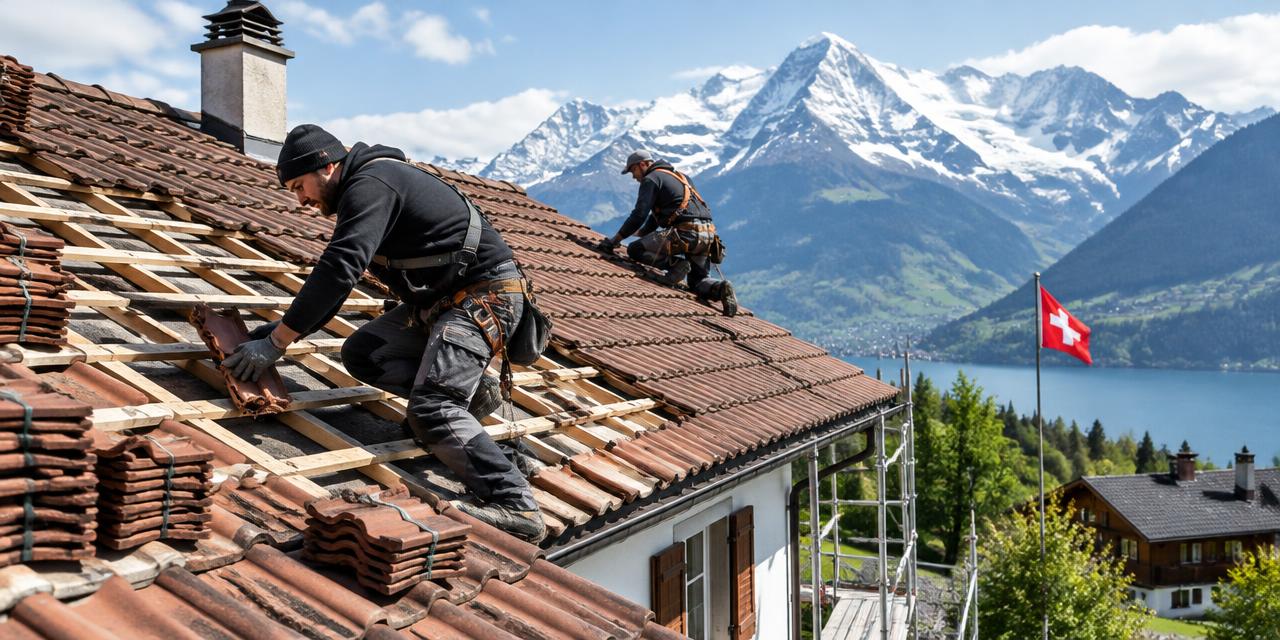
Indicative price, tips, grants and companies for your project in Val-de-Ruz (Neuchâtel).
At a glance
Typical budget
CHF 27'000 – CHF 59'500
Midpoint
CHF 40'800
Grants found
1
Nearby companies
4
Worked examples in Val-de-Ruz
Small project
CHF 14'900 – CHF 34'200
Typical project
CHF 27'000 – CHF 59'500
Large project
CHF 45'100 – CHF 97'400
Project
Quantity
Low
High
Per unit
Small project
70 m²
CHF 14'900
CHF 34'200
CHF 300
Typical project
140 m²
CHF 27'000
CHF 59'500
CHF 300
Large project
245 m²
CHF 45'100
CHF 97'400
CHF 300
Computed with our estimator for Val-de-Ruz (regional factor included), standard finish. Only the project size changes.
Cost split (typical project)
Labour :CHF 20'400(50 %)
Materials :CHF 16'300(40 %)
Other costs :CHF 4'100(10 %)
What the price covers
Included
Supply and installation
VAT
Covering, scaffolding, insulation and removal according to answers
Not included
Permits and architect fees
Unexpected structural issues
Possible subsidies
New roof structure, asbestos, roof windows and structural reinforcement
Val-de-Ruz's housing stock in figures
In Val-de-Ruz, the federal building register lists 3'879 residential buildings and 8'448 dwellings. These municipal benchmarks help put your home in context, but do not replace an individual assessment.
52 %built before 1980
60 %heated by oil or gas
9.3 %electric hot water
19.9 %with declared solar thermal
Age of residential buildings
52 % built before 1980
Before 191923 %
1919–19455 %
1946–19608 %
1961–19707 %
1971–19809 %
1981–199011 %
1991–200010 %
2001–201014 %
Since 201111 %
Construction year does not reveal past renovations: check the current insulation condition.
Main heating energy
34 % · Heating oil
Heating oil34 %
Gas26 %
Heat pump24 %
Wood10 %
District heating3 %
Electricity2 %
Solar thermal1 %
This distribution describes recorded buildings, not your system's consumption or efficiency.
Heating and hot water: which energies?
Energy
Heating
Hot water
Gas
26 %
19.6 %
Heating oil
34 %
28.7 %
District heating
3 %
2.6 %
Heat pump
24 %
14.1 %
Electricity
2 %
9.3 %
Wood
10 %
5.8 %
Solar thermal
1 %
19.6 %
Each line gives the share of buildings using that energy, separately for heating and for hot water. The two columns do not always reach 100%: some buildings combine two systems, or reported none.
Type of heating system
Boiler (unspecified)63.1 %
Heat pump24 %
Stove3.9 %
Heat exchanger (district)2.8 %
Condensing boiler2.6 %
Central electric heating2.1 %
A standard non-condensing boiler is usually older and less efficient.
Houses or apartment buildings?
Single-family houses64.2 %
Two-dwelling houses14.5 %
Apartment buildings (3+)21.3 %
Other0 %
12.3 % of buildings mix housing with shops or offices.
The typical building
storeys (median)
2
median footprint
135 m²
median dwelling area
100 m²
Renovations, heritage and volumes
For renovation projects in Val-de-Ruz, official building register data indicates that 4 buildings are heritage-protected. Homeowners should consult municipal authorities early regarding permits if this applies to their property. Additionally, the median volume of 1008 m3 across 2489 houses, measured by SIA 416 standards, helps determine the scale of necessary heating or insulation upgrades. Please be aware that data coverage is partial regarding volumetric measurements for all properties. Furthermore, there is no official data recorded in the register concerning the year of the last renovation for buildings in this municipality.
4
buildings flagged as protected
status known for 153 of 3'879 buildings; check with the municipality
ADR Toitures - Energies SA carries out roofing, timber construction, photovoltaic installation, joinery and facade work in the cantons of Neuchâtel and Vaud.
Typical delay : environ 20 jours (pour les installations solaires soumises à annonce)
Solar panels : La procédure d'annonce remplace déjà le permis de construire classique pour les installations solaires 'suffisamment adaptées' posées sur un toit, dans la zone à bâtir et hors des zones ou objets protégés définis par le droit cantonal. Une simple annonce à l'autorité communale ou cantonale compétente suffit, en général une vingtaine de jours avant le début des travaux.
Carry-forward : Seule la part des frais d'investissement destinés à économiser l'énergie et à ménager l'environnement ainsi que les frais de démolition en vue d'une construction de remplacement, qui n'a pas pu être déduite l'année de facturation (année N) car elle aurait engendré un revenu net négatif, peut être reportée sur les deux années fiscales suivantes (N+1 et N+2). Ces frais doivent avoir été intégralement déclarés l'année de leur facturation. Si des frais sont reportés, la déduction forfaitaire n'est pas possible pour l'immeuble concerné pour la période fiscale correspondante. Le droit de reporter est réservé au propriétaire ayant supporté les frais. L'Intendance des impôts détermine d'office les frais reportables.
Flat rate deduction : 10% du rendement brut des loyers ou de la valeur locative (max. 7 200 CHF) si l'âge du bâtiment est inférieur ou égal à dix ans; 20% du rendement brut des loyers ou de la valeur locative (max. 12 000 CHF) si l'âge du bâtiment est supérieur à dix ans. Aucune autre déduction supplémentaire n'est possible avec le forfait. Les propriétaires d'immeubles commerciaux affectés à leur activité indépendante ne peuvent pas opter pour la déduction forfaitaire pour ces immeubles, mais c'est possible pour d'autres immeubles de leur fortune privée.
Maintenance costs : Le/la contribuable peut choisir, lors de chaque période fiscale et pour chaque immeuble, entre la déduction des frais effectifs et la déduction forfaitaire. Les frais effectifs déductibles sont ceux visant à maintenir la valeur de l'immeuble, facturés durant l'année de calcul. Si les dépenses comportent des dépenses d’entretien, d’amélioration et/ou d’économies d’énergie, une répartition par nature est nécessaire selon un catalogue de répartition.
Energy investments : Les investissements destinés à économiser l’énergie et à ménager l’environnement (remplacement d'éléments vétustes ou adjonction d'éléments/installations dans les bâtiments existants) sont déductibles. Ces frais peuvent être reportés sur les deux années fiscales suivantes s'ils n'ont pas pu être déduits intégralement l'année de facturation (N, N+1, N+2).