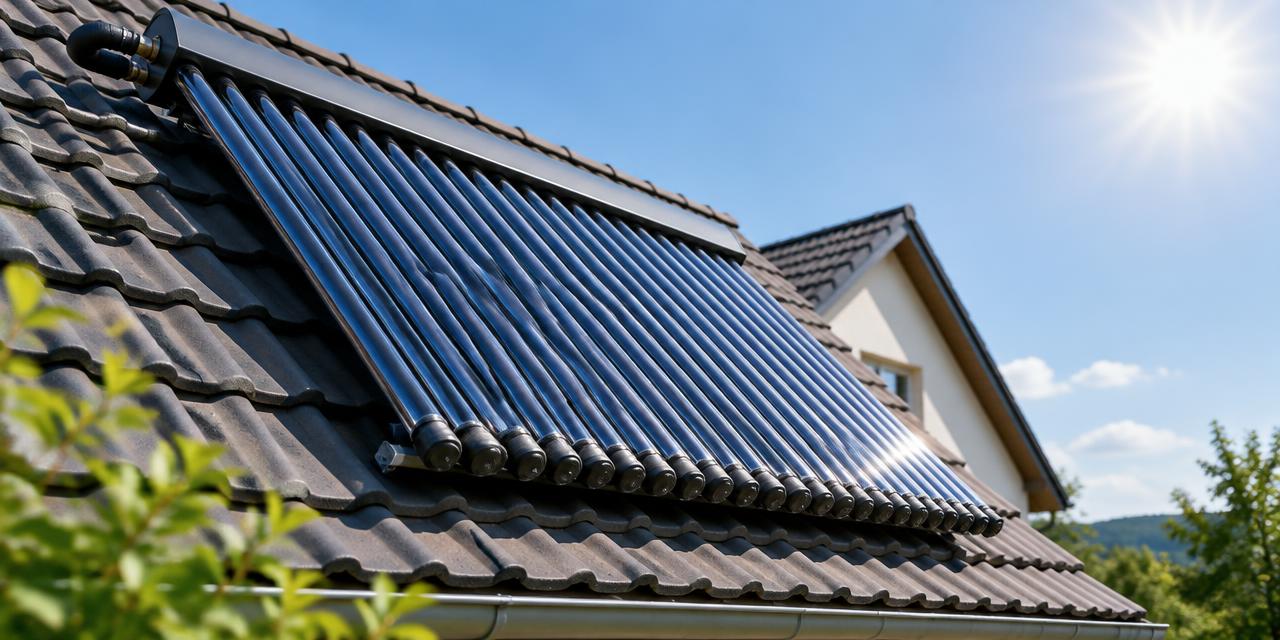
Are you planning to install solar thermal panels in Liestal to produce your domestic hot water? This eco-friendly solution reduces your reliance on fossil fuels while increasing your property value. Before starting your project, it is essential to understand the technical and financial aspects involved. RenoIndex is here to guide you with expert advice. Use our free estimator to get an accurate price range in CHF and plan your renovation budget with complete peace of mind for your home in Liestal.
At a glance
Typical budget
CHF 12'400 – CHF 28'800
Midpoint
CHF 20'000
Grants found
0
Nearby companies
4
Worked examples in Liestal
Small project
CHF 9'600 – CHF 22'600
Typical project
CHF 12'400 – CHF 28'800
Large project
CHF 17'000 – CHF 39'100
Project
Quantity
Low
High
Per unit
Small project
3 m²
CHF 9'600
CHF 22'600
CHF 5'200
Typical project
6 m²
CHF 12'400
CHF 28'800
CHF 3'300
Large project
11 m²
CHF 17'000
CHF 39'100
CHF 2'500
Computed with our estimator for Liestal (regional factor included), standard finish. Only the project size changes.
Cost split (typical project)
Labour :CHF 8'000(40 %)
Materials :CHF 10'000(50 %)
Other costs :CHF 2'000(10 %)
What the price covers
Included
Supply and installation
VAT
Collectors, controls, standard connection and tank according to answers
Not included
Permits and architect fees
Unexpected structural issues
Possible subsidies
Roof refurbishment and replacement of main heating
Liestal's housing stock in figures
In Liestal, the federal building register lists 2'778 residential buildings and 8'161 dwellings. These municipal benchmarks help put your home in context, but do not replace an individual assessment.
57 %built before 1980
61 %heated by oil or gas
16.2 %electric hot water
5.1 %with declared solar thermal
Age of residential buildings
57 % built before 1980
Before 191914 %
1919–194515 %
1946–196013 %
1961–19707 %
1971–19808 %
1981–199010 %
1991–200011 %
2001–201010 %
Since 201112 %
Construction year does not reveal past renovations: check the current insulation condition.
Main heating energy
42 % · Gas
Gas42 %
District heating20 %
Heating oil19 %
Heat pump12 %
Wood4 %
Electricity3 %
This distribution describes recorded buildings, not your system's consumption or efficiency.
Heating and hot water: which energies?
Energy
Heating
Hot water
Gas
42 %
34.7 %
Heating oil
19 %
10.7 %
District heating
20 %
19.2 %
Heat pump
12 %
11.7 %
Electricity
3 %
16.2 %
Wood
4 %
2.4 %
Solar thermal
0 %
5 %
Each line gives the share of buildings using that energy, separately for heating and for hot water. The two columns do not always reach 100%: some buildings combine two systems, or reported none.
Type of heating system
Boiler (unspecified)64.7 %
Heat exchanger (district)19.9 %
Heat pump12.3 %
Central electric heating3.1 %
A standard non-condensing boiler is usually older and less efficient.
Houses or apartment buildings?
Single-family houses64 %
Two-dwelling houses9.6 %
Apartment buildings (3+)26.4 %
11 % of buildings mix housing with shops or offices.
The typical building
storeys (median)
3
median footprint
111 m²
median dwelling area
90 m²
Renovations, heritage and volumes
For your renovation projects in Liestal, data from the federal building and dwelling register provides key insights. With 663 buildings under heritage protection, it is essential to contact the municipality early to clarify permit requirements. Regarding building volume, the median value for the 25 properties measured according to the SIA 416 standard is 734 m3, which helps in scaling heating or insulation work. Please note that volume data coverage is partial, as the majority of buildings are recorded under other standards or are unknown. These figures are crucial for planning the scope of your renovation investment accurately.
663
buildings flagged as protected
status known for 2'778 of 2'778 buildings; check with the municipality
Solar thermal collectors capture sunlight to heat a fluid circulating towards a storage tank. In Switzerland, this technology is particularly efficient during sunny months. Solar thermal collectors usually cover much of summer hot water.
To optimize output, it is crucial to position the panels correctly and ensure the system's insulation is of high quality.
Regular maintenance ensures the longevity of your installation while providing consistent performance for your household's daily hot water needs, ultimately contributing to a more sustainable and energy-efficient home.
Sizing and integration
Sizing is a key step to ensure your installation is cost-effective. A system that is too small won't meet your needs, while an oversized one is unnecessarily expensive. Combining collectors with a heat pump needs a sizing study.
This type of hybridization often achieves optimal efficiency throughout the year.
RenoIndex's professional partners can analyze your consumption habits to propose a bespoke solution that best fits your roof and current technical setup in Liestal, maximizing energy output and long-term savings.
Grants and financial support
It is highly recommended to inquire before signing any quotes, as eligibility criteria can change. In addition to direct grants, you may benefit from tax deductions according to the rules in force in the canton of Basel-Landschaft.
Use the free RenoIndex estimator to gain a clear view of costs and potential savings before submitting your official grant applications.
Key steps for your project
Implementing a solar thermal project follows a structured process. Start by evaluating your roof: orientation, inclination, and the general condition of the structure. Then, hire a specialist for a detailed technical study.
Once the sizing is validated, request comparative quotes and check the available grant opportunities in the canton of Basel-Landschaft. Finally, ensure you follow local administrative procedures for the panel installation.
With the free RenoIndex estimator, you have a simple tool to compare costs and move forward with confidence in your energy renovation projects.
Your project in 5 steps
1. Estimate
Set a budget range with the estimator.
2. Grants
Apply before work starts.
3. Quotes
Compare at least 3 quotes.
4. Permit
Check with the municipality whether a permit is needed.
5. Works
Follow the site and do a written handover.
Grants and subsidies
No specific grant listed for this work. Maintenance tax deductions may still apply.
Companies in the area
F. Imeri Sàrl
2829 Vermes · about 25.9 km
The website presented under the name Imeri Chauffage et Sanitaire Sàrl offers plumbing, heating and solar thermal work, while F. Imeri Sàrl’s registered purpose refers to a scrap metal business.
Suggestions from the commercial register by distance and activity. Not an endorsement or partnership.
Frequently asked questions
What collector surface area is needed?
The area depends on the number of occupants and your hot water consumption. Generally, expect about 1 to 1.5 m² of collectors per person for a standard installation. A sizing study remains essential to refine these specific requirements for your home.
Does solar thermal work in winter?
Yes, but with reduced efficiency due to fewer daylight hours and lower temperatures. The system then uses auxiliary energy, such as a heat pump or boiler, to ensure a constant water temperature for your daily needs.
What is the system's lifespan?
A well-maintained solar thermal installation can last between 20 and 25 years. The storage tank may require replacement or servicing after 15 to 20 years, depending on water quality and the regularity of the maintenance performed.
Do I need a building permit?
In Liestal, it is advisable to contact municipal authorities to check local requirements. Some solar installations are exempt, but rules regarding architectural appearance may apply, particularly in protected areas within the canton.